
Every grading pitch, including the first draft of this article, leads with the ten: pay ~$25, maybe multiply your card. But a submission is not a ten. Most of the time it is a nine or an eight, and for 217 cards where we hold every honest input, raw price, verified PSA 10, 9 AND 8 medians, and true registry odds for each grade, we priced those outcomes too. The result cuts the story in half: the expected value is positive on 97% of these cards, and yet on 106 of 219, the single most likely outcome, the nine, loses money. Whether grading is a good bet depends less on the ten than on what your card is worth when it ISN'T one.
What the most likely grade actually pays
Here is the asymmetry the averages hide. A Lost Thunder full-art Lugia GX looks like a textbook submission: $112 raw, a $1,500 PSA 10, 26% gem rate, expected value +$290. But its PSA 9, the single most likely result at 48%, sells for $15. Submit that card and you lose $122 on the modal outcome; you lose money 74% of the time. The expectation is genuinely positive AND most people who make this bet once walk away poorer. Vintage EX-era stars show the same shape with bigger numbers: a Delta Species Rayquaza ★ carries +$333 of expectation while losing on 71% of submissions. These are lottery tickets, real ones, correctly priced, and a lottery ticket is only a good buy if you can afford to buy many.
Positive expectation, likely loss, the lottery-shaped cards
| Card | Raw | Gem rate | Expected value | If it 9s | Chance you lose |
|---|---|---|---|---|---|
| Lugia GX · Lost Thunder FA | $112 | 26% | +$290 | −$122 (48% likely) | 74% |
| Rayquaza ★ δ · Delta Species | $330 | 5.7% | +$333 | +$620, the 8 is the loss | 71% |
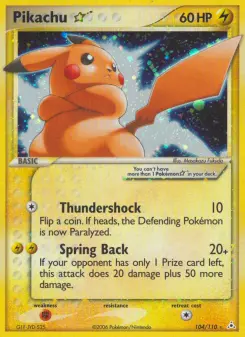
| Pikachu · EX Holon Phantoms | $367 | 4.5% | +$417 | +$608, sub-9s do the damage | 73% |
| Eevee · JP promo | $150 | 31% | +$862 | +$75 | 70% |
Vintage nines protect you; modern nines don't
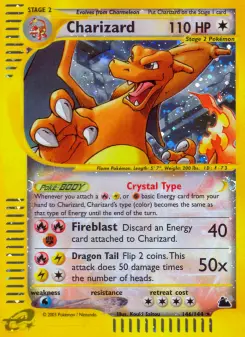
Split the sample by era and the deepest pattern in the whole dataset appears. On the vintage side, the median outcome AT A NINE is +$168, profitable, and the median chance of losing money is 25%. A Skyridge Charizard is the extreme: its PSA 9 sells for $39,997 against a $250 raw price, so every plausible grade profits and the measured chance of loss is zero. On the modern and Japanese side, the median nine LOSES $9, because a modern nine is barely worth more than the raw card, the raw price already assumes near-mint. That is the practical law this data supports: for vintage, the nine is a floor under the bet; for modern, the nine IS the bet's failure mode, and the gem rate alone decides everything.
Protected on every grade, where even the miss pays
Both sides of the bet, by gem rate
| Registry gem rate | Cards | Median EV | Median outcome at a 9 | Median chance of loss |
|---|---|---|---|---|
| Under 10% | 47 | +$333 | +$516 | 25% |
| 10–25% | 35 | +$184 | +$61 | 27% |
| 25–45% | 45 | +$82 | −$12 | 63% |
| 45–65% | 43 | +$70 | −$19 | 41% |
| Over 65% | 49 | +$56 | −$16 | 16% |
The danger zone is not where intuition puts it. The scariest band is the MIDDLE, 25–45% gem rates, where the expected value still reads a respectable +$82 but the median chance of losing money is 63%: gems aren't frequent enough to be reliable, and the nines aren't valuable enough to catch you. Very low gem rates are, counterintuitively, the SAFEST band in this sample (25% median loss chance), not because tens are likely, but because cards that are genuinely hard to gem are overwhelmingly vintage, and vintage nines carry real value of their own. And the 65%+ band is safe in the boring way: you'll probably gem, you'll probably clear the fee, and you'll probably make less than $60 doing it.
Three patterns that void the bet entirely
Beyond the odds, seven cards in the sample have negative expectation outright, and they fail in three checkable ways. THE FEE FLOOR: a modern card whose PSA 10 sells under ~$40 cannot beat a $25 fee at any gem rate, a Scarlet & Violet Poké Ball Pikachu gems a third of the time and still loses. THE PHANTOM TEN: a registry showing 0% gems means the "PSA 10 price" is a rumor, one Diamond & Pearl promo shows $3,180 for a grade that has never been minted. THE INVERTED LADDER: graded medians below the raw price, a thin-record Neo Genesis Lugia, mean the recorded sales are unreliable, not that grading destroys value. All three are flagged on their card pages.
Sample: 219 cards for which moonstone holds, as of August 4, 2026, (a) a live raw market price of at least $1, (b) a verified PSA 10 median with 3+ individually-verified sales, and (c) a real PSA registry population of 100+ with per-grade counts. SELECTION CAVEAT: these are cards our pipeline has fully processed, disproportionately grading-worthy cards, so the 97%-positive-EV share describes this sample, not the catalog. Outcome model per submission: value at 10 = verified PSA 10 median; at 9 = verified PSA 9 median (raw × 0.9 where none exists); at 8 = verified PSA 8 median (raw × 0.8 fallback); below 8 = PSA 8 median × 0.7 (raw × 0.7 fallback). Probabilities are true registry proportions per grade (population at grade ÷ total graded). Expected value = probability-weighted outcomes − raw price − $25 fee; "chance of loss" = summed probability of grades whose outcome is below raw + fee. Grade-inverted and registry-conflicted cards are flagged, not smoothed. Fee = PSA value tier + shipping, rounded to $25. The vintage/modern split is by set family. Nothing here is financial advice.