There is a piece of hobby arithmetic that sounds obviously right: a card that gems easily is a safer card to send in, so its PSA 10 should be the one worth owning. Across the 4,106 cards where we hold a trustworthy gem rate, a registry of at least 50 copies and a recorded PSA 10 median, the relationship runs hard the other way and it does not wobble once. Sort those cards into five gem-rate bands and every column moves in order: the harder the card is to gem, the more its PSA 10 is worth, the fewer copies exist, and the larger the gap between the graded card and the same card ungraded.
The curve
Gem rate against registry, price and the graded multiple, 4,106 cards
| Gem rate | Cards | Average registry | Average raw | Average PSA 10 | Median PSA 10 multiple |
|---|---|---|---|---|---|
| Under 10% | 224 | 2,314 | $240.20 | $4,977.80 | 24.7x |
| 10% to 25% | 588 | 2,919 | $68.15 | $1,021.53 | 19.1x |
| 25% to 50% | 1,431 | 3,289 | $42.39 | $307.85 | 11.9x |
| 50% to 75% | 1,286 | 3,660 | $35.56 | $153.83 | 8.0x |
| Over 75% | 577 | 7,235 | $26.58 | $86.90 | 3.8x |
Four columns, four monotone series, no reversals. That is unusual enough in this data to be suspicious of, so the first thing to say is what the table does not prove.
The 57x number is not a grading effect
The average PSA 10 price falls from $4,977.80 to $86.90, which is a factor of 57. It would be easy to print that as the finding and stop. But look at the raw column: the same cards fall from $240.20 to $26.58, a factor of 9. Most of the 57 is simply that hard-to-gem cards are expensive cards. Vintage holos with soft centring and thirty years of handling are also the cards with the deepest demand and the thinnest surviving supply, and they would be worth more than a modern promo whether or not anyone graded them.
The part that survives that objection is the last column. Dividing each card's PSA 10 median by its own raw price cancels out how expensive the card is, and the multiple still falls in order: 24.7x, 19.1x, 11.9x, 8.0x, 3.8x. That is a 6.5-fold collapse in what the grade adds, measured card by card rather than across price tiers. It is the real result, and it is a third the size of the headline the average price column would have supported.
Two cards that say it better than the table
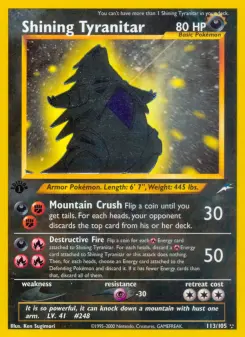
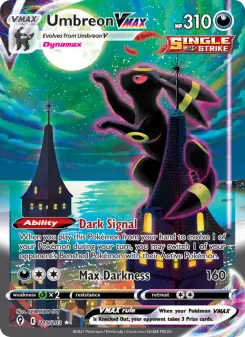
Shining Tyranitar gems 5.4% of the time across 4,818 graded copies. It costs $662.25 raw and its PSA 10 median is $10,900, so the grade is worth roughly sixteen times the card. Umbreon VMAX from Evolving Skies gems 69.3% of the time across 31,214 copies. It costs $2,300.34 raw, more than three times the Tyranitar, and its PSA 10 median is $4,300, so the grade is worth 1.9 times the card.
Two genuinely expensive cards, and the cheaper one pays eight times more for its grade. Nothing about demand explains that. The Umbreon is arguably the more wanted card of the two. What separates them is that a Tyranitar 10 is a thing most submissions fail to produce and an Umbreon 10 is what you get by default.
Two mechanisms, pointing the same way
The first is close to a tautology and is still worth stating. If a card gems 5% of the time then 95 of every 100 submissions produce something other than a 10, and the population of 10s stays small however many people send cards in. If it gems 80% of the time then the population of 10s is very nearly the population of the card, and the grade has stopped separating anything. A label that everyone's copy also carries is not scarcity, it is packaging.
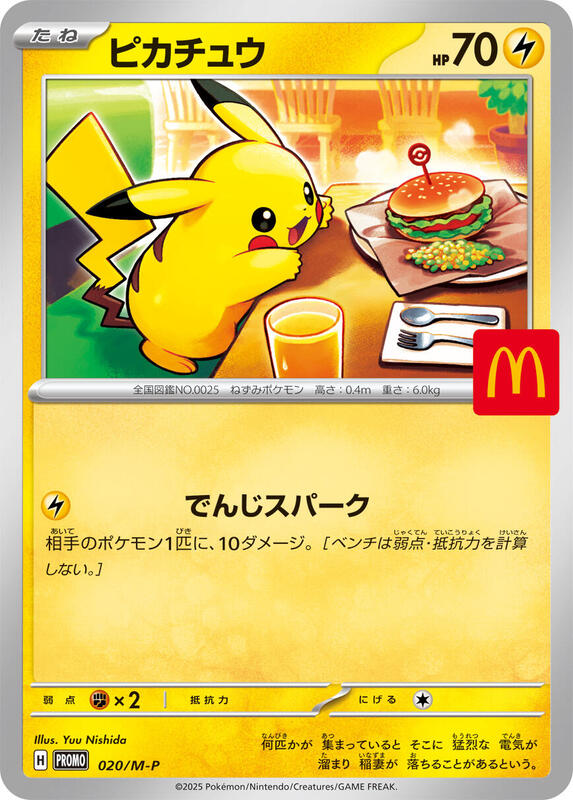
The second is the registry column, and it is what turns the observation into an argument. The easy-gemming band carries 3.1 times the average registry of the hard band, and its median registry is more than twice as deep. Those cards are not submitted more because they are more valuable, because the raw column says they are not. They are submitted more because submitting them works, and each successful submission adds one more 10 to a pool that was already the largest in the study. Pikachu 020/M-P sits at the far end of this: 332,353 graded copies, an 87.6% gem rate, and a PSA 10 that carries 2.3 times a $34.11 card.
What it does to a grading decision
It inverts the intuition you started with. A high gem rate raises your odds of getting the grade and lowers what the grade adds, and across this book the second effect is much larger than the first. Moving from a 10% card to an 80% card multiplies your chance of a 10 by roughly eight and divides the premium that 10 carries by six and a half, before any fee. The expected value of the submission does not obviously rise when the submission gets safer, and on a card whose multiple is under about 2x it cannot rise at all once grading and postage are paid.
Which is why our own grading panel prices the outcome rather than the odds, and why hard to gem treats difficulty as a feature rather than a risk. The cards worth sending are the ones where a 10 is hard AND the market pays for the difficulty. The multiple ladder covers the other half of the same arithmetic, which is that the multiple also falls as the price tag rises, so a cheap hard card and an expensive hard card are not the same trade.
Read from moonstone production on September 17, 2026, from the nightly feature table. EVERY COLUMN IN THE TABLE COMES FROM THE SAME 4,106 ROWS: a card is included only where the recorded PSA population is at least 50, a PSA 10 median is on the tape, a canonical raw price exists, and the gem rate passes our trustworthiness test. That last rule matters more than it sounds, because the provider intermittently omits the PSA 10 breakdown and such a row lands as zero tens beside a real total; a row that cannot support a gem claim is EXCLUDED rather than counted as a 0% gem rate. Gem rate is recorded tens divided by the total recorded population of the same snapshot, never across snapshots. Raw price is the canonical printing price the card pages publish, not the raw provider market field. Price columns are arithmetic means and are pulled upward in the hard bands by a small number of very expensive vintage cards; the ordering holds on medians as well ($2,903.75, $456.31, $132.38, $79.50, $65.00). The multiple column is deliberately a median of each card's own PSA 10 divided by its own raw price rather than a ratio of the two averages, so it is not driven by the same outliers. THIS IS A CROSS-SECTION, NOT A CAUSAL CLAIM: gem rate, era, surviving supply and collector demand move together here, and nothing in this table separates them, which is exactly why the raw column is printed beside the graded one. Related: the gem rate curve for the era axis.