A creased card still sells for money. How much is a question the marketplace answers card by card, and the answer usually surprises the owner. We read the condition ladder, meaning the row of prices one marketplace quotes for the same card as Near Mint, Lightly Played, Moderately Played, Heavily Played and Damaged, for every English Pokémon product in our catalogue. A Near Mint price was quoted on 21,364 of them. A damaged copy carried its own quoted price on 16,824 of those, which is 78.7%. The median damaged quote sits at 39.7% of the Near Mint price, and the middle half of them runs from 25.3% to 58.1%.
Where the damaged price runs out
That 78.7% hides a steep gradient, and the place it fails is the bottom of the price list. Sort every English product by its Near Mint quote and the damaged rung is there for 26.3% of the 1,165 cards quoted under ten cents, 33.9% of the 2,954 quoted between ten and twenty cents, then 61.5%, then 87.8%. From fifty cents upward it rarely goes missing. Above a dollar every band we cut sits between 94.9% and 97.3%. The eight bands below hold all 21,364 cards, with nothing counted twice.
A damaged copy has a quoted price, by what the mint copy costs
At the cheap end the obstacle is arithmetic. Among sub-ten-cent cards that do carry a damaged quote, the median damaged quote is one cent. In the ten-to-twenty-cent band it's five cents. That's the shape you'd expect if a card has to be worth something before anyone bothers pricing a beaten copy of it. Moderately Played is quoted on 909 of those same 1,165 sub-ten-cent cards, which is 78.0%, so the ladder keeps its middle and loses its floor. A blank rung means our source published no quote for that condition when we read the snapshot. Somebody may well buy the card. Our data just can't price it.
Damage costs proportionally more on a dear card
On English cards under a dollar the median damaged quote is 48.8% of Near Mint. From $100 to $500 it's 27.6%, and at $500 and up it's 26.3%. The damaged rung falls almost the whole way down the price list. The rungs above it behave differently. Lightly Played takes one step down out of the sub-dollar band, from 85.0% to 77.2%, then holds between 71.9% and 78.8% through the $100 to $500 band, and gives way only above that, at 64.4%. Moderately Played runs the same shape about twenty points lower, 63.2% at the cheap end and 47.5% at the dear one. Somebody paying $700 inspects the card. Somebody paying 50 cents doesn't.
Damaged gives up the most as the card gets dearer
Two earlier pieces measured these ratios on other populations. The Condition Tax read the damaged rung at 31.9% of Near Mint on 4,915 cards in August, and Pokémon Card Condition Price Guide read it at 36.0% on the 5,639 damaged pairs inside its 30,926 same-day pairs, taken on September 28. We get 39.7% on 16,824 English cards. Hold ours to the stricter rule that guide used, counting only the 10,841 cards whose damaged and Near Mint rungs were observed on the same day, and the median reads 38.09%. That sits above both earlier figures, and closer to the guide's 36.0% than our own 39.7% is. Three populations inside eight points is about as settled as a listing figure gets, so the ratio isn't the news here. The coverage count above and the selling fee below carry the weight.
One rule of thumb can't do this job, because the quotes scatter so widely. In the $5 to $20 band the middle half of them runs from 21.4% to 51.6% of Near Mint. The folk answer, somewhere around half, is where 728 of those 3,021 quotes land, 24.1% of them. The table cuts the same measure band by band.
The damaged quote as a share of Near Mint, and how widely it scatters
| Near Mint price | Damaged quotes | A quarter sit below | Median | A quarter sit above | Inside 40% to 60% |
|---|---|---|---|---|---|
| Under $1 | 6,750 | 32.6% | 48.8% | 71.1% | 2,029 (30.1%) |
| $1 to $5 | 4,060 | 27.3% | 38.9% | 54.5% | 1,183 (29.1%) |
| $5 to $20 | 3,021 | 21.4% | 34.0% | 51.6% | 728 (24.1%) |
| $20 to $100 | 2,038 | 20.6% | 30.3% | 44.0% | 392 (19.2%) |
| $100 to $500 | 826 | 20.2% | 27.6% | 39.8% | 143 (17.3%) |
| $500 and up | 129 | 18.6% | 26.3% | 38.6% | 19 (14.7%) |
So look up your own card. In every band the middle half of the damaged quotes spans nineteen points or more, which is wider than any single ratio can cover. Each card page here carries four tabs, Near Mint, Lightly Played, Moderately Played and Damaged, and prints a dash where it has no price to show you. A dash can also mean we hold a quote and withhold it. Our price code drops the whole recorded ladder when any played rung is quoted above Near Mint, which happens on 5,837 of these 21,364 cards. It drops the ladder again when you switch the page to a printing other than the one the quote was recorded for.
On a cheap card the selling fee decides the outcome
A damaged quote on a cheap card is usually smaller than the cost of selling it. eBay publishes a final value fee for trading cards, meaning the cut the venue takes when the item sells, of 13.25% of the sale plus 40 cents per order, or 30 cents when the order is $10 or less. The median damaged quote in the under-$1 band is 19 cents. The published fee on a 19-cent sale is 33 cents. Of the 6,750 English damaged quotes under a dollar, 5,434 are no larger than the fee their own sale would carry, and 6,617 of them, 98.0%, lose at least half the sale to it.
What the selling fee takes out of a damaged sale
Those flat charges are per order, so one lot of forty damaged commons pays the 40 cents once instead of forty times. That's the whole reason bulk lots exist, and it's why a dealer quotes you by the thousand. The arithmetic stops mattering quickly as the card gets dearer: in the $5 to $20 band 95 of 3,021 damaged quotes lose half the sale to the fee, and of the 2,993 damaged quotes on cards above $20, three do. All three are stale asks, an ask being the price a seller lists a card at, each one sitting months behind a much newer mint figure. One is a 25-cent damaged ask on Yveltal GX from Forbidden Light, last observed on June 5 against a $20.69 Near Mint quote from October 9. Postage is in none of these numbers, so the cheap end is worse than it looks here.
Four of these ten cards have no damaged quote
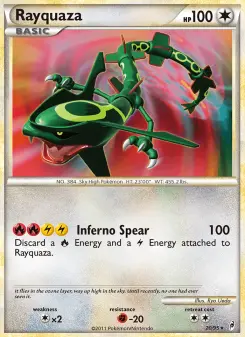
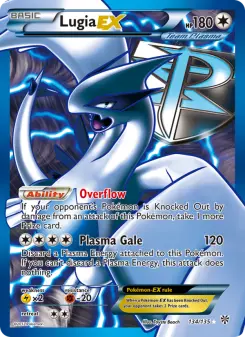
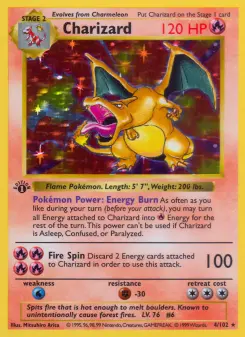
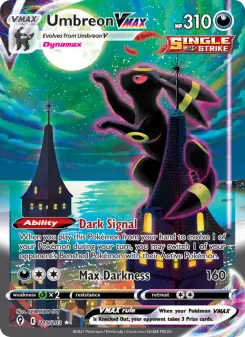
These are real ladders out of the October 9 snapshot, picked to span the range. The observation dates are in the table because our source reads each rung on its own schedule, and two of the six damaged quotes here are weeks or months older than the Near Mint figure beside them. The last four carry no damaged figure at all.
Near Mint and damaged on ten English cards, with the day each rung was seen
| Card | Near Mint | Damaged | Damaged share | Rungs observed |
|---|---|---|---|---|
| Rayquaza, Call of Legends | $1,013.27 | $22.14 | 2.2% | both October 9 |
| Lugia-EX, Plasma Storm | $1,344.24 | $211.63 | 15.7% | both October 9 |
| Charizard, Base Set | $928.06 | $182.08 | 19.6% | both October 9 |
| Umbreon VMAX, Evolving Skies | $2,351.42 | $958.50 | 40.8% | both October 9 |
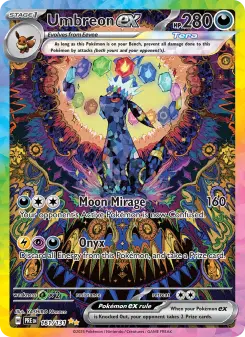
| Umbreon ex, Prismatic Evolutions | $1,301.12 | $750.00 | 57.6% | mint October 9, damaged August 6 |
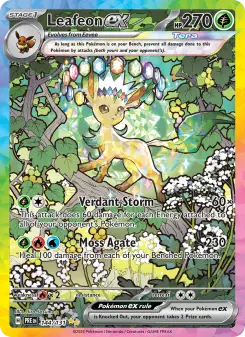
| Leafeon ex, Prismatic Evolutions | $315.40 | $225.00 | 71.3% | mint October 9, damaged September 23 |
| Victini, Black Bolt | $627.44 | no quote | not quoted | mint October 9 |
| Umbreon, Neo Discovery | $300.00 | no quote | not quoted | mint October 9 |
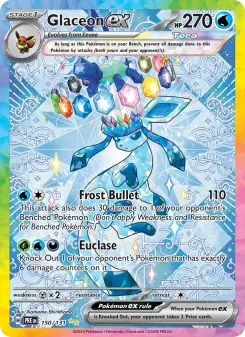
| Glaceon ex, Prismatic Evolutions | $261.54 | no quote | not quoted | mint October 9 |
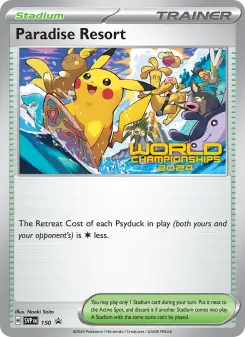
| Paradise Resort, SVP Black Star Promos | $597.66 | no quote | not quoted | mint October 8 |
Those four gaps are the finding in miniature. Paradise Resort carries a $597.66 Near Mint quote from October 8 and no played quote on any rung, so the mint figure is the only one our source published for it. Victini has a lightly played quote at $495.48 from October 9 and a moderately played one at $380.00 that our source last observed on March 1, with nothing beneath them. Own a damaged copy of one of these and there's no number to look up, so the first six rows are the closest guide you have. Those six shares run from 2.2% to 71.3%. No single haircut covers a spread that wide, which is why we publish the ladder card by card.
The ten ladders above


Two quotes to distrust
A damaged Japanese card usually has no rung to read
Our snapshot also covers 20,736 Japanese products with a Near Mint quote on the same marketplace, and a damaged quote exists on 2,984 of them, 14.4%. A lightly played quote exists on 62.6%. Japanese cards trade heavily on venues we don't read, so that 14.4% measures our source's coverage and stops there. It matters for two reasons. First, own a damaged Japanese card and there's usually no number to look up, so the English curve above is the nearest guide you have. Treat it as a guide. Second, pool all three populations we hold, which is 50,043 products including 7,943 marketplace products our catalogue cannot name, and the sub-$1 damaged coverage falls to 34.6%. Just under half of that pool is English, 10,915 of 22,421. The Japanese rows carry a damaged quote only 4.0% of the time, 321 of 8,035, and they're what pulls the pooled figure down, which is why every headline number here is English only.
What the mint copy is worth decides your next move
Under about thirty cents, don't list the card on its own. Either the damaged rung is missing, which it is about two times in three below twenty cents, or the fee swallows the whole sale, which it does for 5,434 of the 6,750 quoted damaged copies under a dollar. Either way the card belongs in a bulk lot or a trade.
Between a dollar and twenty dollars, look the quote up: it exists for roughly 96% of cards in that range. Expect something near a third of mint. The $5 to $20 band has a median of 34.0% and a middle half running 21.4% to 51.6%, wide enough that your own card's quote beats any ratio you could apply.
Above twenty dollars, sell it on its own. A damaged quote exists on 2,993 of the 3,083 English cards in that range, which is 97.1%, and coverage thins as the card gets dearer: 97.3% between $20 and $100, 96.9% from $100 to $500, 94.9% at $500 and up. The median damaged share runs from 30.3% in the first of those bands down to 26.3% in the last. For the middle half of those 2,993 cards the published fee takes 14.2% to 16.8% of the sale, with a median of 15.4%, and the three stale asks named above push the top of the range to 133.3%.
If you're buying, the dear end is where the discount runs deepest: a damaged copy of a $100-plus card is quoted at a median 27.6% of a mint one, across 826 cards. One more sorting rule falls out of Where the Money Sleeps, which found 1% of cards holding 45% of the value across the 5,723 English cards it priced in August. Spend your afternoon reading ladders on the dozen cards that carry your collection, and move the rest by the handful.
POPULATION, stated first. Our condition_quotes snapshot holds the per-condition ladder for 52,130 marketplace products, 50,043 of which carry a Near Mint rung. Those 50,043 are three different populations and this article is about one of them: 21,364 products that resolve to an English catalogue card, 20,736 that resolve to a Japanese one, and 7,943 that resolve to no catalogue row at all. Every headline figure above is the English 21,364, which is 99.6% of the 21,449 distinct English products in our catalogue. Catalogue rows sharing a marketplace product id are collapsed to one row, preferring the lexically first card id, because 243 English product ids are claimed by two rows each. The pooled 50,043 reads differently and is printed once, in the Japanese section, so the difference stays visible. AS OF. Each rung carries the date our source last observed it, and the rungs are not all read on one schedule. Across all 96,400 English rungs the newest reading is October 9, 2026; 79.6% were observed within seven days of that, 90.7% within thirty, and the oldest is March 24, 2025. At the seven-day cut the damaged rung is the stalest in the ladder, 66.9% against 67.1% for heavily played, and by thirty days the two have swapped, 80.0% damaged against 79.1% heavily played. Only 50.7% of English ladders have every rung observed inside a week. Of the 16,824 damaged and Near Mint pairs behind the 39.7% headline, 5,122 have their two rungs observed more than seven days apart and 3,366 more than thirty, with a worst gap of 485 days. ROBUSTNESS, since that staleness could move the headline. Restricting to the 10,841 cards whose damaged and Near Mint rungs carry the same observation date gives a median share of 38.09% against the 39.69% published above, a gap of 1.6 points, and the same-day figure sits closer to the 36.0% that Pokémon Card Condition Price Guide measured on its own same-day pairs. The headline is quoted on all 16,824 pairs because that's the population a reader looking up one card is drawing from. A ladder is one snapshot, so no figure here measures a change over time. PRICES. Every figure is a listing quote on one marketplace, never a completed sale, and asks run above sales on cheap cards. The snapshot stores one row per product per condition, so each rung holds exactly one quote and there were no duplicates to reconcile. Shares are each card's own rung divided by its own Near Mint quote, then the median of those shares, never a ratio of two medians. Medians take the upper middle value on even samples, and the quarter-below and quarter-above columns are the values a quarter and three quarters of the way up the same sorted list. The 40% to 60% counts are inclusive of both ends and compared in integer cents: 4,494 of 16,824 cards, 26.71%, and per band 2,029, 1,183, 728, 392, 143 and 19. Only 4 of the 16,824 English ladders carry a different printing on the damaged rung than on the Near Mint rung, so printing mismatch moves nothing here. THE ABSENCE. A missing rung means our source published no quote for that condition when the snapshot was read. It can mean nobody has a copy listed in that condition, or that our source did not publish the rung, and we cannot separate those two from inside our own data. Blank rungs are left out of every median and every share-of-mint count; the coverage bars count them only as the gap they are, and no chart enters one as a zero. Price bands are closed on the lower bound and open on the upper, they partition the population with nothing counted twice, and the eight coverage bars sum to 21,364. FEES. eBay's published final value fee for trading cards, 13.25% of the sale plus a per-order 40 cents, or 30 cents at or under $10, from the schedule recorded in our own code and read from eBay's seller fee page on September 23, 2026. The schedule drops to 2.35% on the portion of a sale above $7,500, which no damaged quote here reaches. The per-order charge is applied once per card, because the question is what one damaged card sells for on its own; a lot pays it once for the whole lot, which is the point made above. Postage, packaging, promoted-listing fees and any sales tax are not counted, so the cheap-end figures are generous. THE COHERENCE TEST is the one our own price code applies before publishing a Near Mint figure: a ladder is refused whole when any played rung is priced above the Near Mint rung. 5,837 English ladders fail it. They are counted in the coverage figures, because the question there is whether a quote exists, and they are what the callout above warns about. LINKS. All ten sets named in that table carry a link to their set page. Nothing in this article is financial advice.