A reader wrote in with a clean, testable idea: when a new set arrives with a chase card of some beloved Pokémon, the old prints of that same Pokémon should get pulled up with it, a halo of attention lifting a decade of dormant cardboard. It is the kind of pattern the hobby repeats as folklore without ever measuring. So we measured it. Using our daily price history across a 520-card universe, we ran the hypothesis against two real set launches where the chase card's identity is unambiguous, then pointed it at the set the reader actually cares about, the November 2026 Mega Rayquaza expansion. The verdict: the halo is real and sometimes violent, but it is a catalyst, not a compounding engine, it front-runs the release, fades into it, and round-trips entirely for anyone who buys the hype.
Define the pattern so it can fail
Folklore is unfalsifiable; a measurement is not. We defined the halo narrowly: for a set whose chase card is Pokémon X, do the older, unrelated prints of X earn an excess return over the broad market in the window from a set's announcement to its release? Excess is the word that matters. Nearly every vintage card in our universe rose over the last eighteen months, the BW/DP-era repricing we documented in our monthly reviews lifted the whole board. A halo has to beat that tide, not just ride it. So every figure below is stated against a control: the median move of our entire 520-card universe over the identical window, and, where the set gives us one, a same-family control of related Pokémon that were not featured. Our daily history runs from late January 2025, which fixes which launches we can audit cleanly.
Black Bolt & White Flare, the cleanest natural experiment
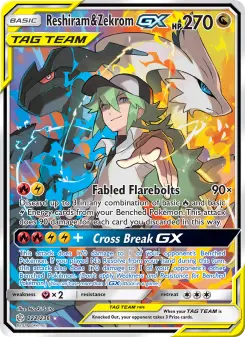
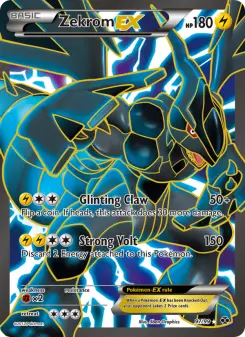
In May 2025, The Pokémon Company announced a split expansion, Scarlet & Violet—Black Bolt and White Flare, built entirely around the original Unova Pokédex. The two mascots were the whole point: Zekrom leads Black Bolt, Reshiram leads White Flare, each returning as a textured 'Black White rare' ex deliberately echoing their original 2011 full arts. Announced May 6, 2025; released internationally July 18. That gives us a chase card whose identity is not in dispute, and a basket of seven older Zekrom and Reshiram prints (2011–2019) sitting in our history with a clean before-and-after.
The halo, measured against the market: Black Bolt / White Flare
The shape is the finding. In the six weeks after the announcement, the old Zekrom and Reshiram prints ran +19.2% against a market that moved +1.7%, a seventeen-point excess concentrated in the exact window the pattern predicts. By international release, the basket was +26.1% versus +8.0% for the universe. A same-era control of legendaries that were not featured (vintage Rayquaza, Groudon and Kyogre) rose about +16.5% over the same stretch, so roughly ten of those points are attributable specifically to being the chase, and the rest to a rising vintage market. Then the tell: after launch, the featured basket kept +11.3% into year-end but underperformed that same non-featured control (+21.8%). The halo does not reverse, it dissolves. Once the set is on shelves, the featured Pokémon rejoins the pack.
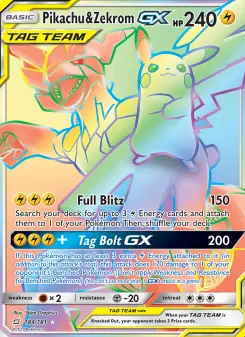
The Zekrom/Reshiram cohort, priced at the announcement, and today


Moonbreon, the halo that ate its buyers
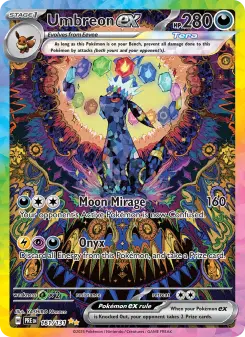
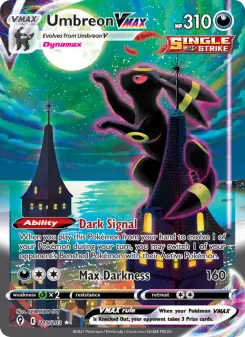
The most famous recent instance is also the cautionary one. Prismatic Evolutions (January 2025) was built around the Eeveelutions, and its Umbreon ex special illustration rare was explicitly designed to echo the 2021 Evolving Skies 'Moonbreon', the most iconic modern chase card in the hobby. In the year before release, contemporaneous reporting shows collectors bidding older Umbreon cardboard up in anticipation; the Prismatic Umbreon SIR itself drew pre-order bids past $18,000, then settled to roughly $2,900 in a PSA 10 by March 2025. That is the halo in its manic form, and its aftermath. Our daily history, which begins ten days after Prismatic's launch, catches the come-down rather than the run-up: through the first months of 2025 the old Umbreon prints managed only +12.7%, in line with the market, and over the full eighteen months the whole Eeveelution complex returned +74% against a +139% universe. The Eeveelutions did not fall, they were simply left behind, because their halo had already been spent before the set even shipped.
The Umbreon line, the new chase and the old prints it was meant to echo

Charizard, where the halo disappears
One more test, because a pattern that only ever confirms itself is worthless. September 2025's Mega Evolution set led with Mega Charizard among its chases. If the halo were universal, thirty-one older Charizard prints in our universe should have lit up. They did not: old Charizard returned +8.0% into the set's release against a +8.3% market, an excess of essentially zero. The reason is instructive. Charizard is the single most-printed, most-traded, most-perpetually-bid name in the hobby; its old prints are already priced as if every future set features it, because most of them do. A halo needs slack in the rope. On a name the market never stops watching, there is none. This is the pattern's most important boundary condition, and, as we will see, it is exactly why the Delta Reign read is not as simple as 'buy Rayquaza.'
Delta Reign, what is actually confirmed
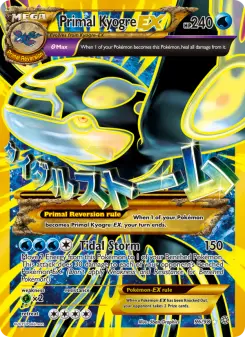
The reader called the upcoming set 'Systemic Delta Rain.' The real set is Delta Reign, and separating fact from fan-name matters before a dollar moves. Here is what is officially established as of late July 2026: Delta Reign is the sixth Mega Evolution-series expansion, releasing in English on November 6, 2026, as the counterpart to Japan's Storm Emeralda (July 31, 2026). Its headline chase is Mega Rayquaza ex, with a special-illustration rare by 2024 Illustration Contest winner Kazuki Minami. The name references Mega Rayquaza's Delta Stream ability, not the 2005–06 Delta Species mechanic, and not a weather-trio theme. That distinction is the whole investment case, because it tells us who gets the halo and who does not.
So the reader's 'weather trio' framing is one-third right. Only Rayquaza is a chase; Groudon and Kyogre sit lower on the card list, as basics with a single secret-rare each rather than the Mega ex that anchors the set. Under the pattern we just measured, that hierarchy predicts a full halo for old Rayquaza prints and, at most, a weaker, later one for Groudon and Kyogre, if their secret rares generate any pull at all. And this is the rare case where we can watch the prediction resolve in near-real-time: the Japanese reveal landed in late June 2026, and our data runs through July 26. The first five weeks are already on the tape, with the important caveat that the Groudon and Kyogre secret rares themselves were only surfacing at the very edge of that window, so their halo, if any, would not yet be in these numbers.
The halo, live, the weather trio since the Delta Reign reveal
The divergence is exactly what the pattern orders. From the reveal window onward (June 1 to July 26), old Rayquaza prints ran +15.4% while Groudon fell −1.5% and Kyogre fell −1.6%, against a +4.9% market. Groudon, the pure control, is a flat line, a Pokémon in the set but not of it, doing nothing. But note the honest complication in the chart: Rayquaza was already climbing before the official reveal, from day zero. Some of that is Japanese leak culture pulling the anticipation forward, and some is simply that Rayquaza is the most beloved of the three and was already the trio's leader. The clean signal is the spread: Rayquaza pulling +17 points clear of its own family the moment the chase was confirmed, not the level, which was already moving.
How much halo is left to buy?
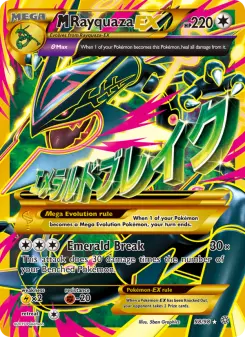
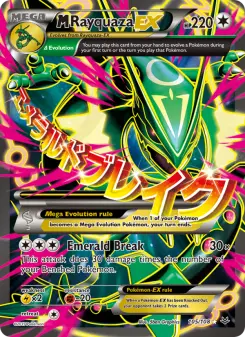
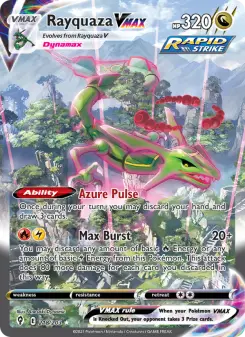
This is where the Charizard boundary condition comes back. The pattern says buy the featured Pokémon before the crowd; the crowd, for Rayquaza, has already arrived. The old prints have run +24% into the reveal and another +15% since, a chunk of the November launch is priced in July. So the disciplined move is not 'buy Rayquaza,' it is 'buy the Rayquaza the halo has not reached yet.' Sort the complex by how much it has already moved, and a split appears. The Evolving Skies Rayquaza VMAX and V, the liquid modern favorites, have already run +27% and +28% in the reveal window on top of +33–44% before it. Chasing those is buying the vertical move, the single most expensive habit in our loss ledger. The laggards are the older, supply-frozen XY-era Mega Rayquaza prints, which are also the tightest thematic fit: Delta Reign literally revives Mega Rayquaza, and these are the cards that first printed it, in dead sets that can never reprint.
The Delta Reign read, old Mega Rayquaza, sorted by halo already spent

The broader lesson closes the loop with the rest of our research. The halo is a demand-side catalyst, and every demand catalyst in this hobby pays only where supply is fixed, which is why the XY-era prints, not the freely available modern ones, are the honest expression of the trade. It is the same discipline as our print-clock and launch-curve work from the other direction: buy the supply that is frozen, time the demand that is arriving, and never confuse a three-month spotlight with a decade of scarcity.
Universe: the 520-card moonstone graded-study universe, daily TCGplayer market prices via the Pokémon Price Tracker API, history spanning January 27, 2025 – July 26, 2026. Baskets are name-matched within that universe (old Zekrom+Reshiram prints n=7, excluding the 2025 Black Bolt/White Flare prints themselves; Rayquaza n=17, Groudon n=8, Kyogre n=8; Charizard n=28; Eeveelutions n=43). Window returns are the median of per-card percentage changes between nearest daily prices within ±20 days of each anchor date; the control is the median change of the entire universe over the identical window. Event dates: Black Bolt/White Flare announced May 6, 2025 (press.pokemon.com), international release July 18, 2025 (PokeBeach); Mega Evolution set September 26, 2025; Prismatic Evolutions January 17, 2025; Delta Reign/Storm Emeralda Japanese reveal late June 2026, full main set revealed July 23, 2026, Japanese release July 31, 2026, English release November 6, 2026 (PokeGuardian, PokeBeach, Serebii, Bulbapedia). Caveats, stated plainly: samples are small (the cleanest case rests on seven cards) and were measured inside a broad vintage bull market, so excess-over-control is the load-bearing statistic, not raw magnitude; vintage raw daily prices carry condition-mixing noise (see our accuracy note), so individual vintage prints are cited only where the daily path is clean and steady, spike-and-revert artifacts (e.g. a Neo Discovery Umbreon series swinging $700→$1,800→$160, and two thin Rayquaza prints) were excluded from per-card figures and survive only inside the robust medians. The Prismatic pre-launch run-up predates our history and is cited from contemporaneous reporting (dotesports, ScreenRant, The Gamer), not measured here. Set-content claims are scoped to the confirmed column as of July 30, 2026; unconfirmed details are labeled. Delta Reign rating language is forward-looking analysis, explicitly not a data point. Linked product pages price live and will drift from captured figures. Nothing here is financial advice.