If you bought one of each of the 252 cards in Surging Sparks on October 3, you paid $1,199.97. On November 1 the same shopping list cost $1,062.97. That is an 11.4% slide across a 30-day window of TCGplayer market prices, and the damage was not spread evenly across the binder. The typical card slipped only 2.6%, so the set is not rotting from the bottom up. It is the expensive end giving back money.
The 189 cards under a dollar barely noticed the month. More of them went up than down, 83 pricier against 76 cheaper, and the typical move was flat, which is what binder filler does when nobody is watching. The trouble starts once a card is worth real money. The 31 cards between $1 and $5 fell a typical 8.7%, the 20 cards from $5 to $20 fell a typical 8.9%, and the 12 cards at $20 or more all got cheaper, every one of them, a typical drop of 13.6%. Widen the lens to everything that cost $5 or more on October 3 and you get 32 cards, of which 29 lost value and 3 gained. Owning the expensive part of this set in October was a nearly uniform experience, and not a pleasant one.
How each price band moved, October 3 to November 1, 2026
| Price on October 3 | Cards | Got cheaper | Got pricier | Typical move |
|---|---|---|---|---|
| under $1 | 189 | 76 | 83 | flat |
| $1 to $5 | 31 | 24 | 7 | down 8.7% |
| $5 to $20 | 20 | 17 | 3 | down 8.9% |
| $20 and up | 12 | 12 | 0 | down 13.6% |
Where the money actually sits
Surging Sparks is famous for its Pikachu, and the concentration figures say the fame is earned. The five priciest cards hold 58.1% of what the whole 252-card set costs, half the value of the set on fewer cards than fit on one side of a binder page. The losses were just as lopsided. Of the $144.26 surrendered across every card that got cheaper, 63.1% came from just five cards. When a set's value and a set's losses both live in the same handful of chase cards, the set's price is essentially a poll of those cards, and in this window they voted down.
Biggest drops, cards over $5
- 1
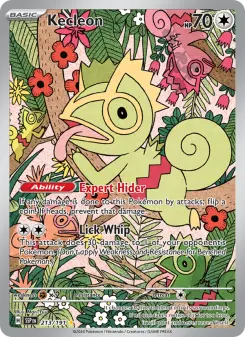 Kecleon #213$8.65 to $6.24slid steadily across the window-27.9%
- 2
 Exeggcute #192$7.70 to $5.74slid steadily across the window-25.4%
- 3
 Feebas #198$8.87 to $7.11slid steadily across the window-19.8%
- 4
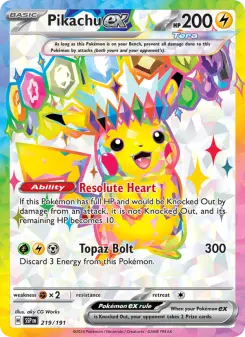 Pikachu ex #219$28.24 to $22.82slid steadily across the window-19.2%
- 5
 Lisia's Appeal #246$26.20 to $21.37slid steadily across the window-18.4%
- 6
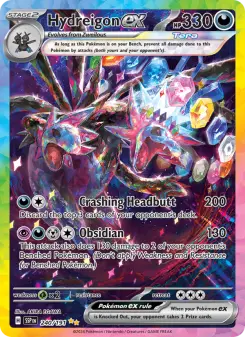 Hydreigon ex #240$36.59 to $30.52slid steadily across the window-16.6%
Start with Pikachu ex #238, the Special illustration rare. It went from $284.71 to $246.21, down 13.5%, and its $38.50 slide is the most money lost by any single card in the set. Behind it, Latias ex #239 gave back $18.59, falling from $186.13 to $167.54, and Milotic ex #237 dropped from $117.73 to $102.15, down 13.2%. The Hyper rare Pikachu ex #247 lost $12.26, going from $79.77 to $67.51, and Hydreigon ex #240 fell 16.6%. The steepest percentage drop among anything over $5 belonged to a much cheaper card: Kecleon #213, an Illustration rare, went from $8.65 to $6.24, down 27.9%, with Exeggcute #192 close behind at a 25.4% fall. None of the 10 cards on the drop list got there in a single one-day repricing; each slid steadily across the window, which reads as sellers losing conviction rather than one bad morning.
Half the value of a 252-card set fits on one side of a binder page, and this month it slid.
The practical shape of this is simple. If you want Surging Sparks exposure, the set is its chase cards, and the rest of the binder is a rounding error on the receipt. Buying mid-tier singles to own this set means paying for a top end that is getting cheaper on its own. Whether the slide is a dip or a repricing is the one thing a 30-day window cannot tell you. But if you were waiting for the headliners to come to you, they did: Pikachu ex #238 is $38.50 cheaper than it was at the start of October, and nothing about the way it fell looks like panic, just a slow, steady leak.
Population: Surging Sparks, 252 English cards with a TCGplayer market price on both October 3, 2026 and November 1, 2026. Every move compares a card to itself on the same TCGplayer product, first day against last, before anything is ranked or summed; a set total is never compared across days. Prices are TCGplayer market prices for the flagship printing, read from our daily price file. Graded figures are sold medians from our graded comps, PSA population counts come from our daily registry snapshot, and the expected value counts the PSA 9 outcome as well as the PSA 10, net of the grading fee and selling costs. Angle: how much of the whole population's value sits in its top few cards, and what those cards did.