
Collectors talk about artists as though the signature moves the price. It does, and we can put a number on it, but the number is smaller than the one everybody already accepts without argument. Across 19,582 priced English cards by 395 artists, knowing only the illustrator predicts 12% of where a card ranks inside its own set when tested on sets the model never saw. Narrow to the 12,671 test rows the species model also sees and the artist figure is 14%; knowing only which Pokemon is on the card predicts 40% on those same rows.
The design that keeps this honest
The dependent variable is a card's price percentile inside its own set, which removes set price level and set size by construction. Sets are split odd and even into two disjoint halves. An artist's score is computed only on the training half, then tested on cards in sets the training half never contained. The two quantities therefore share no observation and no algebra. A placebo run with the artist labels shuffled scores minus 0.02, which is what a null looks like.
This matters because the corpus has been burned before by a regression whose dependent and independent variables shared a term. Here the numerator and denominator are literally different cards in different sets.
The ladder, and the man at the bottom of it
Where an artist's cards land inside their own sets
| Artist | Priced cards | Sets | Mean within-set percentile | Share in their set's top decile |
|---|---|---|---|---|
| Hikaru Koike | 46 | 15 | 0.85 | 56.5% |
| Kimiya Masago | 25 | 5 | 0.83 | 44.0% |
| Shizurow | 81 | 21 | 0.76 | 43.2% |
| aky CG Works | 184 | 42 | 0.75 | 25.5% |
| Ryo Ueda | 442 | 84 | 0.60 | 31.7% |
| Mitsuhiro Arita | 709 | 123 | 0.57 | 15.8% |
| Ken Sugimori | 1,059 | 90 | 0.43 | 7.1% |
| Miki Tanaka | 196 | 78 | 0.32 | 1.9% |
[Ken Sugimori](/artist/ken-sugimori) designed the original Pokemon. Across 1,059 priced cards in 90 sets his mean within set percentile is 0.43 and his median card is $1.75. He ranks below the middle of his own sets, because he is given the checklist rather than the chase. That is the whole mechanism in one line: the artist premium is mostly an assignment premium.
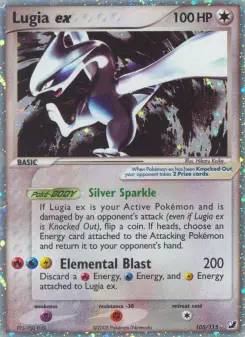
[Mitsuhiro Arita](/artist/mitsuhiro-arita), who painted the Base Set Charizard, sits at 0.57 across 709 cards with a median of $3.12 and a best of Gengar ex at $1,399.99. The highest scorer among artists spread over more than one set is Hikaru Koike at 0.85 across 46 cards in 15 sets, with 56.5% of them in their set's top decile and Lugia ex at $2,500 as the peak. The ladder excludes single-set artists, who cannot be scored across their own sets: one of them, ConceptLab, sits above Koike on twenty cards in one set.
The collapse nobody announced
The share of an era's top-decile cards held by its five biggest artists, in era order: WotC 66.3%, EX 81.7%, DP and HGSS 46.1%, BW 72.9%, XY 77.3%, SM 62.6%, Sword and Shield 39.7%, Scarlet and Violet with the Mega era 15.5%. Read in that order it is not a steady decline. Concentration peaks in the EX era, drops sharply through DP and HGSS, climbs back through BW and XY, and only then falls away across the last three eras. The clean trend is the other measure: distinct artists holding top-decile slots per set has gone from 4.1 in the EX era to 10.7 today. The chase tier used to be a handful of names and is now a crowd.
One more thing the numbers insist on. The single largest holder of value tier work is not a person. 5ban Graphics, a production house, holds 373 of the 2,017 top-decile cards that carry an illustrator, 18.5% of the attributed value tier, across 1,699 priced cards in 95 sets. Any story about artists as auteurs has to account for the fact that the biggest name in the top decile is a studio credit.
Population: 21,071 priced English cards in the 171 sets holding at least 20 priced cards; 19,582 carry an illustrator, across 395 artists. Prices resolve through the shared canonical printing rule. The dependent variable is a card's price percentile within its own set. Sets are split odd and even into disjoint halves; an artist's score is estimated on the training half only and evaluated on cards in the held-out half, so the two are computed from disjoint samples in disjoint sets and cannot be mechanically linked. A label shuffled placebo scores minus 0.02 at card level and minus 0.04 at artist level. Artist-level reliability is a split-half correlation across the 141 artists with at least ten cards in each half. The species comparison is run on the identical 12,671 test rows. Top decile membership is computed within each set. Illustrator attribution comes from the catalog's illustrator field, which is backfilled from TCGdex and is missing on roughly 7% of priced English cards; those cards are excluded rather than imputed.