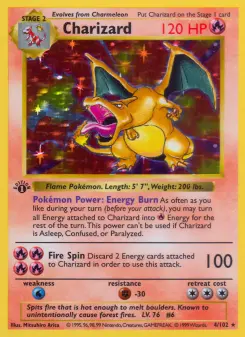
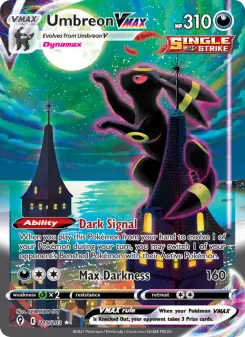
We price both catalogs daily: the English market and the Japanese market, more than fifty thousand cards across the two. Line up the same artwork on both sides of the ocean and the result is not one story but two. Vintage icons converge. Modern chase art diverges, sometimes by an order of magnitude or more. Both patterns come from supply mechanics you can reason about.
Same artwork, both markets, listed TCGplayer market quotes, August 2026
| Card | English print | Japanese print | Pattern |
|---|---|---|---|
| Charizard, Base Set art | $855.52 (Base Set) | $800 (Expansion Pack, 1996) | vintage parity |
| Umbreon VMAX alt art | $2,410.66 (Evolving Skies) | $64.81 (VMAX Climax reprint) · $42.73 (Eevee Heroes) | modern chasm |
Why vintage converges
The 1996 Japanese Base Charizard and the 1999 English one both stopped printing decades ago, both have fixed surviving populations, and both are bought by the same global collector for the same reason. When supply is closed on both sides, price finds the artwork, not the language. The gap on our boards is $55.52, 6.5% of the English price, and the Japanese half of it deserves a warning the English half does not: that $800 is a single listed quote on a catalog row carrying no collector number, and it has not moved by a cent on any day we have recorded it. Parity here is two quotes agreeing, not two tapes agreeing.
Why modern diverges
Modern Japanese sets print in enormous volume relative to demand, Japanese pull rates are friendlier, and the grading-driven premium that powers English alt art prices is a substantially English-market phenomenon. The same Umbreon artwork that anchors a four-figure English card lists in the tens of dollars as a Japanese print. Important honesty note: those Japanese quotes are marketplace listed-market figures on thinner liquidity than the English legs, not deep sold medians, so treat them as the shape of the gap rather than an executable arbitrage at size.
Both legs from our daily TCGplayer sync across the English and Japanese catalogs, August 2026, quoted as listed market values with the liquidity caveat stated inline. Same-artwork pairing verified manually for the examples shown. WHICH JAPANESE ROWS: every Japanese leg here is a TCGplayer Japanese catalog row, the family whose ids we store with a jat- prefix, not a TCGdex-sourced row, and the two read very differently on price coverage; the three quoted are jat-575604 (Expansion Pack Charizard), jat-571497 (VMAX Climax Umbreon VMAX 245/184) and jat-570556 (Eevee Heroes Umbreon VMAX 094/069). The catalog counts are deduplicated on the TCGplayer product id before they are quoted, because a share of rows on both sides claim an id another row also claims: on the dedupe the two catalogs hold 21,452 English and 29,055 Japanese products, which is the fifty thousand the lede means. Recomputed 2026-09-22 against the per-card tape at its first surviving reading, 2026-08-30: Base Charizard $855.52 English against $800 Japanese, Eevee Heroes Umbreon $42.73, VMAX Climax Umbreon $65.41 against the $64.81 printed here from August 27.