
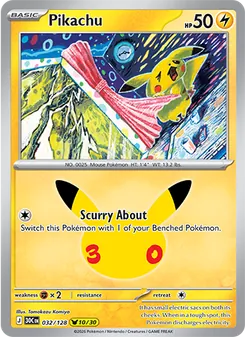
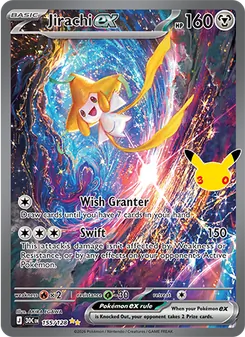
The 30th Celebration set has fallen hard over the past week, and we can put a number on it: across the 40 cards we hold a price for on both days, the median card lost 34.2% between September 15 and September 16. That is one day. Widen to five days and the ten cards with a full run lost 64.9% at the median. This piece is about what those numbers are made of, which turns out to be a more interesting question than how big they are, because across all 159 cards in this set that we track we hold exactly zero recorded sales. Every figure quoted here, ours included, is an asking price. One of them was ours, and it was wrong.
A price that does not move is not a price
Before the fall there was a plateau, and the plateau is the tell. Six of this set's Pikachu cards were quoted at exactly $49.99, not approximately, for a combined 63 days. Pikachu 032/128 held that precise figure for seventeen consecutive days. Pikachu 030/128 held it for fifteen and then broke straight to $10.88. Mewtwo ex was quoted at exactly $1,000.00 every single day from August 13 to September 9, twenty-eight readings without a cent of movement, and then went to $875, then $829.99, then $706.24.
Six independent cards do not agree on $49.99 to the cent for weeks because six markets independently cleared there. A round number that holds perfectly flat and then gaps is the signature of a small number of sellers asking the same thing while nothing trades, and the figure updating only when one of them blinks.
Cards whose recorded series opens with a flat run of four days or more
| Card | Held at | For | Broke on | Next reading | Latest |
|---|---|---|---|---|---|
| Pikachu 032/128 | $49.99 | 17 days | Sep 13 | $39.99 | $17.60 |
| Pikachu 030/128 | $49.99 | 15 days | Sep 16 | $10.88 | $10.88 |
| Pikachu 025/128 | $49.99 | 8 days | Sep 9 | $49.50 | $14.14 |
| Pikachu 038/128 | $49.99 | 8 days | Sep 6 | $49.97 | $18.02 |
| Pikachu 042/128 | $49.99 | 8 days | Sep 6 | $49.98 | $22.97 |
| Pikachu 026/128 | $49.99 | 7 days | Sep 8 | $49.66 | $17.37 |
| Alolan Meowth 139/128 | $99.00 | 6 days | Sep 14 | $98.90 | $64.19 |
| Pikachu 023/128 | $49.97 | 5 days | Sep 11 | $49.96 | $15.36 |
| Rayquaza EX (Classic Collection) | $299.00 | 4 days | not yet | $299.00 |
Note the fourth column against the sixth. Several of these did not break downward at first: they stepped from $49.99 to $49.97, which is a seller shaving two cents, and only later collapsed by two thirds. The plateau did not erode. It held, and then it failed.
The break, measured honestly
A set-wide average is useless here and it is worth saying why, because the naive version of this article would have been badly wrong. Our coverage of this set went from 25 cards priced on September 16 to 76 on September 17, as linking caught up with the catalogue. The set-wide median price fell from $49.50 to $2.79 across that boundary, a 94% crash that never happened: the new cards were commons, and adding commons to a sample lowers its median. So every figure below is a CONSTANT PANEL, comparing only cards priced on both days.
Same cards, both days: what the set actually did
| Window | Cards in panel | Median change | Aggregate change |
|---|---|---|---|
| Sep 15 to Sep 16 | 40 | -34.2% | -32.5% |
| Sep 14 to Sep 16 | 28 | -36.3% | -37.3% |
| Sep 13 to Sep 16 | 16 | -67.1% | -40.5% |
| Sep 12 to Sep 16 | 12 | -64.9% | -49.5% |
| Sep 11 to Sep 16 | 10 | -64.9% | -57.9% |
Two readings of that table. The one-day move is real and large: a third of the quoted value of this set came off between September 15 and 16 on cards that were priced on both days. And the panels get more negative as they get longer and narrower, which is what you would expect if the cards tracked longest are the chase cards that ran up first and fell furthest.
Fall from each card's own peak, by rarity
| Rarity | Cards | Median fall from peak |
|---|---|---|
| Pikachu Rare | 8 | -67.3% |
| Rare | 2 | -44.4% |
| Double rare | 1 | -43.0% |
| Illustration rare | 5 | -35.2% |
| Special illustration rare | 1 | -25.2% |
| Common | 9 | -19.6% |
The rows with one or two cards carry no weight and are printed so the table is not silently filtered. The row that does carry weight is the first one: the eight Pikachu Rares, the sub-series built for this anniversary and the thing people queued for, are down 67.3% at the median from their own peaks. Pikachu 040/128 ran to $69 on September 12 and was last read at $9.45. The commons, which nobody was speculating on, are down 19.6%.
Our own number was wrong, on 92 cards
Checking this set is what found it. A provider payload carries two different market figures: a top-level one that arrives with the daily bulk export, and a per-printing one computed by a separate per-card fetch that carries its own timestamp. For a card that exists in one printing only, our price rule prefers the top-level figure. On this set that is the wrong choice, and the provider's own daily history says so to the cent: Jirachi ex reads $204.13 on September 16 in that history and $204.13 in the per-printing field, while the top-level field says $249.99, which is where the card sat two days earlier.
What we publish against what the provider last recorded
| Card | We publish | Provider's latest | Overstated by |
|---|---|---|---|
| Mew ex 158/128 | $1,808.25 | $1,158.37 | 56.1% |
| Mewtwo ex 157/128 | $829.99 | $706.24 | 17.5% |
| Jirachi ex 155/128 | $249.99 | $204.13 | 22.5% |
| Galarian Meowth 141/128 | $144.98 | $56.09 | 158.5% |
| Pikachu 027/128 | $62.00 | $14.09 | 340.0% |
| Pikachu 040/128 | $73.00 | $9.36 | 679.9% |
92 cards in this set are currently published at the stale figure, and in aggregate our quoted value for them is 48.1% above what the provider last recorded. Catalogue-wide the same fault touches 248 cards, so this set is 37% of the total damage in a single three-week-old release. That concentration is the whole point: the two figures only diverge when a price is moving fast, and almost nothing in a mature catalogue moves fast.
What a reader should take from this
Not that the set is cheap now. We have no idea, and neither does anyone quoting you a figure, because there is still not one recorded sale on our tape for any of these 159 cards. What we have is a wall of asks that has been repricing downward for a week, which tells you the asks were too high and tells you nothing about where they stop.
The usable rule is narrower. A quoted price that has not moved by a cent in a week is not evidence of stability, it is evidence that nothing is trading, and it will gap rather than drift when it finally moves. Six cards in this set held $49.99 for an average of more than ten days and then lost two thirds. If you are pricing a position off a number that has been identical for a fortnight, you are pricing it off one seller's opinion. Our study of what a price is made of covers the general version of this, and the 30th Celebration is now the cleanest example of it we have on record.
Read from moonstone production on September 17, 2026. The set is 188 catalogue rows, of which 159 carry a TCGplayer link and a stored provider payload and 131 currently resolve to a price. Price series are the provider's own daily history as we cache it, one reading per card per day, quoted unmodified. ALL CHANGE FIGURES ARE CONSTANT PANELS: a card enters a window only if it has a reading on both endpoints, because our coverage of this set tripled on September 17 and a set-wide median across that boundary falls 94% for reasons that have nothing to do with price. Median change is the median of per-card ratios, not the ratio of medians; aggregate change is the sum of the panel on each day. Fall from peak uses each card's own maximum recorded reading and requires at least three readings, which is why the rarity table holds 26 cards and not 159; rows of one or two cards are printed rather than hidden and carry no weight. Zero sold comps means our stored payload for all 159 cards contains an empty sales array and an empty graded array; it is a statement about our tape, NOT a claim that no copy has changed hands anywhere. 83 of the 159 carry a listing count. The publishing fault is measured by comparing, on single-printing cards, the top-level market field our price rule selects against the per-printing figure whose timestamp is fresher, validated against which of the two matches the provider's own latest daily reading: where the per-printing block is fresher than the bulk export, it matches 90% of the time and the field we publish matches 10%. The fault is not fixed at the time of writing and no figure in this article is taken from the field it affects.