If your Ascended Heroes hits live in toploaders, the last month cost you money, and if your copies of the set live in a bulk box, you'd hardly know anything happened. Between October 30 and November 28, every one of the 25 Ascended Heroes cards that cost $20 or better got cheaper, while the cheapest cards drifted the other way. For once the bulk box had the better month of the two, and it wasn't close.
The split is about as clean as TCGplayer market prices get. Of the 573 cards we tracked, 494 opened the window under $1, and the typical one finished up 2.6%, with 248 getting dearer against 203 getting cheaper. That's mostly noise. It's the kind of move that won't change what anybody pays for a stack of commons at the counter. Climb toward the cards people actually pull out to show their friends and it turns, gently through the middle of the set and then hard at the top, where the typical card over $20 lost 18.6%. The turn is already plain a step below that, in the $5 to $20 bracket, where 11 of the 14 cards got cheaper and only 3 rose. All 25 of them fell, which is a lot of agreement for a market that rarely agrees on centering.
How each price band moved, October 30 to November 28, 2026
| Price on October 30 | Cards | Got cheaper | Got pricier | Typical move |
|---|---|---|---|---|
| under $1 | 494 | 203 | 248 | up 2.6% |
| $1 to $5 | 40 | 24 | 16 | down 8.0% |
| $5 to $20 | 14 | 11 | 3 | down 11.2% |
| $20 and up | 25 | 25 | 0 | down 18.6% |
Five cards carry the set
That matters because the top of Ascended Heroes is where the money is. Putting together a full run of the set, single copies throughout, was a $3,848.60 project on October 30 and a $3,040.39 one by November 28, and the five dearest cards are 56.5% of that bill on their own. The median card in the set didn't move. It didn't have to, because the commons were never going to hold up the price of a full set while its chase cards slid. Every card that fell lost $826.20 between them, and five of those cards produced 70.0% of it. The commons can't save you. Anyone building a master set got a cheaper month for it, which is the only good news here and it's mostly good news for people who don't own the set yet.
Biggest drops, cards over $20
- 1
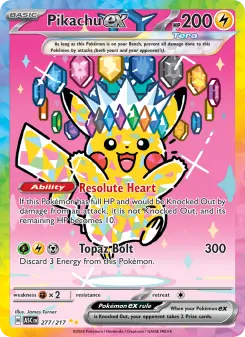 Pikachu ex 277/217$283.81 to $187.38slid steadily; no single day carried more than 10% of the move-34.0%
- 2
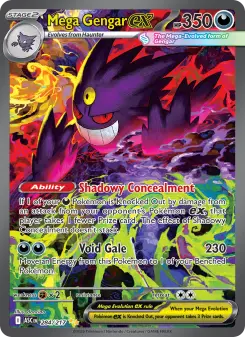 Mega Gengar ex 284/217$734.45 to $496.40slid steadily; no single day carried more than 12% of the move-32.4%
- 3
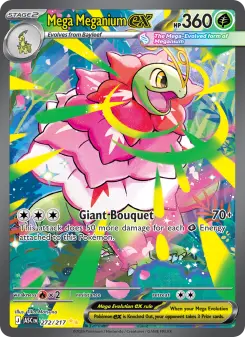 Mega Meganium ex 272/217$54.95 to $37.26slid steadily; no single day carried more than 18% of the move-32.2%
- 4
 Lillie's Clefairy ex 280/217$98.91 to $67.22fell over the window, but 51% of the move came on November 21-32.0%
- 5
 Canari 291/217$23.15 to $15.77slid steadily; no single day carried more than 26% of the move-31.9%
- 6
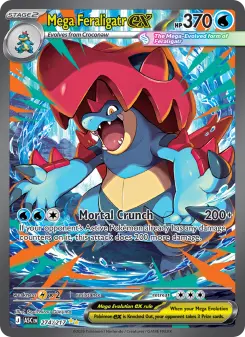 Mega Feraligatr ex 274/217$73.15 to $52.72slid steadily; no single day carried more than 11% of the move-27.9%
- 7
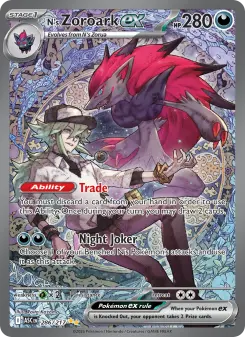 N's Zoroark ex 286/217$115.70 to $88.99slid steadily; no single day carried more than 20% of the move-23.1%
- 8
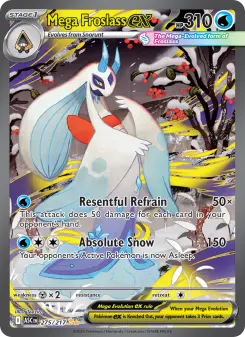 Mega Froslass ex 275/217$49.54 to $38.15slid steadily; no single day carried more than 11% of the move-23.0%
- 9
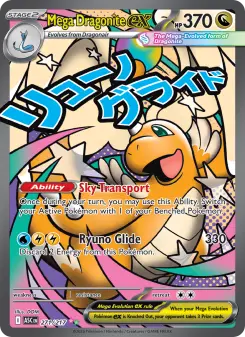 Mega Dragonite ex 271/217$25.06 to $19.54slid steadily; no single day carried more than 25% of the move-22.0%
- 10
 Team Rocket's Mewtwo ex 281/217$194.78 to $152.18slid steadily; no single day carried more than 20% of the move-21.9%
Pikachu ex 277/217 fell furthest of the big cards, 34.0%, and finished at $187.38. Mega Gengar ex 284/217 is the expensive version of the same story, down 32.4% to $496.40 and the largest dollar loss among the ten steepest fallers at $238.05. Behind them, Mega Meganium ex 272/217 lost 32.2% and Lillie's Clefairy ex 280/217 lost 32.0%. What I kept noticing was how few of these drops had a single bad day in them. Of those ten, none came from one sharp repricing, and Lillie's Clefairy was the closest, with 51% of its fall landing on November 21. The others just slid. Team Rocket's Mewtwo ex 281/217 was one of them, losing 21.9% to end at $152.18. Mega Feraligatr ex 274/217 and Mega Froslass ex 275/217 went the same way, down 27.9% and 23.0%. Mega Dragonite ex 271/217, the only Ultra Rare among the ten, ended at $19.54, which leaves it just under the line that got it counted.
All 25 of them fell, which is a lot of agreement for a market that rarely agrees on centering.
If I were shopping the set this week, I'd be looking at the top, since that's where prices fell hardest, and the graded side makes those cards look sturdier than their raw prices suggest. PSA has graded 18,558 copies of Mega Gengar ex and given a 10 to 62.8% of them, and a submission nets $930.22 on average after fees against $430.23 for selling one raw. The slab wins on all four big cards with a grading figure. That includes Mega Charizard Y ex 294/217, a stingy card that gems 19.2% of the time and leaves a submitter $99.20 up on the raw price anyway. The other Pikachu ex, 276/217, is a $474.60 card raw, and grading puts a holder $463.83 ahead of that. The card I'd look at hardest is Pikachu ex 277/217, sitting at $187.38 after 30 days in which no single day took more than 10% of its fall.
Population: Ascended Heroes, 573 English cards with a TCGplayer market price on both October 30, 2026 and November 28, 2026. Every move compares a card to itself on the same TCGplayer product, first day against last, before anything is ranked or summed; a set total is never compared across days. Prices are TCGplayer market prices for the flagship printing, read from our daily price file. Graded figures are sold medians from our graded comps, PSA population counts come from our daily registry snapshot, and the expected value counts the PSA 9 outcome as well as the PSA 10, net of the grading fee and selling costs. The expected value sits beside the raw price less the same eBay selling fee, so the two compare like with like. It counts copies that grade below a 9 at nothing and leaves out shipping to PSA and back. Angle: the steepest percentage falls above a price floor, each with how much of its fall landed in one day.