
A quoted raw price is an ASK: what somebody is currently requesting. A sold median is what buyers actually paid. Everyone knows those differ. We have not seen the shape of that difference measured across a population, so we measured it. On September 21, 2026 we held both a live raw ask and a raw eBay sold median for 1,065 distinct marketplace products, and on 440 of them the sold median stands on at least five verified single-card comps. On those 440, the sold median is 1.39 times the ask at the median. The direction flips with price: below $5 the sold median runs 5.56 times the ask, and above $500 the two sit within about 5% of each other while the sold median comes in BELOW the ask on 45% of cards.
Two honest numbers, one card
The ask here is the quoted market price our card pages print, drawn from our daily price dump. It is worth knowing what that number is made of: on September 22, 2026 it was identical to the cheapest listed copy, to the cent, on 43,282 of 52,309 priced lines, which is 82.7%. On another 10.0% the cheapest listing sat above it. So for most of the catalog the quoted price is the front of the queue rather than the middle of a book, a point Five Cards in Six Trade on a Single Listing established as a census and this study inherits as a premise.
The sold median is the middle of up to 25 recent eBay sold listings, each screened for grader words so a slab cannot pose as a raw comp, and each title-matched to the card, set, number and printing. It is a different venue with different buyers, different shipping economics and different condition risk. The comparison below is not an arbitrage. It is a disagreement between two instruments, and the disagreement has a shape.
The gap closes as the card gets expensive
Raw sold median against quoted ask, by what the card asks
| Quoted ask | Products | Typical sold over ask | Share selling below the ask | Median ask | Median sold |
|---|---|---|---|---|---|
| Under $5 | 51 | 5.56x | 0.0% | $2.73 | $14.99 |
| $5 to $25 | 103 | 2.14x | 7.8% | $15.27 | $30.00 |
| $25 to $100 | 121 | 1.24x | 25.6% | $53.04 | $75.00 |
| $100 to $500 | 125 | 1.08x | 43.2% | $218.33 | $204.25 |
| $500 and up | 40 | 1.05x | 45.0% | $799.69 | $800.00 |
Above $100 the two numbers are doing the same job and mostly agree, which is the useful half of this result: on an expensive raw card the quoted ask is a fair estimate of the sale, and it is slightly optimistic, with the sold median landing under it on 43% to 45% of cards. Below $25 they are not measuring the same transaction at all, and the reason is a floor rather than a premium.
What a raw card actually fetches on eBay, in finer bands
| Quoted ask | Products | Median ask | Median raw sold | 25th percentile sold | 75th percentile sold |
|---|---|---|---|---|---|
| Under $2 | 15 | $1.50 | $9.99 | $6.63 | $14.99 |
| $2 to $5 | 36 | $3.79 | $21.24 | $12.49 | $27.80 |
| $5 to $10 | 29 | $7.47 | $24.00 | $13.24 | $35.00 |
| $10 to $25 | 74 | $17.52 | $33.00 | $25.00 | $50.50 |
| $25 to $50 | 53 | $35.42 | $55.00 | $40.00 | $79.00 |
| $50 to $100 | 68 | $67.58 | $85.00 | $58.00 | $115.00 |
| $100 to $250 | 76 | $158.97 | $185.00 | $135.00 | $225.00 |
| $250 to $1,000 | 79 | $445.00 | $490.00 | $305.00 | $710.00 |
| $1,000 and up | 10 | $1,415.27 | $1,525.00 | $600.00 | $2,200.00 |
Read the fourth column down. A card asking $1.50 sells for a median $9.99. A card asking $3.79 sells for $21.24. A card asking $7.47 sells for $24.00. The sold figure barely responds to the ask until the ask passes about $25, which is the signature of a fixed cost rather than a valuation. Shipping, packaging, fees and the seller's time do not scale down, so a raw single that reaches eBay at all reaches it at a price that covers them. The comps are clean: Bulbasaur from Base Set is quoted at $3.69, and the 22 verified comps behind its $32.50 sold median are individually titled single copies, the twelve most recent running from $10.50 to $65.00. Nothing is contaminated. The two markets simply do not overlap at that price.
Where the ask is too high, it is too high by a lot
Where the ask overshoots, it overshoots hard, and in this cohort the overshoots sit in vintage and promo printings. The table below lists the ten widest ask-over-sold gaps among the 287 products carrying at least ten verified raw comps behind the sold figure. It is the head of that ranking in order, ranks one to ten with none skipped. Every left-hand number is an ask and every right-hand number is a median of verified sales, which is the comparison this site refuses to let you forget.
Cards whose raw ask sits furthest above their raw sold median
| Card | Quoted ask | Raw sold median | Verified comps | Sold over ask |
|---|---|---|---|---|
| Rayquaza EX, XY Black Star Promos | $213.62 | $90.00 | 13 | 0.42x |
| M Charizard EX, Flashfire | $68.57 | $31.00 | 25 | 0.45x |
| Gyarados δ, Holon Phantoms | $304.74 | $138.53 | 25 | 0.45x |
| Charizard G, DP Black Star Promos | $399.08 | $190.00 | 19 | 0.48x |
| Charizard, Stormfront | $737.50 | $400.00 | 17 | 0.54x |
| Colress, Plasma Storm | $89.66 | $50.00 | 25 | 0.56x |
| Armored Mewtwo, SM Black Star Promos | $309.30 | $172.50 | 14 | 0.56x |
| Charizard, Base Set | $919.98 | $515.00 | 25 | 0.56x |
| Charizard δ, Crystal Guardians | $809.33 | $475.00 | 25 | 0.59x |
| Gyarados, XY Evolutions | $10.06 | $5.99 | 25 | 0.60x |
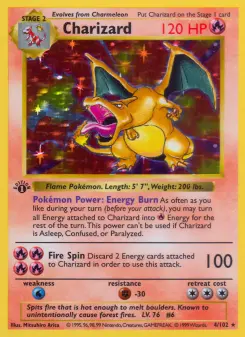
Base Set Charizard is on that list. Raw, it asks $919.98 and its 25 most recent verified raw sales have a median of $515.00. Both numbers are honest. One is a request and one is a receipt, and the distance between them is 44% of the request. This is the same structural gap The Ask Is Lying to You found by comparing a PSA 9 sold median against a raw ask; that study compared two different assets, and this one compares the same card in the same condition on two venues, which is why both exist.
Is this ratio a fact or a reading?
We hold the same pair on two dates. Of the 1,003 products present on both September 18 and September 21, 2026, the sold-over-ask ratio held within 10% across both readings on 970 of them, which is 96.7%. Held within 10% means neither reading exceeds the other by more than a tenth, which is the strict symmetric form of that test. So the ratio is a property of the card rather than a feature of the day we looked, at least across three days. That is a short test and it is the only one available: this table started accreting on September 7, 2026 and has three recorded days.
What would overturn this
The claim is that the sold-over-ask ratio falls monotonically with price and converges on 1.0 from above once the ask passes about $100. A later reading in which the under-$5 band comes in below 2x, or in which the $500-plus band comes in above 1.6x, breaks it. A rebuilt comp filter that removes multi-card lots and leaves the under-$25 bands unchanged would confirm the floor explanation; one that collapses those bands toward 1.0x would show the gap was our instrument rather than the market, and we would retract the lower half of the table.
What this study cannot show
It cannot tell you whether an eBay sold price includes shipping, and if it systematically does, the low bands are overstated by a few dollars on every row. It cannot see condition: the ask is a near-mint quote and the sold comps are whatever condition the seller had, so part of the gap in both directions is condition mix, which our condition tax study prices separately. The sold comp pool is capped at 25 listings, so no card here has more than 25 comps and the deep tail is invisible. A recorded comp count of zero means the count was not recorded on that row, never that no sales exist. And 1,065 products is not the catalog: coverage is the set of cards our enrichment cron happened to have cached, which skews toward cards people look at.
Sources: `ebay_divergence` (card, UTC day, eBay raw sold median, recorded comp count, quoted market price) on day 20717 (September 21, 2026), and `price_history` (product, day, price, cheapest listing) on day 20718 for the ask-versus-floor cross-check. The eBay median is the 10%-trimmed median of up to 25 recent eBay sold listings for that product, each rejected if its title matches any grader pattern and each required to match the card's name, set, number and printing; the field the comp count reads is the length of that kept list, so its maximum is 25 and a zero means the list was not stored on that row rather than that no sales occurred. The quoted ask is the canonical market price our card pages print for that card on the same reading. The table is keyed on the catalog row and 1,212 marketplace product ids are claimed by two catalog rows each, so every count here is deduped to one row per product, keeping the row with the deepest comp pool: 1,108 usable rows collapse to 1,065 products. The headline population is the 440 of those 1,065 carrying at least five recorded comps; the five-comp gate is an exclusion and the unrestricted 1,065-product figures are printed beside it so the gate can be judged (median 1.60x unrestricted against 1.39x gated, 25.2% inverted in both). Bands are cut on the ask. Medians and percentiles use the upper-middle nearest-rank convention: the value at index floor(p x n) of the ascending sample, which puts the median at the upper middle on even samples. The named ask-over-sold table is the head of a single ranking of every product with at least ten verified raw comps, 287 of them, ordered by sold over ask ascending, printed ranks one to ten with none skipped. Every left-hand figure in this study is an ASK and every right-hand figure is a SOLD median. Not financial advice.