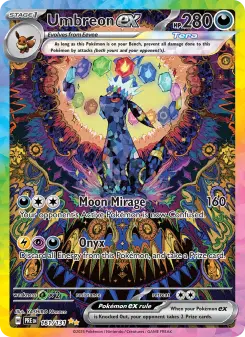

Umbreon ex (Prismatic Evolutions) carries a Near Mint quote of $1,301.12, TCGplayer, read 10 October 2026. It is a Stage 1. Of the 6,370 Stage 1 cards we hold a Near Mint price for it is the second dearest, behind Houndoom (Aquapolis) at $1,571.99. The slot it sits in is stranger than the card. Prismatic Evolutions has 26 Special Illustration Rares with a Near Mint quote and all 26 are the same Holofoil printing, so the comparison is like for like: the 11 Stage 1 cards there run a median of $257.53 and the 14 Basics run $29.29. The middle rung is 8.8 times the first. That is not evolution doing the work. Eight of those 11 Stage 1 cards are Eeveelutions, and the three that are not sit at $97.96, $45.22 and $39.71, all three below the two dearest Basics in the slot.
Widen out and the received wisdom looks fine for one paragraph. Across the 21,405 cards that carry a printed Stage value of Basic, Stage 1 or Stage 2 and a Near Mint quote above zero, the Stage 2 median is $4.26, the Basic median is $1.10 and the Stage 1 median is $0.88. Stage 2 is 3.9 times Basic. It is also an accounting result rather than a market one. The Species Premium ranked creatures inside their own set and rarity cohort and found the name worth real money, which is why the Prismatic slot reads the way it does, but it could not say whether the evolution rung carries anything of its own once you do the same thing to the rung. It does not. Standardise the rarity mix and 3.9x becomes 1.3x. Pair the rungs inside one set and one rarity, five or more cards at each rung, and it becomes 1.1x across 107 cells, or 1.0x across the 92 of those that sit in a main expansion outside the Promo rarity. Neither reading is a premium.
Where the 3.9x comes from
Sets do not spread their evolution rungs evenly across the rarity slots, and they never have. Of the 12,570 Basic cards here, 5,555 are Common, which is 44.2%. Of the 2,465 Stage 2 cards, eight are Common, which is 0.3%. Five of those eight sit in 30th Celebration and three in Kalos Starter Set, where Greninja (Kalos Starter Set) is quoted at $5.54. Take Common and Uncommon together and you cover 52.4% of the Basic rows, 45.1% of Stage 1 and 6.0% of Stage 2. A pooled median across those three groups is not comparing evolution rungs. It is comparing a bulk bin against a hit list.
How much of each rung is printed at the cheap rarities
Hold the rarity slot and most of the gap goes. Among Common cards the three rungs read $0.28 for Basic, $0.22 for Stage 1 and $0.20 for Stage 2, though that last figure rests on eight cards and should be read as a count rather than a price. Among Uncommons it is $0.46, $0.33 and $0.20. Among plain Rares, $1.00, $0.68 and $1.04. Reweight all three rungs onto a single rarity mix, using the rarity distribution of the full 21,405 rows as the weights and dropping any cell with fewer than five cards, and the three medians land at $4.77 for Basic, $3.63 for Stage 1 and $6.38 for Stage 2. That is 1.3x, and the weights cover 99.3% to 99.8% of each rung.
The three rungs inside one rarity slot at a time
| Rarity | Basic | Stage 1 | Stage 2 | Stage 2 vs Basic |
|---|---|---|---|---|
| Common | $0.28 (5,555) | $0.22 (533) | $0.20 (8) | 0.71x |
| Uncommon | $0.46 (1,032) | $0.33 (2,337) | $0.20 (141) | 0.43x |
| Rare | $1.00 (1,056) | $0.68 (1,463) | $1.04 (779) | 1.0x |
| Holo Rare | $7.34 (614) | $11.23 (544) | $8.91 (635) | 1.2x |
| Promo | $10.31 (1,793) | $8.47 (645) | $9.93 (404) | 0.96x |
| Ultra Rare | $7.66 (1,315) | $4.68 (247) | $17.38 (174) | 2.3x |
| Illustration Rare | $11.63 (276) | $8.76 (181) | $10.88 (54) | 0.94x |
| Double Rare | $1.02 (231) | $0.83 (156) | $1.26 (123) | 1.2x |
| Secret Rare | $84.99 (142) | $25.01 (49) | $121.14 (42) | 1.4x |
Hold the set as well and the premium is gone
Ultra Rare is the one row in that table that still looks like a stage effect, at 2.3x, and it is the row most worth distrusting: 1,236 of the 1,315 Basic Ultra Rares carry a V, GX or ex in the name, 94.0%, and cards like that are Basic by rule, while the 174 Stage 2 Ultra Rares are a thinner and somewhat older selection, at a median group year of 2018 against 2020 for the Basics. Pair that one rarity by set instead, three or more cards at both rungs, and the 25 sets that qualify read 0.91x with Stage 2 dearer in 12. A rung and a rarity still travel together across 211 different release groups, so the next cut pairs them inside one set and one rarity at a time: take each cell's median at each rung, divide, then take the median of the cell ratios. With two or more cards at both rungs, 335 cells qualify and the Stage 2 ratio is 1.0x. With five or more, 107 cells qualify, the ratio is 1.1x and Stage 2 is the dearer rung in 55 of them, 51.4%. Cut to main expansions only and drop the Promo rarity, still five or more at both rungs, and 92 cells give 1.0x with Stage 2 dearer in 43, Basic dearer in 45 and four cells level to the cent. Both of those are coin flips, and they are the answer to the question in the title.
Push it further and ask for all three rungs in the same cell, four cards or more at each, inside a main expansion and outside the Promo rarity. That leaves 114 cells. Their median Stage 2 ratio is 0.98x, Stage 2 beats the Basics in 53 of the 114 and is the dearest of the three rungs in 43, and Stage 1 comes in under the Basics in 67. Ten of them are below, and they include the highest and the lowest Stage 2 ratio of the 114, which is where the honesty lives.
Ten of the 114 cells that hold all three rungs
| Set and rarity | Basic | Stage 1 | Stage 2 | Stage 2 vs Basic |
|---|---|---|---|---|
| Deck Exclusives, Rare | $0.56 (88) | $0.91 (94) | $1.32 (110) | 2.4x |
| World Championship Decks, Rare | $4.80 (97) | $2.19 (47) | $4.92 (40) | 1.0x |
| Prize Pack Series Cards, Rare | $0.42 (75) | $0.35 (58) | $0.54 (39) | 1.3x |
| Deck Exclusives, Holo Rare | $7.27 (48) | $8.15 (31) | $9.68 (47) | 1.3x |
| Paldean Fates, Shiny Rare | $5.02 (67) | $4.53 (43) | $4.52 (10) | 0.90x |
| Ascended Heroes, Rare | $0.27 (39) | $0.27 (21) | $0.24 (15) | 0.89x |
| 30th Celebration, Common | $0.18 (41) | $0.18 (18) | $0.16 (5) | 0.89x |
| Hidden Fates Shiny Vault, Shiny Holo Rare | $9.42 (50) | $16.48 (28) | $84.23 (6) | 8.9x |
| Aquapolis, Holo Rare | $539.99 (4) | $173.90 (19) | $139.99 (7) | 0.26x |
| Unseen Forces, Ultra Rare | $1,067.00 (5) | $240.00 (5) | $239.99 (5) | 0.22x |
The Hidden Fates Shiny Vault cell reads 8.9x off six Stage 2 cards, and the Unseen Forces Ultra Rare cell reads 0.22x off five Basics, three of which are Gold Stars and one of which is a $2,500.00 Lugia ex (Unseen Forces). Neither is a finding. They are what a 114-cell distribution looks like when you pick its tails, which is why the number we publish is the median of the 114 and not a card from either end.
One result holds in every paired cut of the whole population, and it runs the other way. Paired inside set and rarity with two or more cards at both rungs, 534 cells give a Stage 1 ratio of 0.86x against Basic. At three or more, 436 cells, 0.86x. At five or more, 287 cells, 0.85x. Of those 287, Basic is the dearer rung in 190 and Stage 1 in 88, with 9 cells level to the cent, so the Basic share is 66.2%. Pooled rather than paired, the direction is not safe: the Holo Rare row of the nine-rarity table above puts Stage 1 at $11.23 against $7.34 for Basic. Those two pooled samples are not drawn from the same sets, and pairing by set inside that one rarity turns the row back over: across the 59 sets with three or more cards at both rungs it reads 0.92x, with Basic dearer in 32, and across the 19 sets with five or more it reads 0.98x, with Basic dearer in 10 of 19. Run the same test inside each of the nine provider rarities, on set counts from 5 for Secret Rare to 115 for Uncommon, and Stage 1 is the cheaper rung in seven of them. The two that do not follow are flat rather than reversed: across 45 Common sets the ratio is 1.03x, with Stage 1 dearer in 23 of them, and across 22 Double Rare sets it is 1.02x. So the discount is real, and it is not universal. Same set, same rarity slot, and the first evolution usually goes for about fifteen cents on the dollar less than the thing it evolves from.
The likeliest reason is boring: a Stage 1 is the card nobody builds a deck or a binder page around, and it is rarely the art the set is sold on. It is still only the cheapest of the three Pokemon evolution rungs, and not the cheapest thing in the game. The provider prints the same Stage attribute on trainer cards, and sorted by median Near Mint price, Trainer at $0.46 across 63 cards, Item at $0.47 across 77, Supporter at $0.53 across 80, Stadium at $0.54 across 26 and Tool at $0.56 across 36 all sit below Stage 1's $0.88. Of the 19 printed Stage values with 15 or more priced cards, the cheapest is Trainer, by a cent. The ladder below is that attribute unfolded, 31 spellings across 22,522 priced products with nothing merged, which is why Level Up and Level-Up sit on separate lines. The 12 spellings left out hold 13 cards or fewer each, down to one product filed as bASIC at $0.14. A one-card spelling is not a price tier.
Every printed Stage value with 15 or more priced cards
| Printed Stage value | Cards | Median Near Mint |
|---|---|---|
| Legend | 22 | $233.50 |
| Level Up | 65 | $97.50 |
| Level-Up | 29 | $80.00 |
| Mega | 85 | $42.21 |
| VMAX | 278 | $7.77 |
| Energy | 43 | $6.81 |
| VSTAR | 135 | $6.52 |
| BREAK Evolution | 39 | $6.13 |
| V-UNION | 25 | $5.95 |
| Stage 2 | 2,465 | $4.26 |
| Special Energy | 34 | $1.60 |
| Basic | 12,570 | $1.10 |
| Restored | 15 | $0.97 |
| Stage 1 | 6,370 | $0.88 |
| Tool | 36 | $0.56 |
| Stadium | 26 | $0.54 |
| Supporter | 80 | $0.53 |
| Item | 77 | $0.47 |
| Trainer | 63 | $0.46 |
The eras disagree, and that is the tell
The Stage 2 premium, pooled and with rarity held constant
The pooled line swings from 1.00x to 13.70x and back. Nothing about the evolution rung changed over the 27 years those buckets cover at anything like that speed. What changed is which rarity slots each era handed to each rung, and the pooled line is reading that. The Holo Rare line, which asks the same question of one rarity slot, sits between 0.66x and 1.01x in the first five buckets. Its last point, 3.41x, is the thin one flagged under the chart, and the only Holo Rare point outside that band. The vintage end inverts the headline outright. Among the 330 Holo Rares in sets published between 1999 and 2003, Basic is the dearest rung: $159.00 across 78 cards, against $146.83 across 117 Stage 2 cards and $124.99 across 135 Stage 1 cards. Of the 16 vintage sets whose Holo Rare slot holds both rungs, Aquapolis is the lowest at 0.26x, with four Basic Holo Rares at a $539.99 median against seven Stage 2 at $139.99; Neo Revelation is next at 0.41x. Four cards is four cards, so read the Aquapolis cell as an illustration and not a measurement. Anyone whose instinct about this came from the Base Set holos will find the vintage Holo Rare result uncomfortable. It is one rarity slot and not the era, though: the vintage plain Rare slot is nearly as deep, at 75 Basic, 150 Stage 1 and 86 Stage 2 rows, and it runs the other way at 1.21x.
The shape of each rung, not its middle
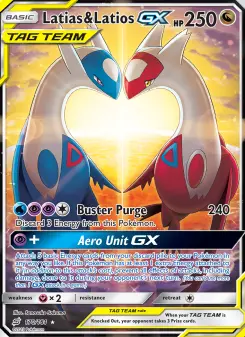
So the rungs are not identical, they are just not different in the way people think. A Stage 2 card is much less likely to be worthless: 30.8% of them are quoted under a dollar against 48.7% of Basics, and 10.3% clear $100 against 4.7%. That is the rarity mix again, seen from the other side. If almost none of the Stage 2 print run goes into the Common slot, almost none of it can be bulk. The tops of the three rungs then go the other way. The dearest row with a card page in the whole population is Latias & Latios GX (Team Up), a Basic, at $4,499.66; the dearest Stage 2 with a card page is Charizard (Base Set (Shadowless)) at $2,146.38, quoted 29 September 2026; and only two Stage 2 rows anywhere beat the dearest Stage 1, the $1,571.99 Aquapolis Houndoom from the top of this piece. Two rows sit above every clickable row at their own rung and cannot be linked at all, because they have no catalog row and no card page: a Mew filed as R/RGB in the 30th Celebration group at $6,000.27, which is the dearest Basic in this population, and a prerelease staff Gengar in the Sword & Shield promo group at $2,199.99, which is the dearest Stage 2. The Gengar is a staff handout rather than a printing anyone could pull, which is a second reason not to lead with it.
Three things constrain all of this. Every price here is a Near Mint quote and nothing else: the LP, MP, HP and Damaged rungs of the same table were not touched, so no condition mixing enters. Printing is not held constant in the pooled figures, and it is not neutral between rungs, because 67.0% of Stage 2 quotes are a holofoil printing against 40.9% of Basic and 36.0% of Stage 1. Hold it anyway and the story does not change: on Holofoil rows only, Basic is $6.60 across 4,738 cards, Stage 2 is $6.46 across 1,530 and Stage 1 is $4.53 across 2,044. We never used the provider's own price series, which mixes printings card by card and is the fault The $479 Lie was written about.
None of these medians is reproducible to the cent, and we would rather say so than imply a precision we do not have. The quote table is upserted continuously, so the population keeps moving under its own figures: the subset quoted in the seven days to 12 October 2026, which is 20,432 of the 21,405 rows, reads $1.01 for Basic, $0.81 for Stage 1 and $3.72 for Stage 2 against the full population's $1.10, $0.88 and $4.26. The quote dates span 2025-07-21 to 2026-10-11 across 132 distinct provider dates, with 95.5% of rows inside the last week. That is why every ratio in this note is printed to two significant figures, and why a reader who recomputes it next month should expect the third digit to have moved and the finding not to have. The coverage is partial in two directions and neither gap is a zero. Of 32,868 TCGplayer products we hold, 10,133 ship without a Stage attribute at all, which is where trainers, energy and sealed products live, and 213 of the 22,735 that do carry one have no Near Mint quote, so they are absent rather than priced at nothing. Inside the three rungs, 353 of the 21,405 rows have no catalog row and therefore no card page, which is why the dearest Basic and Stage 2 cards named above are the dearest clickable ones rather than the dearest full stop. Every row that does resolve resolves to an English card, zero to Japanese, so the set-name fold that double-counts 1,211 catalog ids across Japanese and English spellings cannot reach these figures.
Tables: tcgcsv_products for identity and rarity, tcgcsv_groups for the release year, condition_quotes for price, cards for the catalog join and the card page link. The Stage value is parsed out of the raw extendedData JSON in tcgcsv_products.extended, exact key 'Stage', with no case or spelling folding, which leaves 31 distinct spellings across 22,735 of 32,868 products; the other 10,133 products carry no Stage attribute and are excluded. Price is condition_quotes where condition = 'NM' and price > 0, one row per product: 22,522 of the 22,735 qualify and 213 are excluded for having no Near Mint quote, with no price at or below zero found. The three Pokemon evolution rungs are 21,405 of those, Basic 12,570, Stage 1 6,370 and Stage 2 2,465; the remaining 1,117 rows sit in 28 other Stage spellings. Rarity throughout is tcgcsv_products.rarity, the provider's product rarity, which can differ from the rarity shown on a card page; Greninja in Kalos Starter Set is Common on the provider and blank on the catalog row, for example. Quote dates run 2025-07-21 to 2026-10-11 across 132 distinct dates with no nulls, and 20,432 rows were quoted in the seven days to 2026-10-12. Medians are the upper middle value on an even sample. A paired cell is one TCGplayer group plus one provider rarity; a cell ratio is one rung's cell median divided by another's, and the published figure is the median of the cell ratios, never a ratio of pooled medians. A rung is counted dearer in a cell only when its median is strictly higher to the cent; cells whose two medians are equal to the cent are reported as level and counted on neither side, which is why the three counts at five or more sum to 287. Where one rarity is paired on its own, the cut is three or more cards at both rungs inside each set, and the set count is printed with the ratio. The rarity-standardised figures weight each rung's per-rarity medians by the rarity distribution of all 21,405 rows, dropping cells with fewer than 5 cards, which retains 99.3% to 99.8% of the weight. Release-year buckets use the TCGplayer group's published date; no row lacks one. Of the 21,405 rows, 21,052 join an English catalog row, 353 join none and zero join a Japanese one. Every figure above is printed by scripts/pokemon-evolution-stage-value-figures.mts in one run.