
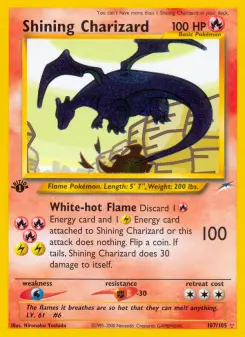
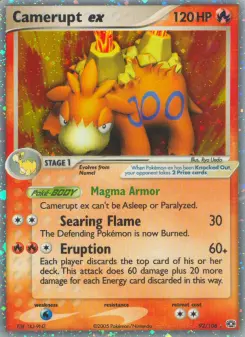
Everyone in this hobby believes the creature on the card is worth something. Nobody has put a number on it, because the obvious comparison is rigged: Charizard cards are expensive partly because Charizard gets the secret rare slot and the common Rattata does not. So we took the set and the printed rarity away. For every English card we price, we compared its ask to the median ask of every OTHER card printed in the same set at the same rarity. That ratio is what the name is worth. Across the 302 species with twenty or more printings inside such a cohort, the middle species sits at 1.09x, a hundred and twenty sit below parity, and the highest ranked creature is not the one on the box.
The method, in one sentence
A card's cohort is every other English card in the same set at the same printed rarity, and its ratio is its ask divided by that cohort's median ask. Set controls for era, print run and hype. Rarity controls for the slot the card was given. What is left is the name. 20,246 of the 21,422 priced English products sit in a cohort with ten or more other members, and 1,176 do not and are dropped. Because every card is measured against a cohort it is excluded from, the median ratio over the whole population is exactly 1.0000. That is arithmetic, not a result, and it is printed here only so a recompute can confirm the frame is level.
The twelve highest species premiums, median ask against the same set and rarity
The top twenty, in order
Ranks are contiguous and the selection rule is mechanical: every species with twenty or more printings inside a cohort, sorted by its median ratio, ties broken on the species key ascending. The share column counts how many of that species' printings ask more than their own cohort median, which is a cleaner test of consistency than the median itself.
Species by median cohort premium, ranks 1 to 20 of 302
| Rank | Species | Printings | Sets | Premium | Middle half | Above cohort | Median ask |
|---|---|---|---|---|---|---|---|
| 1 | Ditto | 26 | 16 | 11.78x | 3.27x to 30.94x | 24 of 26 | $54.13 |
| 2 | Gengar | 43 | 32 | 11.31x | 7.18x to 24.21x | 42 of 43 | $54.45 |
| 3 | Charizard | 83 | 47 | 8.96x | 3.68x to 16.24x | 79 of 83 | $52.49 |
| 4 | Umbreon | 41 | 26 | 8.19x | 5.00x to 12.76x | 41 of 41 | $73.03 |
| 5 | Mew | 40 | 29 | 7.63x | 3.67x to 16.22x | 38 of 40 | $101.69 |
| 6 | Squirtle | 30 | 25 | 6.66x | 3.02x to 11.64x | 30 of 30 | $4.86 |
| 7 | Snorlax | 53 | 44 | 6.55x | 3.30x to 10.82x | 53 of 53 | $17.33 |
| 8 | Psyduck | 34 | 29 | 6.23x | 1.94x to 17.16x | 33 of 34 | $9.84 |
| 9 | Dragonite | 45 | 30 | 6.12x | 2.06x to 9.25x | 41 of 45 | $36.45 |
| 10 | Lugia | 36 | 25 | 5.90x | 2.57x to 13.03x | 32 of 36 | $43.51 |
| 11 | Rayquaza | 52 | 29 | 5.89x | 2.60x to 11.80x | 52 of 52 | $75.91 |
| 12 | Bulbasaur | 28 | 23 | 5.51x | 2.16x to 9.83x | 27 of 28 | $8.42 |
| 13 | Sylveon | 31 | 17 | 4.82x | 2.06x to 13.45x | 31 of 31 | $23.94 |
| 14 | Pikachu | 187 | 84 | 4.68x | 2.07x to 12.01x | 166 of 187 | $12.86 |
| 15 | Arceus | 26 | 8 | 4.54x | 2.48x to 6.53x | 24 of 26 | $36.66 |
| 16 | Giratina | 21 | 14 | 4.15x | 2.62x to 10.26x | 18 of 21 | $25.52 |
| 17 | Mimikyu | 30 | 19 | 3.86x | 2.00x to 8.78x | 29 of 30 | $14.68 |
| 18 | Eevee | 85 | 53 | 3.86x | 2.05x to 7.35x | 84 of 85 | $4.92 |
| 19 | Espeon | 35 | 24 | 3.68x | 1.96x to 7.51x | 33 of 35 | $27.16 |
| 20 | Greninja | 29 | 16 | 3.56x | 1.78x to 6.31x | 25 of 29 | $14.67 |
Why Ditto is first and why that is a warning
Ditto tops the straight ranking and should not be read as the answer. Ten of its 26 qualifying printings come from a single set, the EX Delta Species run, which printed Ditto four times as a common and six times as an uncommon. Those ten sit between 19.87x and 62.43x against cohort medians of $1.26 and $2.53, and they carry the species on their own. The set is the subject of the delta species run, and it is the exact shape our own ledger warns about: a ranking that is really a story about one print run.
So the same table is rebuilt with each species' sets weighted equally: take the median ratio inside each set the species appears in, then the median across sets. That removes set concentration entirely. On that convention Ditto falls from first to sixteenth at 5.03x and Gengar and Charizard take first and second. Inside the twelve printed below, the largest moves are Pikachu, from fourteenth to eighth, and Rayquaza, from eleventh to fifth. Outside it, the largest move anywhere in the straight top twenty is Arceus, which falls from fifteenth to thirty-eighth because nine of its 26 printings come from the set that shares its name. Further down the list the moves run larger still, because a species carried by two or three sets is a set story on either convention: Necrozma rises 89 places and Butterfree falls 58.
Set-balanced ranking, median of each species' per-set medians, ranks 1 to 12
| Rank | Species | Sets | Set-balanced premium | Rank on the straight median |
|---|---|---|---|---|
| 1 | Gengar | 32 | 14.68x | 2 |
| 2 | Charizard | 47 | 11.85x | 3 |
| 3 | Umbreon | 26 | 8.71x | 4 |
| 4 | Squirtle | 25 | 8.43x | 6 |
| 5 | Rayquaza | 29 | 7.86x | 11 |
| 6 | Mew | 29 | 7.63x | 5 |
| 7 | Dragonite | 30 | 7.59x | 9 |
| 8 | Pikachu | 84 | 7.09x | 14 |
| 9 | Snorlax | 44 | 6.55x | 7 |
| 10 | Lugia | 25 | 6.28x | 10 |
| 11 | Psyduck | 29 | 6.28x | 8 |
| 12 | Bulbasaur | 23 | 5.62x | 12 |
Gengar finishes ahead of Charizard on both conventions, and that is the citable finding. It is not a claim that a Gengar costs more than a Charizard: the median Charizard printing asks $52.49 and the median Gengar $54.45. It is a claim about the gap to the neighbours. Put a Gengar in a set and it out-asks the cards printed around it by more than Charizard does, in 42 of its 43 printings, from Fossil through Phantom Forces and Fusion Strike to the Mega Evolution era sets Ascended Heroes and Perfect Order.
Three ways this could be wrong
The first objection is that this is a vintage artefact, because WotC-era chase holos are scarce and everything around them is a common. Read the bar before the numbers: these rebuilds run on populations a tenth the size, so they report a species at TEN printings rather than twenty, and at the published twenty the WotC rebuild would have exactly one reportable species. Rebuilt on WotC cards alone, cohorts and all, 19 species clear ten printings, Charizard leads at 8.55x and Pikachu follows at 6.74x, so the effect is there. Rebuilt on the current eras alone, Scarlet & Violet plus Sword & Shield plus Mega Evolution, 170 species clear it, Gengar leads at 10.15x and Charizard follows at 8.18x. The ranking is not an old-cardboard effect; it is present in the three eras still on shelves.
The second objection is that the rarity label is too coarse, so a species premium is really a chase-slot premium hiding inside a rarity bucket. The test is to throw away every card that could be a chase card. On commons and uncommons alone, 10,881 products and 355 species at the same ten-printing bar, Ditto leads at 30.97x, Squirtle at 8.55x, Pikachu at 8.16x and Bulbasaur at 6.77x. Charizard carries only three printings at those two tiers and does not clear the bar. The premium survives in the part of the catalog where nobody is chasing anything.
The third objection is that one card carries each species. Drop every species' single dearest printing and recompute: Ditto 11.78x, Gengar 11.31x, Charizard 8.96x, Umbreon 8.19x, Mew 7.33x. The top four do not move at all, because a median over forty-odd printings does not care what the maximum was.
The same ranking under four rebuilds, top five of each; the last three report a species at ten printings, not twenty
| Rebuild | 1st | 2nd | 3rd | 4th | 5th |
|---|---|---|---|---|---|
| As published, 302 species | Ditto 11.78x | Gengar 11.31x | Charizard 8.96x | Umbreon 8.19x | Mew 7.63x |
| Set-balanced, 302 species | Gengar 14.68x | Charizard 11.85x | Umbreon 8.71x | Squirtle 8.43x | Rayquaza 7.86x |
| WotC cards only, 19 species at 10+ printings | Charizard 8.55x | Pikachu 6.74x | Mewtwo 4.04x | Haunter 2.59x | Growlithe 2.56x |
| SV, SWSH and Mega only, 170 species at 10+ | Gengar 10.15x | Charizard 8.18x | Mew 7.90x | Umbreon 6.70x | Lugia 5.56x |
| Commons and uncommons only, 355 species at 10+ | Ditto 30.97x | Squirtle 8.55x | Pikachu 8.16x | Bulbasaur 6.77x | Psyduck 6.28x |
The bottom of the list
A species below parity is one the market discounts against its own neighbours. These are not obscure creatures: they are the ones that got printed a lot in sets nobody is collecting, which is a different thing from being rare or bad.
Species by median cohort premium, ranks 293 to 302 of 302
| Rank | Species | Printings | Premium | Above cohort | Median ask |
|---|---|---|---|---|---|
| 293 | Lanturn | 25 | 0.56x | 5 of 25 | $1.04 |
| 294 | Malamar | 21 | 0.55x | 4 of 21 | $0.49 |
| 295 | Shiftry | 23 | 0.54x | 3 of 23 | $1.48 |
| 296 | Heatran | 24 | 0.52x | 2 of 24 | $1.82 |
| 297 | Bronzong | 29 | 0.50x | 5 of 29 | $0.41 |
| 298 | Toxicroak | 21 | 0.49x | 3 of 21 | $0.44 |
| 299 | Forretress | 21 | 0.48x | 2 of 21 | $1.34 |
| 300 | Bronzor | 23 | 0.47x | 2 of 23 | $0.14 |
| 301 | Claydol | 22 | 0.45x | 4 of 22 | $0.63 |
| 302 | Camerupt | 26 | 0.44x | 4 of 26 | $1.20 |
What this study cannot show
Raw prices here are ASKS from the daily tape, not sold prices. A species whose cards list optimistically and sell rarely will read high, and nothing in this construction can separate an ask nobody pays from a price the market clears. The ask is lying to you measures how wide that gap runs in general. The twenty-printing bar excludes most of the dex: 302 species are reported out of the 1,025 our table holds, and a species with nineteen printings is absent rather than average. The ten-other-cards cohort bar drops 1,176 products, and they are not where you would guess: 707 of them come from sets holding more than a hundred priced English products, because a thin modern rarity tier can hold fewer than eleven cards inside a large set. Shrouded Fable loses 36, Black Bolt and White Flare 33 each and Paldean Fates 32, while only 19 of the 1,176 come from a trainer kit.
A cohort is a set and a rarity string, and rarity strings are not evenly grained. Twenty-one distinct rarity values appear in the population, one of which is the absence of a rarity, carried by 119 products and forming its own per-set cohort. A card whose set uses one broad label for everything gets a noisier ratio than a card in a set with a fine ladder. This is why the commons-and-uncommons rebuild matters: it is the one cut where the rarity label means the same thing everywhere.
The 129 English products that name two or more species, the tag teams and the LEGEND halves, are excluded rather than split, so a Reshiram & Charizard GX counts for neither. And this is a single-day cross-section. It says what the market pays for a name today, not whether that has changed.
What would overturn this
The central claim is the ordering at the top: Gengar above Charizard on both the straight and the set-balanced convention. A recompute on the same day's tape that put Charizard above Gengar on either convention would overturn it. The secondary claim is that the species factor is large relative to the illustrator factor measured the same way. A recompute returning a species spread inside the 0.81x to 1.23x band the illustrator study found would kill the whole piece. Related work on the same tape: how many printings does a Pokemon card have, the Pokemon card rarity chart by value, and the price-level view of one species in how much is a Charizard card worth.
Sources: the `cards` catalog and the daily `price_history` tape, read on day 20718, September 22 2026. 63,600 catalog rows; 11,881 carry no TCGplayer product id and cannot be priced; the remaining rows collapse to 50,507 products after deduplicating the 1,212 product ids that two catalog rows each claim. 21,422 English products carry an ask. Prices are ASKS, the most recent daily market figure for the product, and 52,309 of the 52,656 priced products across both languages were written on day 20718 itself, so the evaluation day is complete rather than stitched. Cohort: every other English priced product in the same `set_name` at the same `rarity` label, with a null rarity forming its own per-set cohort; a product needs ten other members to receive a ratio, which admits 20,246 products in 604 cohorts and drops 1,176. The ratio is the product's ask divided by the leave-one-out median of its cohort, so the population median ratio is 1.0000 by construction. Species: the 1,025 names in our `pokemon_indices` table, with both the dex name and the card name folded to one canonical key (NFD, accents stripped, the gender signs folded to f and m, apostrophes, periods and colons deleted, other non-alphanumeric runs collapsed to a single separator), parenthetical catalog annotations removed first, and the longest key consumed first. 17,852 English priced products name exactly one species, 3,441 name none (trainers, energy, items and stadiums) and 129 name two or more and are excluded. A species is reported at twenty or more printings inside a cohort, which gives 302. The median ask column in every table here is taken over a species' MEASURED printings rather than over every priced printing it has, which is why Eevee reads $4.92 in this study and $4.98 in every Eeveelution ranked, where the same column is defined over all priced printings. Medians are upper-middle on even samples, quartiles are nearest-rank, and ties in every ranking break on the species key ascending. The set-balanced ranking covers the same 302 species at the same twenty-printing bar, and so does the drop-the-dearest-printing check. The other three rebuilds apply the identical construction to a filtered population and rebuild the cohorts inside it rather than reusing the full-population ratios, but they report a species at TEN printings rather than twenty, and that single changed parameter is what produces the 19, 170 and 355 species counts beside them. At the published twenty-printing bar those three rebuilds report one species (Unown, 0.94x), eleven species (led by Charizard at 8.18x, with Gengar short of the bar) and 94 species (led by Squirtle at 8.55x, with Ditto short of it); the figures printed above are the ten-printing versions and are labelled as such. Not financial advice.