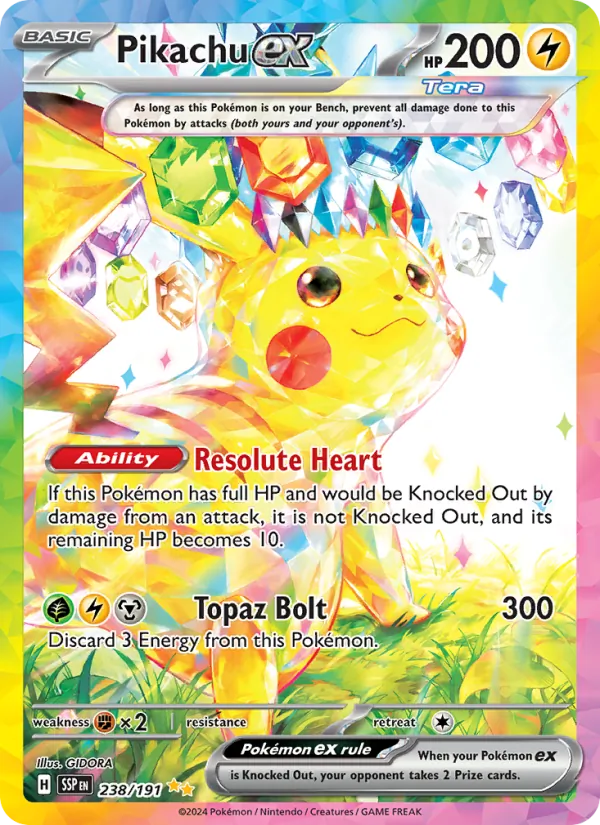
Anyone with a raw Pikachu ex 238/191 in a Surging Sparks binder watched it lose $39.02 over the last 30 days, sliding from $256.63 to $217.61 by the TCGplayer market price, which is a real chunk of money to lose on one card that never left its sleeve, and I spent the morning working out whether that should change what they do with it.
Pikachu ex 238/191
- October 26
- $256.63
- November 24
- $217.61
- Move
- -15.2%
Mostly, it shouldn't. The drop came as a slow drip rather than one bad day, since no single day carried more than 15% of it, and the price PSA 10 copies sell for, $780.50, is the number that does the heavy lifting here. Of the 32,540 that have gone through PSA, 35.3% came back as a 10. A 9 still fetches $249.00, which is more than the raw card is worth today. Put a raw copy through those odds, pay the grading fee and eBay's cut, and the average outcome lands at $288.36. Selling it raw on the same terms nets $188.38. That gap is $99.98, and it's computed the stingy way, with any copy that misses a 9 written off at zero. The postage to send it off is left out of that sum, the grading fee isn't, and I'd still call it the most comfortable grading call in the set by a distance.
Each card's price, against where it started
A set that sagged at the top
You'd expect a falling card to make grading look worse, and in Surging Sparks the falling was everywhere above the $20 line. All 12 of those cards ended the window cheaper, with the typical one off 13.9%. The cheap end went the other way. Down among the 193 sub-$1 cards, the typical move was up 8.3%, which is lovely news if your binder is full of commons and no help at all if it's full of special illustration rares. The top of the set is also where the money sits, since the five priciest cards hold 56.7% of what it costs to buy one of everything, so when they sag the whole set follows, from $1,095.25 on October 26 to $985.63 a month later.
Most money lost per card
- 1Pikachu ex 238/191$256.63 to $217.61slid steadily; no single day carried more than 15% of the move-15.2%
- 2
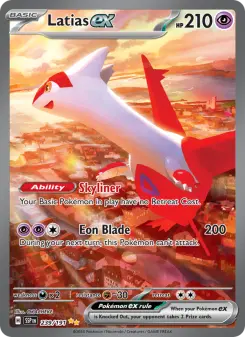 Latias ex 239/191$171.68 to $155.62slid steadily; no single day carried more than 12% of the move-9.3%
- 3
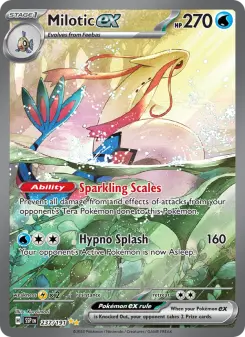 Milotic ex 237/191$104.49 to $92.14slid steadily; no single day carried more than 16% of the move-11.8%
- 4
 Durant ex 236/191$34.88 to $25.46slid steadily; no single day carried more than 17% of the move-27.0%
- 5
 Latios 203/191$30.95 to $23.71slid steadily; no single day carried more than 14% of the move-23.4%
Where grading works, it's mostly a Pikachu story. Of the 10 graded cards that carry an estimate, 4 come out ahead of selling raw. Pikachu ex 247/191 clears it by $28.13. Pikachu ex 219/191, a $21.41 card, scrapes through by $5.26, a margin I wouldn't lean on. The fourth, Latias ex 239/191, gave up $16.06 to finish at $155.62, and grading it beats selling raw by $15.01. Milotic ex 237/191 is the near miss: it slid to $92.14 and trails selling raw by $7.81, but 11.4% of its graded copies land below a 9 and get scored as nothing, so that gap is softer than it looks. Latios 203/191 is the strange one. Its PSA 10 sells for $240.00, 10.1x the raw price and the fattest multiple on our sheet, yet PSA has given a 10 to just 26.8% of the 28,308 it has graded, and that's enough to drag the whole bet $2.03 underwater.
So the slab case in Surging Sparks rests on Pikachu, and on the 238 above all. If I had one sitting raw, the $39.02 it lost this month wouldn't push me to sell it as is; it would push me to fill out a PSA form, because even a 9 is worth more than the raw card today and the 10 is worth a great deal more. The cards I'd leave alone are the cheaper ex cards with handsome 10 prices, the ones that look like easy money on a phone screen. Hydreigon ex 240/191 sells for $112.50 in a 10 and trails selling raw by $30.25, and Durant ex 236/191, down 27.0% on the month, trails by $29.15. Alolan Exeggutor ex 242/191 is the same story with a $109.50 slab. Those slab prices are real. They just don't pay for the trip, and the Pikachu does.
Population: Surging Sparks, 252 English cards with a TCGplayer market price on both October 26, 2026 and November 24, 2026. Every move compares a card to itself on the same TCGplayer product, first day against last, before anything is ranked or summed; a set total is never compared across days. Prices are TCGplayer market prices for the flagship printing, read from our daily price file. Graded figures are sold medians from our graded comps, PSA population counts come from our daily registry snapshot, and the expected value counts the PSA 9 outcome as well as the PSA 10, net of the grading fee and selling costs. The expected value sits beside the raw price less the same eBay selling fee, so the two compare like with like. It counts copies that grade below a 9 at nothing and leaves out shipping to PSA and back. Angle: whether grading pays: PSA 10 and PSA 9 sale prices against the raw card, the gem rate, and the expected value after fees.