
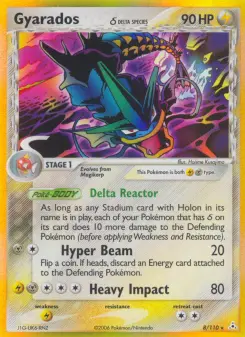
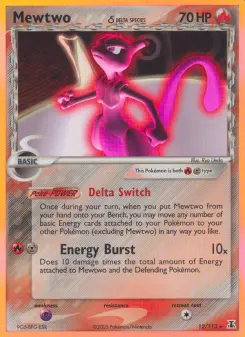
Between 2005 and 2007 the Pokémon TCG ran a mechanic where a card's type was simply wrong on purpose. A Gyarados that should be Water was Lightning. A Mewtwo that should be Psychic was Metal. The cards carried a small δ next to the name and nothing else marked them out. They were scattered across eight sets rather than gathered into one, which means the delta species run is a set that exists only if you go looking for it. We price 191 of them in English, every one of them, and as a group they average $95.71 against a catalogue where the median card is worth a couple of dollars.
Where they are
Every set holding English delta species cards, by average price
| Set | Delta cards | Average price |
|---|---|---|
| POP Series 4 | 3 | $276.41 |
| Legend Maker | 1 | $211.85 |
| Nintendo Black Star Promos | 1 | $194.80 |
| Crystal Guardians | 12 | $114.04 |
| Delta Species | 35 | $102.05 |
| Dragon Frontiers | 80 | $101.66 |
| Holon Phantoms | 51 | $70.38 |
| POP Series 5 | 8 | $47.70 |
Two sets hold 131 of the 191 between them, and the three most expensive rows by average are the ones holding one or three cards, which is what happens when a promo distribution meets a small sample. The interesting comparison is the pair that actually carry the run: Dragon Frontiers at 80 cards and $101.66, and Holon Phantoms at 51 cards and $70.38. Same mechanic, adjacent years, a 44% gap in average price.
Why a scattered run behaves like a set
Collectors chase completeness, and completeness needs a boundary. The delta run has one, it is just not printed on a box: the δ is either there or it is not, and there are exactly 191 English cards with it. That makes the run collectable in the way a set is collectable, while making it invisible to anyone browsing by set, which is most people. A run that is chased by the people who know about it and ignored by everyone else is the shape that produces prices well above the catalogue median without producing headlines.
It also means the run is priced inconsistently across its own sets, which a real set would not be. A Holon Phantoms delta and a Dragon Frontiers delta are the same mechanic, the same era and roughly the same scarcity, and one averages 44% more than the other. The cleanest reading is that Dragon Frontiers is where the gold stars live and Holon Phantoms is where the commons live, so the averages are measuring rarity mix rather than any premium on the mechanic itself.
The mechanic nearly broke our own data
This run is also the reason a bug sat in our language matching until this week, and it is worth telling because it is the same fact about the mechanic seen from the engineering side. Japanese prints spell it out in full, “Gyarados (Delta Species)”, where English prints use the δ. Our cross-language matcher stripped parentheticals before joining, so the Japanese key came out as plain “gyarados” and the English key kept its marker, and the two halves of the same card could never meet.
Worse than a miss: the Japanese card then matched the cards that really are plain Gyarados at 90 hit points, and offered a reader two Skyridge Gyarados and a Deoxys Gyarados as the English versions of a delta card. Folding the markers to one spelling gave 6,045 cards a counterpart they never had and narrowed 130 that had been matching the wrong thing. Gyarados δ and its Japanese print now resolve to each other and to nothing else, which is what made the language price study possible at all.
What to do with a run like this
Treat the boundary as the product. The reason this run holds a price is that it is finite, identifiable and awkward to assemble, and none of those depend on any one card being good. If you are buying into it, the sets to read are the two that carry it, because the promo rows are three cards averaging a number that means nothing. And if you are selling out of it, the δ is worth putting in the listing title, because a buyer searching for the mechanic will not find the card by its set.
Read from moonstone production on September 17, 2026. A delta species card is any English catalogue row whose name carries the δ marker; 191 such rows exist and all 191 carry a live price, so no selection on price was applied and no card was dropped. Prices are the canonical printing price the card pages publish, not the raw provider market field, read on the morning of September 17 and live enough to move by a dollar or two by the time you read this. Set averages are arithmetic means over the cards in that set and are therefore measuring the rarity mix of each set as much as anything about the mechanic: rows with one or three cards are reported because the run really is that scattered, not because a three-card average carries weight. The scarcity comparison between Dragon Frontiers and Holon Phantoms is an argument from the sets' contents and is not a measurement of print runs, which we do not hold. The Japanese side of the run is named “(Delta Species)” rather than marked with δ; the counterpart join that reconciles the two is described in the body and shipped on September 17, 2026.