Ask a collector whether Japanese cards are cheaper and you will get a confident yes. Ask a different collector and you will get a confident no. We can finally settle it, because we now hold both sides of the same card often enough to measure rather than assert. Take every card in our catalogue that exists as exactly one English printing and exactly one Japanese printing, joined on the card's own identity rather than on its name alone, and keep the ones where both sides carry a live price. That is 1,373 pairs. The Japanese copy is the dearer of the two in 832 of them, the cheaper in 533, and identical in 8. The median Japanese price is 1.39 times its English twin. So the confident no is winning, on the count. And the confident yes is right about every card anyone actually argues over.
The flip, band by band
Sort the same 1,373 pairs by what the English card costs and the aggregate dissolves into something much cleaner. This is not a noisy relationship with a trend through it. It is monotone across every band we can measure, in both the median ratio and the share of pairs pointing each way.
Japanese price as a multiple of its English twin, by what the English card costs
| English price | Pairs | Median Japanese / English | Japanese is dearer |
|---|---|---|---|
| Under $1 | 479 | 4.75x | 90% |
| $1 to $5 | 381 | 1.63x | 74% |
| $5 to $20 | 238 | 0.79x | 35% |
| $20 to $100 | 176 | 0.50x | 16% |
| Over $100 | 99 | 0.30x | 5% |
Read the two end rows against each other. A card the English market prices under a dollar is typically almost five times that in Japanese. A card the English market prices over $100 is typically less than a third of that in Japanese. The crossover sits inside the $5 to $20 band, where the median ratio is 0.79 and roughly a third of pairs still run the other way. Nothing in this table is close to flat, and nothing in it doubles back.
Why both camps are certain
The explanation is not mysterious once the table is in front of you, and it is mostly about shipping. A Japanese common is a cheap card that has to cross an ocean: the card costs cents and the freight does not, so the landed price is dominated by a fixed cost that the English copy sitting in a domestic warehouse never pays. That fixed cost is a rounding error on a $500 card and it is the entire price of a $0.20 card. At the top of the market the fixed cost disappears and what is left is supply and demand for the specific object, where the English print run is the one chased by the larger collector base paying in the currency the market quotes.
Which means the two camps are each generalising honestly from their own shelf. Somebody building a Japanese master set is buying hundreds of commons and watching every one of them cost more than the English equivalent. Somebody chasing a single Japanese chase card is watching it cost a third of the English one. Neither is wrong, and neither has seen the other half.
The extremes, both directions
Restricting to pairs where the English side is at least $20, so the ratio is not being driven by rounding on a penny card, these are the widest gaps we record in each direction.
Widest recorded gaps, English side $20 and above
| Card | English | Japanese | Gap |
|---|---|---|---|
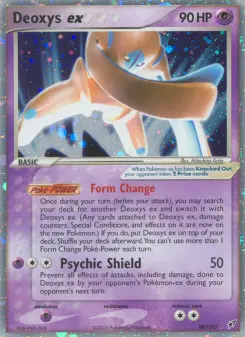
| Deoxys ex (Deoxys) | $550.00 | $22.00 | 96% cheaper in Japanese |
| Entei ex | $175.00 | $8.00 | 95% cheaper |
| Team Aqua's Kyogre | $228.30 | $14.99 | 93% cheaper |
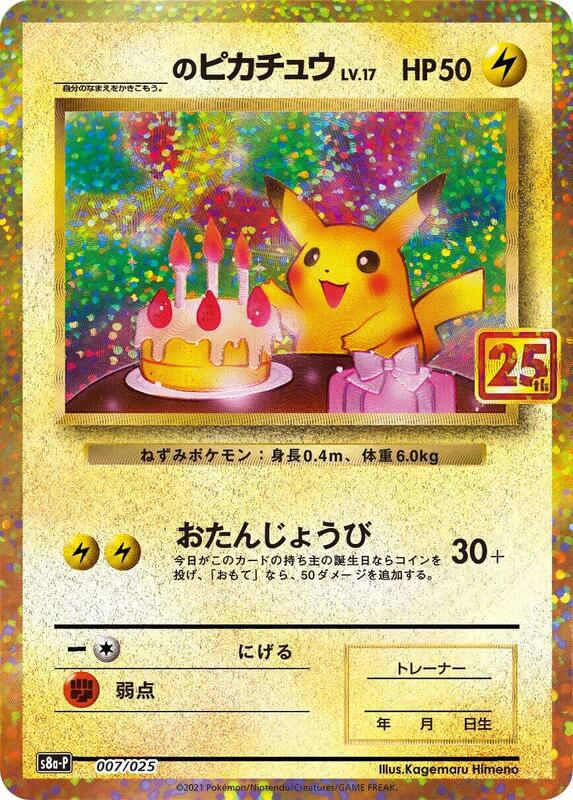
| _____'s Pikachu | $31.57 | $195.00 | 6.2x dearer in Japanese |
| Shining Ho-Oh | $26.68 | $147.50 | 5.5x dearer |
| Pikachu | $30.31 | $115.26 | 3.8x dearer |
The dearer-in-Japanese rows at this price level are all promos, and that is the one place the fixed-cost story does not explain the result. A Japanese promo is often a genuinely scarcer object than the English card sharing its name, distributed at a single event rather than printed into a set, and the market prices it accordingly. That is a different mechanism from the freight floor at the bottom of the book, and it is worth separating rather than folding into one number.
How many cards even have a twin
The study above needs both sides, which raises the obvious question of how often both sides exist. Joining the whole catalogue the same way gives four buckets, and the one-to-one pairs this piece measures are the smallest of them.
Every card in the catalogue, by whether it has a counterpart across the language line
| Bucket | Identity groups |
|---|---|
| Exactly one English and one Japanese printing | 1,597 |
| English only, no Japanese counterpart | 1,441 |
| Japanese only, no English counterpart | 2,131 |
| Several printings on one or both sides | 4,981 |
Two things in that table are worth keeping. Japanese-only identities outnumber English-only ones by about three to two, which is the promo and deck-exclusive programme that never crossed over. And the largest bucket by far is the messy one, where a card was reprinted several times on one side or both, and a clean one-to-one ratio cannot be computed at all. This study deliberately measures only the clean cases, because a ratio between a card and four of its own reprints is not a ratio.
The bug that had to be fixed before any of this could be measured
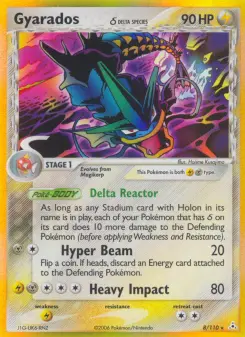
None of the above was measurable until yesterday, and the reason is worth printing because it is the kind of error that produces confident nonsense rather than an obvious blank. The join matched cards on their cleaned English name plus printed hit points, and the cleaner stripped parentheticals. The Japanese print of a delta species card is named “Gyarados (Delta Species)” where the English one is named “Gyarados δ”, so the Japanese key came out as plain “gyarados” and the English key kept its marker. They could never meet.
The failure was not that the pair went missing. It is that the Japanese card then matched the cards that genuinely do key as plain Gyarados at 90 hit points, and offered a reader two Skyridge Gyarados and a Deoxys Gyarados as the English versions of a Holon Phantoms delta card. Different cards, presented as the same card in another language. Folding the mechanic markers to one spelling moved cross-language pairs from 123,545 to 140,344, gave 6,045 cards a counterpart they never had, and narrowed 130 that had been matching the wrong thing. Gyarados δ and its Japanese print now resolve to each other and to nothing else.
Read from moonstone production on September 17, 2026. Counterparts are joined on a cleaned English card name plus printed hit points, computed over the bundled catalogue snapshot of roughly 63,800 rows; Japanese rows carrying kana names bridge to English through the species dictionary, and mechanic markers are folded to one spelling first, so “(Delta Species)” and “δ” are the same key, as are a trailing “Star” and “☆”. Only identity groups holding EXACTLY one English and one Japanese printing enter the ratio study: 1,597 such groups exist and 1,373 carry a live price on both sides. Prices are the canonical printing price, the same rule the card pages publish, not the raw provider market field, which on a multi-printing card quotes the dearest printing. Ratios are Japanese price divided by English price, and medians are per band rather than pooled, because the bands differ by two orders of magnitude and a pooled median would simply report whichever band is most populous. THIS MEASURES ASKING AND MARKET PRICES ON ONE MARKETPLACE, in United States dollars, for cards sold domestically and cards that must be imported; it is not a claim about what a card costs inside Japan, which we do not price. The explanation offered for the flip is an argument from the shape of the data, not a measurement: we do not hold shipping costs and cannot decompose the gap into freight, scarcity and demand. Related: Japanese slabs measures the same language line on graded populations rather than raw prices.