
In What First Edition Is Actually Worth we measured the 1st Edition premium at 2.63x across 195 products where the same feed prices both printings on the same day, and we flagged the sample's limits ourselves: two thirds of it was one set. This week we filled in per-printing rows for 1,342 vintage cards that had none, and the census grew to 838 pairs. The headline survived the stress test almost exactly: the median premium is 2.59x. Two of the old article's footnotes did not survive, and they are the interesting part.
What held
Every set now carries a real sample, and the set-level medians barely moved. Fossil leads at 3.70x on 62 pairs, Jungle 3.63x on 64, Neo Discovery 3.06x on 75. The middle of the table is remarkably tight: Gym Heroes 2.51x, Neo Genesis 2.52x, Team Rocket 2.50x, Neo Revelation 2.50x and Neo Destiny 2.50x all land within two points of each other, with Gym Challenge the outlier at 2.24x. Base Set is still a census of one: Impostor Professor Oak at $75.66 against $24.73, because every other Base Set product still carries a single blended row.
The census by set
| Set | Pairs | Median premium | Inversions |
|---|---|---|---|
| Fossil | 62 | 3.70x | 0 |
| Jungle | 64 | 3.63x | 0 |
| Neo Discovery | 75 | 3.06x | 1 |
| Gym Heroes | 132 | 2.51x | 1 |
| Neo Genesis | 111 | 2.52x | 2 |
| Team Rocket | 83 | 2.50x | 1 |
| Neo Revelation | 66 | 2.50x | 0 |
| Neo Destiny | 112 | 2.50x | 7 |
| Gym Challenge | 132 | 2.24x | 6 |
| Base Set | 1 | 3.06x | 0 |
What did not hold: the premium compresses at the top
The old article claimed the premium does not shrink as cards get more expensive, based on 70 pairs with a $20 leg. The full census says otherwise, and the old cut was simply too coarse to see it. Pairs with an Unlimited leg under $5 run a 2.94x median. From $5 to $20 it is 2.27x, from $20 to $100 it is 2.45x, and above $100 it falls to 1.81x across 55 pairs. Nine of the eighteen inversions in the whole census live in that top bucket. The dearer the Unlimited printing already is, the less the stamp adds, which is what you would expect if the stamp premium is partly a cheap-card scarcity story and partly a percentage the market refuses to compound on four-figure cards.
The Neo Destiny anomaly
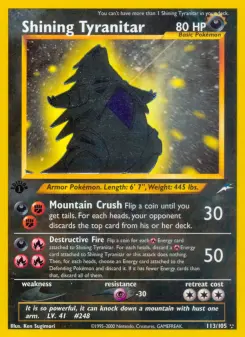
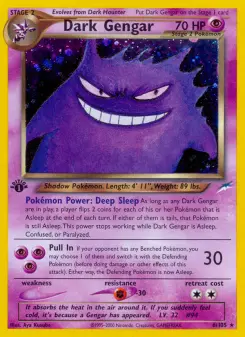
Seven of the eighteen inversions sit in Neo Destiny, and they are not commons: Dark Espeon trades at 0.47x its Unlimited ($200 against $425), Dark Gengar at 0.68x ($749.99 against $1,103), Shining Steelix at 0.34x and Shining Noctowl at 0.69x. Restrict Neo Destiny to pairs whose Unlimited leg is $100 or more and the median premium is just 1.19x across 18 pairs, with 6 inversions: at the top of this set, the stamp is close to worthless. The hobby's usual explanation is that Neo Destiny's Unlimited run was unusually short relative to 1st Edition. Our price data cannot test print runs, but the pattern it predicts is exactly the one we measure, and we measure it nowhere else. Not every shining inverts: Shining Tyranitar posts the census's biggest dollar gap, $4,249.99 against $345, and Shining Celebi runs 4.14x.
This census has since been rerun. How Much More Is a 1st Edition Pokemon Card Worth?, published September 28, 2026, adds a catalog flag confirmation this reading did not have and six consecutive days of the per-printing store, which this reading could not replay at its own date.
Population: per-printing rows in our September 7, 2026 TCGplayer price data, on products holding both a 1st Edition or 1st Edition Holofoil row and an Unlimited or Unlimited Holofoil row above zero. That is 839 pairs, 838 after the disclosed exclusion, of which 163 are holofoil pairs. Both legs are same product, same day, same venue. The sample quadrupled because we filled per-printing rows for 1,342 vintage cards whose products previously carried only a collapsed figure; the methodology is otherwise identical to the prior article, and the prior article's 195 pairs are a subset of this census. The four price buckets are cut on the Unlimited leg and partition all 838 pairs; the n is printed for the bucket the revision turns on, the 55 pairs above $100. Medians on even-sized samples take the upper middle element rather than averaging the two. The Neo Destiny print run explanation is attributed as hobby consensus, not as a measured fact.