
A 1st Edition stamp on an English Pokemon card is worth a median 2.65 times the same card without it. That figure comes from 826 pairs where our price feed quotes both printings of one product on one day, September 28, 2026, and where our catalog independently records that the card was printed with a stamp. The stamped card asks more on 811 of the 826, which is 98.18%. In dollars the median pair runs $3.78 unstamped against $11.19 stamped. Two things narrow the answer before you use it. The premium falls as the card gets dearer, from 2.94x where the unstamped copy asks under $5 down to 2.12x where it asks $100 or more. And Base Set is almost entirely absent: 101 of its cards carry the stamp in our catalog and the feed prices exactly one of them both ways, so a stamped Charizard is not in here. This is a Gym, Fossil, Jungle, Neo and Team Rocket census, and it says so in every section.
What a pair is, and what these prices are
Every number here divides two prices recorded for the same marketplace product, on the same day, at the same venue, under two printing labels: `1st Edition` over `Unlimited`, or `1st Edition Holofoil` over `Unlimited Holofoil`. Same card, same seller pool, same afternoon. Nothing is compared across cards and nothing is compared across days. Where this article prints a median unstamped price beside a median stamped price, those are each leg's own median over the same pairs, and they will not divide to the median ratio, because the middle pair by price is not the middle pair by ratio. Both legs are ASKING prices, the marketplace's market figure for that printing, not recorded sales, so a premium here is the distance between two listings and not a spread anybody captured. Ask Versus Sold is the study of that gap on its own, and Which Market Price explains what the figure is made of.
Our graded sold record cannot answer this question. It is keyed to a card and carries no printing label, so a PSA 10 median for a Neo Genesis Lugia cannot be attributed to the stamped printing or the unstamped one. Anyone quoting a graded 1st Edition against a raw Unlimited is comparing three differences at once and putting all of them on the stamp. That is why this census divides one ask by another ask rather than a sale by an ask.
The count question is a different article. How Many Printings Does a Pokemon Card Have? resolves 21,908 English cards into 34,433 separately priced products and gives the seven printing labels the marketplace uses, including how to tell a stamped card from an unstamped one by eye. This article is only about what the stamp adds to the price.
Four readings in twenty-four days, and they agree
We have measured this four times on four different populations, and the readings sit inside a tight range. None of the earlier ones was wrong. Two grew the sample and the last one narrowed it on purpose.
Every 1st Edition premium moonstone has published, with its pair count
| Published | Pairs | Median premium | What that reading added |
|---|---|---|---|
| 2026-09-04, What First Edition Is Actually Worth | 195 | 2.63x | The first same-day pair census. Two thirds of it was Gym Heroes |
| 2026-09-07, We Remeasured First Edition | 838 | 2.59x | Per-printing rows filled for 1,342 vintage cards, and the finding that the premium compresses above $100 |
| 2026-09-23, How Many Printings Does a Pokemon Card Have? | 675 and 164 | 2.66x and 2.38x | Holofoil pairs reported apart from the rest for the first time |
| 2026-09-28, this article | 673 and 153 | 2.70x and 2.43x | Six days of replayable history, a coverage audit against the catalog, and 826 pairs pooled at 2.65x |
Six medians between 2.38x and 2.70x, on samples from 195 pairs to 839. Two things moved across the four readings and only one of them is coverage. Coverage moved between September 4 and September 7, when per-printing rows were filled for 1,342 vintage cards. Method moved between September 23 and today: this reading adds a catalog flag confirmation the earlier three did not have, which drops 99 pairs the feed prices as stamped but our catalog cannot match, and that is why 839 pairs becomes 826. Nothing filled in this week. The feed's own stamped pair count is 927 on every one of the six days the store holds, 761 non-holofoil and 166 holofoil, and the count matching an English catalog card is 828 on all six. If you want one number to quote, 2.65x on 826 pairs is today's, and it is the pooled figure across both finishes.
The premium can now be checked on more than one day
The per-printing price store now records a day on every row, and its history begins at day 20719, which is September 23, 2026, and runs to September 28. Our September 4 and September 7 readings predate all of it, so neither could be replayed at its own date, and both said so. Holding the pair list fixed at the same 826 products so that no card enters or leaves, here is the same measurement six times.
The same 826 pairs, measured on each of six consecutive days
| Day | Pairs | Median premium | 25th | 75th | Pairs running backwards |
|---|---|---|---|---|---|
| 2026-09-23 | 826 | 2.63x | 2.01x | 3.53x | 15 |
| 2026-09-24 | 826 | 2.64x | 2.00x | 3.53x | 15 |
| 2026-09-25 | 826 | 2.64x | 2.01x | 3.54x | 16 |
| 2026-09-26 | 826 | 2.64x | 2.03x | 3.53x | 16 |
| 2026-09-27 | 826 | 2.64x | 2.03x | 3.49x | 16 |
| 2026-09-28 | 826 | 2.65x | 2.05x | 3.48x | 15 |
The median moves 0.026x across the six days, from 2.627x to 2.654x. The quartiles move less than 0.06x, the wider of the two being the 75th, from 3.535x on September 25 to 3.483x on September 28. Summed across the 826 pairs the unstamped side goes from $20,805.00 to $20,888.70 and the stamped side from $45,388.01 to $44,870.67, so the stamped half gave back about 1.1% of its dollars while the unstamped half added 0.4%. Six days is a short window and proves nothing about a month. What it does establish is that the figure is not a one-day artifact of which listings happened to be live, which is the objection every earlier reading had to concede.
Which sets the stamp exists in at all
The stamp is narrower than the hobby's conversation about it. Our catalog records a first edition printing on 937 English products, and they sit in exactly ten sets. No set outside those ten carries one, and all ten released between 1999-01-09 and 2002-02-28 on the release dates their provider groups carry in `tcgcsv_groups`, with no sentinel date among them. Japanese cards carry no printing flags in our catalog at all, so nothing here speaks to a Japanese 1st Edition.
Median 1st Edition premium by set, nine sets with 62 or more pairs
The ten sets, what we can price in each, and the premium
| Set | Cards carrying the stamp | Pairs we can price | Median premium | Backwards | Median unstamped | Median stamped |
|---|---|---|---|---|---|---|
| Jungle | 64 | 64 | 3.46x | 0 | $5.60 | $15.46 |
| Fossil | 62 | 62 | 3.26x | 0 | $2.26 | $13.46 |
| Neo Discovery | 75 | 74 | 3.17x | 1 | $5.22 | $14.47 |
| Base Set | 101 | 1 | 2.78x | 0 | $25.65 | $71.28 |
| Gym Heroes | 132 | 132 | 2.67x | 1 | $2.96 | $9.05 |
| Neo Genesis | 111 | 111 | 2.62x | 2 | $2.17 | $5.03 |
| Neo Destiny | 113 | 105 | 2.57x | 6 | $7.08 | $20.13 |
| Neo Revelation | 66 | 64 | 2.57x | 0 | $4.39 | $13.36 |
| Team Rocket | 83 | 83 | 2.40x | 1 | $4.92 | $12.65 |
| Gym Challenge | 130 | 130 | 2.32x | 4 | $3.78 | $8.61 |
| All ten | 937 | 826 | 2.65x | 15 | $3.78 | $11.19 |
Read the first two number columns against each other. Six of the ten sets pair on every card that carries a stamp. Four do not, and the shortfall is 111 cards: 100 in Base Set, 8 in Neo Destiny, 2 in Neo Revelation and 1 in Neo Discovery. Those 111 are the subject of the next two sections, because they are not a random 12% of the population. They are concentrated at the two places a reader most wants an answer.
The Base Set problem, unchanged in twenty-four days
Base Set contributes 101 of the 937 stamped cards and 1 of the 826 pairs. That one is Impostor Professor Oak at $25.65 unstamped against $71.28 stamped, 2.78x. Every other Base Set product carries a single blended row rather than separate stamped and unstamped ones: Charizard is one `Holofoil` row at $944.53, Blastoise one at $222.34, Venusaur one at $173.95. There is no second leg to divide by.
That is the same gap the September 4 article disclosed and the September 7 recensus still had, and it has not closed in the twenty-four days between them and today. So the honest answer to the question people actually type, what a 1st Edition Base Set Charizard is worth over an Unlimited one, is that we do not publish a figure for it and will not invent one from a neighboring set. What we can say is that across the nine sets that pair on more than one card, the stamp adds a median 2.65x, and that on the dearest cards in those sets it adds less rather than more. The Base Set Price Guide is where the set's own prices live.
The stamp adds less as the card gets dearer
Median 1st Edition premium by what the unstamped copy asks
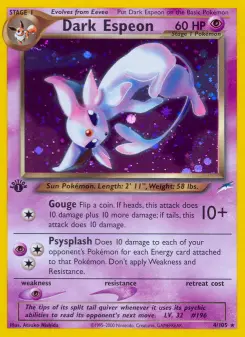
The top and bottom of that chart are 2.94x and 2.12x, and the middle is not monotone: the $20 to $100 band reads higher than the $5 to $20 band. The September 7 recensus found the same shape with the same wobble, 2.94x, 2.27x, 2.45x and 1.81x on its own sample, so this is the second independent reading of it rather than a new claim. The direction survives a check that matters, which is whether it is really a finish effect wearing a price costume. Inside the non-holofoil pairs alone, 2.94x on the 454 under $5, 2.28x on the 179 between $5 and $20 and 2.24x on the 38 between $20 and $100. Inside the holofoil pairs, 2.55x on the 103 between $20 and $100 and 2.12x on the 45 above $100. Two bands are too thin to read and are stated rather than charted: two non-holofoil pairs sit above $100, at a median 2.84x, and five holofoil pairs sit between $5 and $20, at 4.09x, with no holofoil pair at all under $5. The first of those runs against the compression on a sample of two, Umbreon from Neo Discovery at 2.84x and Sabrina's Gengar from Gym Challenge at 1.76x. On the bands that can be read, the premium narrows within each finish and not only across them.
The finish itself matters too, and in the direction fewer people expect. Non-holofoil pairs run a median 2.70x across 673 of them and holofoil pairs 2.43x across 153. A stamp on a holo rare adds proportionally less than a stamp on a common, even though it adds far more in dollars: the median holofoil pair is $55.53 unstamped against $146.19 stamped, and the median non-holofoil pair is $2.39 against $7.01. The same shape shows up on the other finish premium we measure: Are Reverse Holo Pokémon Cards Worth More? finds the reverse premium running to double figures on cards whose ordinary printing asks pennies and settling near 1.9x on modern sets where both printings are already cheap.
One consequence worth carrying to a purchase. Add the whole census up and the 826 unstamped copies ask $20,888.70 while the 826 stamped copies ask $44,870.67, a pooled ratio of 2.15x against a median of 2.65x. The pooled figure is lower because it is dominated by the dear cards, where the premium is thinner. A median tells you what a typical stamp is worth. A total tells you what a stamped collection costs.
Fifteen pairs where the stamp costs you money
Every pair of the 826 where the unstamped copy asks more, on 2026-09-28
| Card | Set | Finish | Unlimited ask | 1st Edition ask | Ratio |
|---|---|---|---|---|---|
| Dark Espeon | Neo Destiny | Holofoil | $649.99 | $165.55 | 0.25x |
| Lugia | Neo Genesis | Holofoil | $531.39 | $164.80 | 0.31x |
| Dark Charizard | Team Rocket | Holofoil | $381.69 | $121.94 | 0.32x |
| Dark Porygon2 | Neo Destiny | Holofoil | $93.22 | $39.21 | 0.42x |
| Fighting Energy | Gym Challenge | Non-holofoil | $2.24 | $1.32 | 0.59x |
| Fire Energy | Gym Heroes | Non-holofoil | $3.63 | $2.28 | 0.63x |
| Espeon | Neo Discovery | Holofoil | $365.17 | $237.50 | 0.65x |
| Dark Tyranitar | Neo Destiny | Holofoil | $295.28 | $200.00 | 0.68x |
| Dark Gengar | Neo Destiny | Holofoil | $1,101.50 | $749.99 | 0.68x |
| Dark Ampharos | Neo Destiny | Holofoil | $161.37 | $120.00 | 0.74x |
| Water Energy | Gym Challenge | Non-holofoil | $4.38 | $3.49 | 0.80x |
| Lightning Energy | Gym Challenge | Non-holofoil | $2.65 | $2.20 | 0.83x |
| Girafarig | Neo Destiny | Non-holofoil | $17.16 | $15.34 | 0.89x |
| PokéGear | Neo Genesis | Non-holofoil | $2.70 | $2.56 | 0.95x |
| Blaine's Quiz #3 | Gym Challenge | Non-holofoil | $5.95 | $5.75 | 0.97x |
Two patterns in that table. Eight of the fifteen are holofoil pairs, and there are only 153 holofoil pairs against 673 non-holofoil ones, so the stamp runs backwards on 5.23% of holofoil pairs against 1.04% of the rest. And seven of the fifteen sit in the $100 and up band, which holds 47 pairs in total. The pairs where the stamp fails are the expensive holos, which is the same finding as the compression chart seen from its tail.
Six of the fifteen are in Neo Destiny, which is 5.7% of that set's 105 pairs against 1.8% across the census. The September 7 recensus found seven inversions in the same set and reported the hobby's explanation, that Neo Destiny's Unlimited run was short relative to its 1st Edition run. Our prices cannot test a print run and we are not asserting one. The pattern is stable across two readings three weeks apart, and it is worth knowing before you pay a stamp premium on a Dark Pokemon holo from that set.
The widest multiples sit on the cheapest cards
The four widest multiples of the 826 pairs, none of them a holo
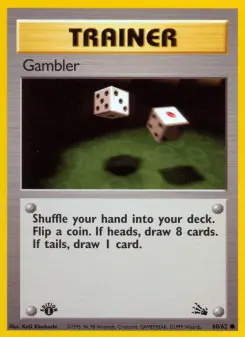
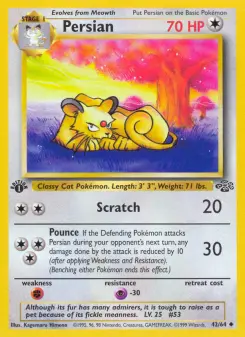
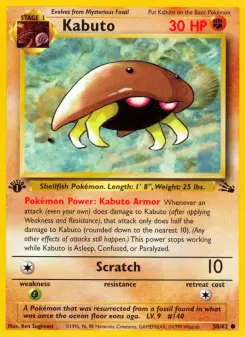
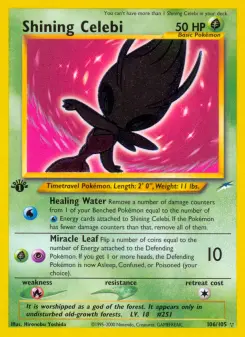
A stamped Gambler asks 19.82 times its unstamped twin, and the whole trade is $0.33 against $6.54. That is the shape of the widest end: a card whose unstamped copy is close to worthless, where the stamped copy has a floor set by the cost of listing it at all. Read those multiples as a warning about ratios on cheap cards rather than as a buying idea. The dollar gaps that are actually large sit on the holos, and they are smaller multiples: Shining Celebi at $435.00 against $3,000.00 is 6.90x, Shining Kabutops at $382.44 against $1,399.95 is 3.66x, Typhlosion at $144.84 against $699.99 is 4.83x, and Erika's Venusaur at $182.42 against $650.00 is 3.56x.
Eleven stamped Neo holos carry no price today
Eleven stamped cards in the three Neo sets carry no priced 1st Edition row on September 28, and they are not a random eleven. Every one of them is a holo, and every unstamped copy asks between $299.99 and $1,700.99, which puts all eleven above the $190.10 median of the census's own top band. Five of them do have a 1st Edition Holofoil row with no price in it: Shining Charizard, Shining Noctowl, Shining Raichu, Shining Tyranitar and Dark Houndoom. The other six carry no stamped row at all, among them Shining Mewtwo, Shining Steelix and Umbreon from Neo Discovery. Eleven is the Neo count and not the census count: of the 111 flagged products with no priced stamped row, 26 are flagged as holo, and the other 15 are in Base Set, Charizard, Blastoise and Venusaur among them, which the next section is about.
An empty price is an unknown, never a zero, and it must not rank as the cheapest or the dearest of anything. Two of those eleven are worth naming for a different reason. The September 7 recensus excluded Shining Charizard and said so, because its stamped row then read $19.99 against a $1,495 unstamped copy, which is a listing artifact rather than a price. Today that row carries no number at all and the unstamped copy reads $1,700.99. And Shining Tyranitar, which that article printed as the widest dollar gap in its own census at $4,249.99 against $345, has no stamped reading today either. Neither figure was wrong when it was published. Both have gone absent, which is why this article states the day on every number and why How to Tell a Pokemon Card Price Is Stale exists.
The catalog and the feed disagree on the stamp twice in 930
Two independent sources say a card was printed with a stamp. One is our catalog's printing flags, which come from a card database and describe which physical printings exist. The other is the price feed, which either quotes a stamped row or does not. Testing them against each other: 937 English products carry the flag, 930 products carry a priced stamped row, and 826 are in both. Of the 104 products the feed prices as stamped without the flag agreeing, 102 match no catalog card in any language, which is a coverage gap on our side rather than a contradiction, and those 102 are excluded from every figure in this article. That exclusion is load-bearing: those pairs run a median 6.18x across 99 of them, and including them would have moved the pooled headline from 2.65x to 2.75x on 927 pairs.
The other two are a real disagreement, and they are small: Giovanni's Nidoran ♀ and Giovanni's Nidoran ♂ are flagged as normal-printing only and priced as stamped, at 2.46x and 2.47x. Two products in the 828 that both sources can see is a 0.24% disagreement rate between a card database and a marketplace, which is the sort of number worth publishing because it sets the size of the trust you can place in either one alone.
What this does not answer
Shadowless is not a printing label in this feed. The whole store uses seven of them, `Normal`, `Holofoil`, `Reverse Holofoil`, `Unlimited`, `1st Edition`, `Unlimited Holofoil` and `1st Edition Holofoil`, and none of them separates a shadowless Base Set card from a later one. So we cannot price a shadowless premium, and a stamped-versus-unstamped figure from us is not a shadowless figure. Japanese 1st Edition is also outside this: no Japanese product in our catalog carries a printing flag, and no Japanese product carries a priced stamped row on this day. Grading is outside it too, for the reason in the second section: a sold median is recorded against a card, not against a printing.
How to spot the stamp on a card in your hand is covered in How Many Printings Does a Pokemon Card Have?, which gives the four checks in order and puts the stamp third, after the set symbol with the collector number and after the finish.
What would overturn this
The cheapest test is the one the new day column makes possible: run the same 826 pairs every day and watch the median. Six days hold it inside 0.026x. If two more weeks move it more than about 0.2x with no change in the pair list, the figure is a listing artifact rather than a level, and this article is measuring noise. The second test is coverage. If the feed ever prices Base Set's cards as separate stamped and unstamped rows, the census gains up to 100 pairs, Charizard, Blastoise and Venusaur among them, and the compression finding predicts the dear ones among them will land below 2.65x rather than above it. If they land above it, the compression is a property of the nine sets that currently pair and not of the stamp. The third test costs nothing and we have not been able to run it: a sold record keyed to the printing rather than to the card would say whether the stamp premium survives in trades or lives only in asks.
Prices: `tcgcsv_prices`, day 20724, which is 2026-09-28, the newest day the store holds. 45,463 rows over 31,476 products that day, and the store's whole history is day 20719 to day 20724. Day is pinned rather than resolved at read time so every figure in this article and its siblings refers to the same day. A pair is one `product_id` carrying both `Unlimited` and `1st Edition`, or both `Unlimited Holofoil` and `1st Edition Holofoil`, with `market` above zero on both legs; a null market is an absent reading and the pair is dropped, never treated as zero. Both legs are marketplace asking prices for that printing, not sales. Population: `cards` rows with lang = 'en' and a non-empty tcg_id, collapsed to one row per tcg_id by preferring a catalog-native id over a synthetic `enx-` one and then the lexically first id, because 243 product ids are claimed by two English rows each, 486 rows in all. That is 21,692 rows and 21,449 products. No flagged product is among those 243, so the rule changes no figure in this article and is applied for consistency with its siblings. A pair enters only if its catalog row's `variant_flags` records a first edition printing, which is the compact flag string written from a card database by src/server/printing-identity.ts. 937 products carry that flag, 930 products carry a priced stamped row, 826 are in both and those 826 are the census. Exclusions and their sizes: 102 products carry a priced stamped row and match no catalog card in any language, contributing 99 pairs at a median 6.18x, and are excluded; including them gives 927 pairs at 2.75x. 2 products are priced as stamped with flags that do not record it, Giovanni's Nidoran ♀ and Giovanni's Nidoran ♂, and are excluded on the same rule. 111 flagged products carry no priced stamped row, 100 of them in Base Set. Nothing is excluded for being an outlier: the 15 backwards pairs and the 19.82x maximum are all kept and printed, because a filter that removes the rows that look odd is how a census lies. Medians on even samples take the upper middle value rather than averaging the two, so the two sets printing 2.57x are 2.570x for Neo Destiny and 2.566x for Neo Revelation and are ordered on the unrounded value. Price bands are cut on the Unlimited leg at $5, $20 and $100, are half-open, and partition all 826 pairs. The six-day series holds the pair list fixed at the 826 products that pair on all six days from day 20719 to day 20724, so no card enters or leaves across the comparison; all 826 are present on all six. Graded medians from `graded_snapshots` are not used for any figure: that table records a sold median and a verified sale count against a card key, with no printing label, so it cannot separate a stamped sale from an unstamped one. `price_history` is not used either, because its flagship-printing figure for nine of these ten sets, every one except Base Set, was requoted onto a different printing on 2026-09-07 and is not a known printing for this comparison. Link check, run once across the whole wave on 2026-09-28: every card id printed anywhere in these five studies resolves to a catalogue row whose name matches the label the sentence gives it, all 129 of them; every set link returned 200 from production; and every linked article slug resolves inside this corpus. Nothing here is investment advice.