The Most Graded Cards in Pokemon walked the top of the PSA registry: a promo Pikachu with 329,337 slabs, five cards past 100,000. This is the other end. More than half the lines we track have fewer than 100 slabs, which sounds like a story until you price them: the median card in that band is worth 39 cents and nobody grades 39-cent cards. The interesting population is money with a thin registry, and it turns out to be small, specific, and, over the last year, the best-performing corner of the tape we can measure. It is also the corner where our data is weakest, so this piece spends as much time on what the numbers cannot say as on what they can.
Thin usually means worthless, until it doesn't
Start with what the bottom mostly is. Of 23,110 priced lines, 12,980 carry fewer than 100 PSA slabs and 7,071 carry fewer than ten; the median raw price in the under-100 band is $0.39. That is the expected shape: a registry is a record of decisions to spend a grading fee, and nobody spends one on a common. Print-Run Archaeology read registry depth as a print-run proxy; at the bottom it is a demand proxy, and the demand is zero.
Filter for money and the bottom shrinks fast. There are 1,521 cards in our universe priced at $100 or more. Only 118 of them, 7.8%, have fewer than 100 slabs, and 729, just under half, have fewer than 1,000. Among the 300 most expensive lines we price, catalog cards and stamped products alike, the tenth-percentile registry is 220 slabs, the median 1,925, and the ninetieth percentile 15,335. Value and grading depth travel together, which is what the top of the registry showed from the other side. The exceptions are the subject of this piece.
The most valuable cards almost nobody has graded
Catalog cards priced $100 or more with fewer than 100 PSA slabs, by recorded raw market (2026-09-13)
| Card | Set | Raw market | PSA slabs | PSA 10s | 365d move |
|---|---|---|---|---|---|
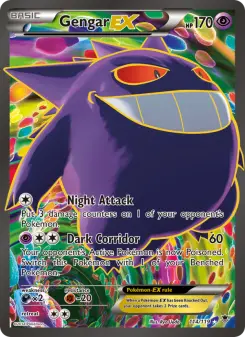
| Gengar EX | Phantom Forces 114 | $768 | 5 | 0 | n/a |
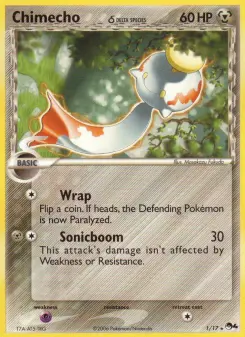
| Chimecho δ | POP Series 4 1 | $750 | 95 | 8 | n/a |
| Primal Kyogre EX | Primal Clash 149 | $338 | 3 | 0 | n/a |
| Lucario | BW Black Star Promos BW85 | $332 | 69 | 0 | n/a |
| Hungry Snorlax | Japanese unnumbered promo | $300 | 20 | 6 | n/a |
| Charizard EX | Flashfire 100 | $269 | 9 | 0 | n/a |
| N | BW2 Red Collection 071/066 (JP) | $250 | 1 | 0 | n/a |
| Lucario | Everyone's Exciting Battle 027/047 (JP) | $240 | 24 | 16 | n/a |
| Sceptile | POP Series 4 5 | $230 | 48 | 4 | n/a |
| Metang | Nintendo Black Star Promos 23 | $200 | 85 | 25 | n/a |
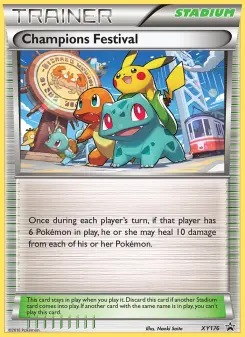
| Champions Festival | XY Black Star Promos XY27 | $200 | 93 | 0 | n/a |
| Scraggy | McDonald's Collection 2016 7 | $200 | 3 | 0 | n/a |
Two things stand out. First, none of these have a year of recorded price history, which is why the last column is empty: our deep curves cover the cards the market talks about, and these are the cards it does not. Second, the prices are thin-market prices. A $768 market on a Gengar EX with five slabs is what a handful of listings and a couple of sales produce; it is the recorded figure, and we print it as recorded, but a market that thin can move a hundred dollars on one transaction. The registry and the tape are thin for the same reason.
The larger group is not in our catalog at all, because it is not really a set of cards. It is a set of stamps. Forty-four of the 118 thin-registry cards above $100 have a catalog page; the rest are Staff-stamped prerelease promos, League and Championship cards, Prize Pack Series cards, and World Championship exclusives, products distributed in small runs through events, leagues, and prize packs, and never meant to be graded at scale.
Thin-registry cards above $100 that live outside our card catalog (no card page), by recorded raw market
| Card | Product family | Raw market | PSA slabs | PSA 10s |
|---|---|---|---|---|
| Gengar VMAX 157/264 | Prize Pack Series | $1,500 | 69 | 9 |
| Tropical Beach BW50 (Worlds 2012) | Black and White promos | $850 | 60 | 3 |
| Tropical Beach BW28 (Worlds 2011) Staff | Black and White promos | $800 | 57 | 0 |
| Victini 43/101 Prerelease Staff | Black and White promos | $591 | 99 | 4 |
| Tropical Wind DP05 (Worlds 2007) | Diamond and Pearl promos | $575 | 37 | 1 |
| Ancient Mew, Japanese exclusive print | Miscellaneous | $390 | 14 | 3 |
| Champions Festival XY27 (2014 Staff) | XY promos | $375 | 93 | 0 |
| Charizard VSTAR 018/172 | Prize Pack Series | $352 | 93 | 3 |
| Poliwhirl 37/95 League Promo Staff | League and Championship | $350 | 86 | 25 |
| Poliwrath 21/95 League Promo Staff | League and Championship | $350 | 16 | 0 |
| Garchomp C 60/147 League Promo Staff | League and Championship | $350 | 57 | 1 |
| Dragonair 52/146 State Championships Staff | League and Championship | $330 | 97 | 5 |
In every price tier above $5, the thin registry won the year
Now the question that was actually asked: how do the least graded cards perform? We took every line with a current price and at least a year of recorded price curve, 2,731 of them, put each in a price tier by its current raw market and in a registry band by its current PSA slab count, and read the median 365-day move of each cell. Price tiers matter because registry depth and price are correlated; without the tiers, the thin band is just the cheap band.
Median 365-day raw price move by registry band, within price tier (2,731 lines with a year of recorded curve)
| Raw price tier | Under 100 slabs | 100 to 999 | 1,000 to 9,999 | 10,000 or more |
|---|---|---|---|---|
| Under $5 | +22% (n=702, 66% up) | +26% (n=416, 80% up) | +35% (n=67, 84% up) | -8% (n=3, 33% up) |
| $5 to $24.99 | +81% (n=162, 91% up) | +47% (n=454, 91% up) | +48% (n=156, 87% up) | +22% (n=16, 69% up) |
| $25 to $99.99 | +107% (n=134, 90% up) | +66% (n=240, 92% up) | +39% (n=133, 90% up) | +13% (n=28, 71% up) |
| $100 or more | +188% (n=30, 97% up) | +113% (n=61, 95% up) | +40% (n=94, 91% up) | +38% (n=35, 91% up) |
Read across any row above $5 and the gradient runs one way. In the $25 to $100 tier, cards with fewer than 100 slabs rose a median 107% over the year, cards with 100 to 999 rose 66%, cards with 1,000 to 9,999 rose 39%, and cards with 10,000 or more rose 13%. In the $100-and-up tier it is 188%, 113%, 40%, 38%. The share of cards that went up at all is above 85% in ten of the twelve cells at $5 and up, which says the year was a broad rally; the registry gradient is about how much, not whether. The same test collapsed to two bands, thin under 1,000 and deep at or above it, and read at 90 days as well as 365, keeps the sign in every cell. Below $5 it does not hold: the sub-$5 thin cohort rose 24% against 30% for the deep one, which is why every claim here is scoped to $5 and up.
Thin (under 1,000 slabs) vs deep (1,000 or more), raw price $5 and up, by tier
| Tier | Registry | n (365d) | Median 365d | Up 365d | n (90d) | Median 90d | Up 90d | Median slabs (365d sample) |
|---|---|---|---|---|---|---|---|---|
| $5 to $24.99 | under 1,000 slabs | 616 | +51% | 91% | 691 | +9% | 80% | 212 |
| $5 to $24.99 | 1,000 slabs or more | 172 | +45% | 85% | 174 | +1% | 51% | 2,119 |
| $25 to $99.99 | under 1,000 slabs | 374 | +77% | 91% | 365 | +12% | 84% | 194 |
| $25 to $99.99 | 1,000 slabs or more | 161 | +33% | 87% | 161 | +4% | 69% | 3,666 |
| $100 or more | under 1,000 slabs | 91 | +125% | 96% | 74 | +16% | 78% | 198 |
| $100 or more | 1,000 slabs or more | 129 | +39% | 91% | 131 | +8% | 84% | 4,192 |
Era does not explain it away. The year-deep sample is mostly Sun & Moon (1,317 lines) and Sword & Shield (787), and inside each era the thin cohort still leads: Sun & Moon cards at $5 and up under 1,000 slabs rose a median 46% against 39% for the deep cohort; Sword & Shield, 48% against 31%. The last ninety days, which are past the spring rally, show the same order at smaller magnitudes: +12% thin against +4% deep in the $25 to $100 tier, with 84% of thin cards up against 69%.
Where the tens are scarce, the ten is worth twenty cards
The cleaner relationship is not with price direction but with the PSA 10 premium, because it is measured on the same day rather than across a year. Where we hold a PSA 10 sold median beside a raw price, the multiple falls monotonically with registry depth: 21.6x under 100 slabs, 14.3x from 100 to 999, 8.4x from 1,000 to 9,999, 4.3x at 10,000 and up. A deep registry means a deep supply of tens, and a deep supply of tens means the ten is priced like a card rather than like a trophy. The Basement of the Registry found the same compression from the grade side; The Registry Is Closed showed what a finished, thin registry does to a PSA 10 when demand arrives.
PSA 10 sold median as a multiple of raw market, by registry band, raw price $5 and up
| Registry band | Cards with a PSA 10 median | Median raw | Median PSA 10 | Premium (median per-card multiple) |
|---|---|---|---|---|
| Under 100 slabs | 86 | $8.95 | $198 | 21.6x |
| 100 to 999 | 1,250 | $15.83 | $250 | 14.3x |
| 1,000 to 9,999 | 1,086 | $27.05 | $210 | 8.4x |
| 10,000 or more | 264 | $64.12 | $319 | 4.3x |
The least graded cards among the 300 most valuable
Least graded catalog cards among the 300 most expensive lines by raw market (stamped products in the same pool are thinner still, see the table above)
| Card | Set | Raw market | PSA slabs | PSA 10s |
|---|---|---|---|---|
| Gengar EX | Phantom Forces 114 | $768 | 5 | 0 |
| Chimecho δ | POP Series 4 1 | $750 | 95 | 8 |
| Champions Festival | XY Black Star Promos XY176 | $420 | 159 | 0 |
| Mega Rayquaza ex | M6 Storm Emeralda 113/076 (JP) | $1,070 | 192 | 163 |
| Mew | BW Black Star Promos BW98 | $500 | 213 | 0 |
| Ultra Ball | Plasma Freeze 122 | $708 | 223 | 23 |
| Espeon | The Town on No Map 046/092 (JP) | $400 | 279 | 101 |
| Gyarados | XY Black Star Promos XY60 | $439 | 283 | 5 |
| Zoroark | Next Destinies 102 | $400 | 314 | 11 |
| Paradise Resort | SVP Black Star Promos 150 | $598 | 442 | 95 |
Two registries with zero tens deserve a sentence. The Champions Festival XY176 line, which the provider shares between the regular and the Staff print, has 159 slabs and not one PSA 10, and the BW98 Mew has 213 and none. A card that has been submitted a couple of hundred times without producing a gem is either brutally hard to gem or was handed out in a condition that never had a chance; either way the first ten, if it ever comes, has no comparable. That is the thin-registry premium at its limit.
A registry of one slab and forty gem sales
The provider feed that keys PSA populations to products fails in a second way at the bottom of the registry, opposite to the collisions the top-of-registry piece described. Some lines are simply mapped to the wrong product. The tell is a PSA 10 sold count larger than the registry: the Special Delivery Pikachu line records one slab and one ten while we hold forty verified PSA 10 sales for it, and a Mega Evolution promo line records one slab against 845 gem sales. Seventy-nine lines failed that test and were removed from every figure here, along with 937 near-duplicate lines at 1,000 slabs and above under the collision rule. Both defects are upstream, and both would have put false entries at the top of the thin-registry tables.
Universe: the 24,126 PSA population lines (keyed by TCGplayer product id) with a current raw market price as of 2026-09-13 UTC, using each line's most recent population snapshot (2026-09-06 to 2026-09-12; a PSA 10 count of zero is treated as absent and the latest snapshot carrying a count is used). Removed: 937 lines at 1,000 slabs or more whose totals agree within 1% and PSA 10 counts within 1.5% with a larger line (provider collisions; the larger is kept), and 79 lines whose verified PSA 10 sold count exceeds their recorded PSA 10 count (provider mismaps). Final: 23,110 lines. Current price is the median of recorded daily marks over the last ten days; 365-day and 90-day moves compare it to the median mark in a two-week window centred 365 and 90 days earlier, using our recorded weekly price curves merged with the daily canonical accretion; the 365-day sample is the 2,731 lines whose curves reach back a year (Sun & Moon 1,317, Sword & Shield 787, uncatalogued products 370, Black & White and XY 126, EX era 44, other 87) and is a survivor pool, as described in the callout. Price tiers use the current raw market; registry bands use the current slab count. Medians on even samples average the two middle values. The collision rule was applied at 1,000 slabs and above; below that, some lines that are variants of one promo (regular, Staff, placement) share a single population and appear once per line, which is why Champions Festival XY27 appears in both thin-registry tables. Current price is the market price of the flagship printing; for every card in the tables it equals the cheapest printing. PSA 10 premiums use the latest eBay sold median with at least three sales, from our graded snapshots, divided by the current raw market, over lines priced $5 and up. Table rows for cards outside the catalog carry the price dump's product name and have no card page. Recorded thin-market prices are printed as recorded and can rest on very few sales. Not financial advice.