A card scanner's real adversary is not blur. It is the fact that The Pokémon Company has printed the same character, in the same set, in the same art style, at prices two thousand times apart. We hold 58,907 printings, 24,564 English and 34,343 Japanese, across 732 distinct set names. Inside that catalog we can count exactly how often identity is ambiguous, and what being wrong costs. The answer: 4,764 groups of cards share a name inside a single set, covering 10,872 printings, and among the 3,497 of those groups where we can price at least two members, the median gap between the dearest and cheapest member is 11.5x. Half of them exceed 10x. Five hundred and seven exceed 100x.
Class one: the number is the whole difference
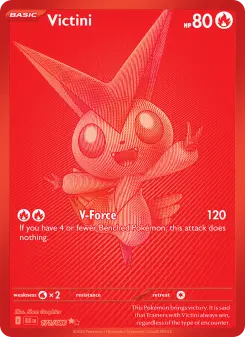
The dominant class by a distance is the modern art rare. A set prints a card at its ordinary collector number and prints the same Pokémon again, later in the checklist, as an illustration rare. Same name, same set, same species, and the only separator on the card face is the number in the footer. Black Bolt alone contributes the widest gap we hold: Victini number 171 at $620.52 against Victini number 012 at $0.25, a factor of 2,482. Seismitoad 105 at $225.26 against Seismitoad 021 at $0.11 is another 2,048x from the same set. Paldea Evolved prints Magikarp 203 at $378.78 and Magikarp 042 at $0.23. Ultra Prism prints Lillie 151 at $469.31 and Lillie 125 at $0.38.
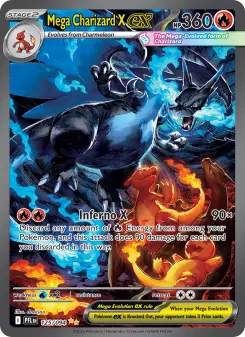
The class is not always a pair, either, which is the part that breaks naive deduplication. Phantasmal Flames prints FOUR cards named Mega Charizard X ex: number 125 at $672.78, number 130 at $273.86, number 109 at $26.90, and number 013 at $4.74. All four are the same Pokémon in the same set at the same moment. An earlier version of this piece counted three of them and quoted a 26x range; the true intra-name range in that set is 142x, and the three dearest are 82.6% of the set's $1,179 canonical bill. A buyer told only "Mega Charizard X ex, Phantasmal Flames" has been told nothing that resolves a 142x range.
On any modern set the collector number in the footer is not a detail of the listing, it IS the listing, and a photograph that does not show it legibly has not identified anything. That is as true for a person reading a listing as it is for a matcher reading pixels.
Class two: the same name and the same number, in a different set
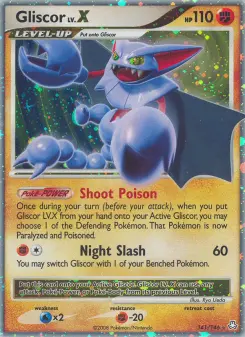
1,155 English name-and-number combinations exist in two or more different sets, covering 2,506 cards, and 956 of those collisions have prices on both sides. The median gap is a mild 2.2x, but the 90th percentile is 15.5x and the top of the list is brutal. Gliscor 141 in Legends Awakened is $93.33; Gliscor 141 in Fusion Strike is $0.01, a factor of 9,333. Celebi 3 in Neo Revelation is $349.99; Celebi 3 in Shining Fates is $0.24. Heracross 6 in Neo Genesis is $44.04; Heracross 6 in Chilling Reign is $0.09, a factor of 489. A seller who types a name and a number into a listing title has, in 1,155 cases, not told you which card they own. Only the set symbol answers it, and the set symbol is the first thing a bad photograph loses.
Class three: the letter suffix, and the cards that were never printed
Sixty-five cards in the catalog carry a printed number ending in a letter, concentrated in Celebrations (21) and Aquapolis (8). The class is small, it is not expensive, and it is the single most persistent failure we have logged in live use: the most common corrected pick of any kind is Aquapolis Porygon 103a against Aquapolis Porygon 103b, six events, three in each direction, on cards worth $7.70 and $7.97. Identification difficulty and price consequence are separate axes, and this is the corner where they come apart.
A fourth class is not a class of confusion at all but of exclusion. 2,480 rows in our catalog are digital-only cards from the app product, sets like Genetic Apex and Space-Time Smackdown. They have artwork and collector numbers, none has a TCGplayer product id, and none exists as cardboard. They are dropped by an id-pattern rule before the scan index is built, because a physical photograph that matches a digital card is always wrong. Of the 58,907 catalog rows, 51,088 carry a visual fingerprint; removing the digital rows and those whose fingerprint is the wrong length leaves 48,443 catalog vectors, joined by 11,809 synthetic exemplars that render the same card under glare and sleeve conditions, for 60,252 vectors in the live index.
What people actually point at a camera
We log scans that were corrected, removed, or flagged weak, so we can audit our own failures. That log is small and it is a log of trouble rather than a log of traffic, so it must be read with its size in the sentence: 996 events between July 24 and September 1, 2026, 994 of them carrying a proposed match, covering 278 distinct cards across 126 sets. Two things in it are worth stating anyway. First, 578 of the proposed matches were Japanese printings against 416 English, in a catalog that is 58% Japanese, so the mix of what gets photographed roughly tracks the mix of what exists rather than the mix of what trades. Second, of the 587 events that carried two or more candidates, 220, or 37.5%, had at least two candidates sharing a single card name. The twin problem is not an occasional edge case in live use. It is more than a third of every difficult scan.
Every price in this piece is a quote with an age attached, and The Frozen Tape measures how old those quotes typically are.
Catalog counts are a full read of moonstone's card table on September 2, 2026: 58,907 rows, 24,564 with lang=en and 34,343 with lang=ja, 732 distinct set names, 18,851 distinct card names, 51,088 rows carrying a perceptual fingerprint, 2,480 digital-only rows excluded from the scan index by id pattern, 48,443 rows surviving into the index, and 11,809 synthetic exemplar rows. Name-collision groups are computed on exact (language, set name, card name) keys, and price gaps use each group's dearest and cheapest priced member; 4,764 groups covering 10,872 cards exist, of which 3,497 carry two or more priced members. Cross-set collisions are computed on exact (card name, printed number) keys within English rows only. Prices are CANONICAL printing prices from our daily TCGplayer sync, the same field the card pages show; an earlier version of this piece read the flagship-printing field instead and published gaps its own card pages contradicted, most visibly a $195.79 Neo Genesis Heracross implying a 3,916x collision where the canonical prices give $44.04 and 489x. Those cache rows carry refresh stamps spanning July 29 to September 2, 2026. The scan log is our own scan_rejections and scan_feedback tables, 996 rows between July 24 and September 1, 2026, since grown to 1,000; it records corrected, removed, weak and low-confidence scans, not successful ones, so it is a sample of difficulty and not a measure of traffic, and every claim drawn from it is stated with that sample size attached. Both the collision counts and the scan log describe the same catalog, so they are not independent confirmations of each other. STALENESS NOTE, added 2026-09-22: the card table is a current-state table with no history, so none of these counts can be recomputed at the September 2 date they carry. On today's catalog the same queries return 63,600 rows, 24,635 English and 38,965 Japanese across 778 set names, 5,553 same-set name groups covering 12,821 printings, and 1,161 cross-set name-and-number collisions covering 2,519 cards. The shape holds and the cross-set figures barely moved; the Japanese side of the catalog grew by about 13% in three weeks, which is where most of the drift is.