On October 10, 2026 our daily price record held a price for 21,412 distinct English Pokémon products, which is every English printing with its own product page on TCGplayer, the marketplace our prices come from, that also had a price recorded there that day. Each price is an asking price for a near mint ungraded copy, meaning a card with no obvious play wear and no grading company's slab around it, and no completed sale sits behind any of them. Add one copy of each and the pile asks $451,170.93. Divide that by 21,412 and the average printing asks $21.07. Now sort the same list and take the value sitting in the middle, the median, and it asks $0.88. The average is 23.9 times the middle card. Pick the wrong one of those two and your answer is out by a factor of about twenty four before you've looked at a single card.
Count times average is the first thing everybody tries
The method makes sense on its face: you count what you have and multiply by an average price you found somewhere. Run 2,000 cards through it on our prices and it returns $42,141.88. The same 2,000 cards valued at the middle printing return $1,760.00. Valued at the middle printing and then charged eBay's published selling fee on each sale, they return $926.80. Three methods, a spread of 45.5 times, and only the last one describes money that reaches a bank account.
The same 2,000 cards, three ways, October 10, 2026
| Method | Per card | 2,000 cards | What it is actually describing |
|---|---|---|---|
| Count times the average ask | $21.07 | $42,141.88 | a box holding one copy of every English card, including the 942 printings that ask $100 or more |
| Count times the median ask | $0.88 | $1,760.00 | a random draw from the English catalogue, before any cost of selling |
| Count times the median, net of the selling fee | $0.46 | $926.80 | the same draw after eBay's published final value fee on each single sale |
None of the three is your shoebox. The second is the closest honest start, and it still sits too high. Common and Uncommon are the two lowest rarity tiers a Pokémon card is printed at, and a real collection leans hard on those two and on recent sets, both of which run below the catalogue middle: the 10,935 English printings our catalogue calls Common or Uncommon ask a median 28 cents against the catalogue's 88 cents. Treat the middle-card figure as a ceiling on the bulk, then do the work below. It costs an afternoon and gets you a number you can defend.
214 printings carry more than a third of the catalogue
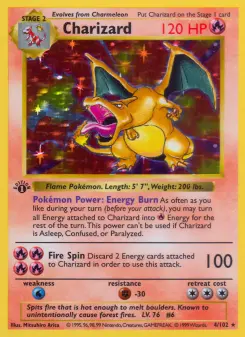
The average runs high because the catalogue is lopsided, and badly. The dearest 214 printings, one percent of the 21,412, hold 38.4% of the $451,170.93. The dearest tenth holds 84.6%. Go the other way and 11,059 printings, 51.6% of the catalogue, ask under a dollar, and all of them together hold 0.78% of the total. An average takes the value sitting in a few hundred cards and smears it evenly across twenty one thousand. If your collection holds one of those few hundred, a Charizard from Base Set asking $928.06 say, price that one on its own page. If it doesn't, the catalogue average is describing somebody else's box.
The dearest tenth of the catalogue holds 84.6% of the money
Sort by era, then price the few cards that matter
Split the cards into piles by age. The copyright year prints along the bottom edge of every card, and the worksheet further down gives the years each era's sets were published, so a card stamped 2008 goes in the Diamond & Pearl pile. Six years sit on a boundary between two eras: 2003, 2007, 2011, 2013, 2019 and 2025. A card stamped with one of those can't be placed on the year alone, so use whichever of the two eras has the lower median and your total stays on the cautious side.
Count each pile, multiply each count by its era median, add the results, and the bulk has a defensible figure. Then go back through everything and pull out the cards that are plainly special: the ones with a shiny holographic finish, the full-art cards whose picture runs right to the edges, any card numbered higher than the set total printed beside it, and anything printed before 2004. That last pile is the Wizards of the Coast era, WotC for short, named for the company that printed the English cards until 2003. Price those cards one at a time on their own pages. That's where the answer lives. Across the catalogue, 3,023 printings ask $20 or more, which is 14.1% of the cards and 89.8% of the money.
The middle card of each era, in cents
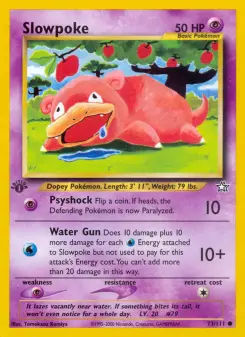
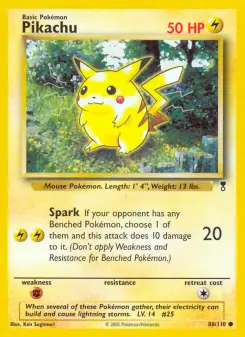
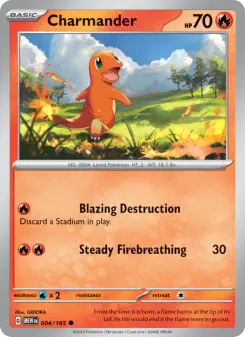
The middle printing from 1999 to 2003 asks 34.5 times the middle printing from 2023 to 2025, and the two can look identical sitting in a binder page. Slowpoke from Neo Genesis asks $7.60 and sits exactly on the WotC median. Charmander from 151 asks $0.27. Both are plain Commons, and twenty five years of attrition is the whole of the gap between them. A famous name doesn't rescue a Common either: Pikachu from Legendary Collection asks $6.55, a dollar below the median of its own era. Age doesn't sort the ten eras perfectly. Three of them have a dearer middle card than the era before them. HeartGold & SoulSilver is the big one, $2.74 against Diamond & Pearl's $1.46, and it's also by far the smallest era on the list, 544 printings against 893 for the next smallest. The other two gaps are slight: Sun & Moon beats XY by 16 cents and Mega Evolution beats Scarlet & Violet by a penny.
Era worksheet, October 10, 2026
| Era | Years its sets were published | Printings priced | Median ask | Middle half asks | Share asking $20 or more |
|---|---|---|---|---|---|
| Wizards of the Coast | 1999 to 2003 | 1,781 | $7.60 | $1.73 to $34.70 | 33.5% |
| EX era | 2003 to 2007 | 1,869 | $3.14 | $1.10 to $23.43 | 27.2% |
| Diamond & Pearl | 2007 to 2009 | 1,412 | $1.46 | $0.50 to $9.27 | 16.7% |
| HeartGold & SoulSilver | 2010 to 2011 | 544 | $2.74 | $0.61 to $16.71 | 24.3% |
| Black & White | 2011 to 2013 | 1,298 | $0.83 | $0.37 to $6.17 | 13.9% |
| XY | 2013 to 2016 | 1,683 | $0.49 | $0.25 to $6.43 | 15.4% |
| Sun & Moon | 2017 to 2019 | 2,811 | $0.65 | $0.26 to $8.39 | 15.7% |
| Sword & Shield | 2019 to 2022 | 3,557 | $0.34 | $0.15 to $3.15 | 5.4% |
| Scarlet & Violet | 2023 to 2025 | 3,560 | $0.22 | $0.14 to $3.22 | 7.8% |
| Mega Evolution | 2025 to 2026 | 893 | $0.23 | $0.14 to $2.45 | 7.1% |
Read the middle-half column before you trust a median. In the Wizards of the Coast pile a quarter of the printings ask under $1.73 and a quarter ask over $34.70, so that $7.60 is a centre of gravity and any one card can sit a long way from it. The spread is why the method has a fourth step. A pile of 300 Sword & Shield cards really is worth roughly 300 times 34 cents, because 94.6% of that era asks under $20. A pile of 300 WotC cards isn't, because a third of that era clears $20 and one printing in ten asks $123.87 or more.
On a third of the catalogue the selling fee eats the whole sale
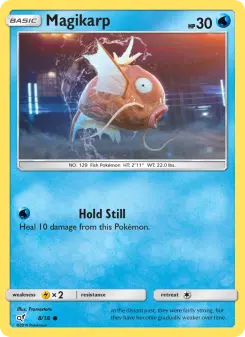
Now add the cost of selling. An ask is what a seller wants; what a seller receives is that ask minus a fee that doesn't scale with the card. eBay publishes a final value fee for trading cards of 13.25% of the sale for a seller with no store subscription, plus a flat per-order fee of 30 cents on orders of $10 or less and 40 cents above that. The percentage is survivable. The flat 30 cents does the damage, because it's the same 30 cents whether the card sold for $500 or for 20 cents. On a card asking exactly the median $0.88, say Magikarp from Detective Pikachu, the fee comes to $0.42, which is 47.3% of the sale, and the seller keeps $0.46. On 7,440 of the 21,412 printings, 34.7% of them, the fee is at least the whole sale price. On 10,487, 49.0%, it's at least half, and those 10,487 printings together hold $2,995.43 of the catalogue's $451,170.93, or 0.66%.
Share of each era where the published fee is at least the whole sale
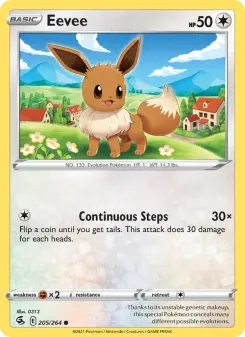
Hold the two era charts side by side and a modern collection takes shape. The middle Sword & Shield card asks 34 cents and the published fee on it is 35 cents, so the middle card of a 3,557-printing era is a penny underwater on its own single sale. Mega Evolution's middle card is 10 cents underwater and Scarlet & Violet's is 11 cents. Eevee from Fusion Strike is a real example at $0.23 against a $0.33 fee. Go back far enough and the problem disappears. In the Wizards of the Coast pile the fee exceeds the sale on 8 printings out of 1,781.
The fee schedule also shows the way out. The 13.25% is charged per item and the flat fee is charged per order. Sell 100 cards one at a time at the Common and Uncommon median of $0.28 and the fees total $33.71 against $28.00 of sales. Put the same 100 cards in one listing and the fee on a $28.00 order is $4.11. Same cards, same gross, and 8.2 times the fee for selling them one at a time. We hold no prices for bulk lots, and a lot won't fetch the sum of 100 single asks, so that's a comparison of fees and you shouldn't read it as a payout. It's still the clearest reason to sell the cheap half of a collection as a lot and the dear half one card at a time.
Six printings, and what each one tells you about your own pile
Four steps you can do at a kitchen table
One. Split the collection into piles by the copyright year on the bottom edge, taking the lower-median era wherever a year is shared, and count each pile. Two. Multiply each count by its era median from the worksheet, add them up, and write that down as the bulk figure, knowing it sits above the truth because commons run below the era middle. Three. Pull every holographic card, every full-art card, every card numbered above its set total and everything printed before 2004, and price those individually. Four. Sort the individually priced cards by ask. A $5 card hands 19.3% of the sale to the fee and a $2 card hands over 28.2%, so anything under about $2 goes into the lot with the bulk.
The number usually disappoints, and it's still the one worth having, because it decides whether you spend an afternoon listing cards or ten minutes bagging a lot. Where the Money Sleeps measures how concentrated the top of this market is, The Most Expensive Pokémon Cards Right Now names the cards sitting at the top of it, and Is Grading Pokémon Cards Worth It? runs this same fee-against-value arithmetic for anybody tempted to send a card away to be graded.
Population: 21,412 distinct English products holding a TCGplayer product id with a recorded price on day 20736 of our daily price record, October 10, 2026. Prices come from one pass over price_history on that day joined to the catalogue on tcg_id and aggregated in JavaScript. The catalogue holds 24,735 English rows, 21,692 of them carrying a product id; 21,654 had a reading that day, and those collapse to 21,412 distinct products because alias rows claim the same product id. Each product is counted once, at the flagship-printing market price stored for that day, which is the price column of price_history; that table carries a second column, price_min, which goes unused here. Taking the lower of the two recorded columns for each product instead would move the total to $444,199.83 and the median to $0.86. Taking price_min on its own would move them the other way, to $481,704.58 and $0.92, because that column sums higher than the one used here across the whole day despite being described as the cheapest printing. All prices are near mint market asks for ungraded copies, and none is a completed sale. Medians and percentiles both take the upper value on even samples, the element at index floor(p/100 * n) of the ascending array. Switching to nearest-rank moves three figures in the middle-half column, Diamond & Pearl's 75th percentile to $9.25 and HeartGold & SoulSilver's quartiles to $0.60 and $16.65, and leaves the other eight eras identical; the one median it moves is HeartGold & SoulSilver's, to $2.71. Total ask $451,170.93, mean $21.0709, median $0.88, 25th percentile $0.23, 75th percentile $6.79, 90th percentile $34.99; the catalogue median and all three of those percentiles read the same under either rule. Era figures come from the same prices joined to the era label in report_features, which exists only for the products our research pipeline scores: 20,453 of the 21,412, of which 19,408 fall in the ten named eras and 1,045 in an unclassified or Japanese-origin bucket that is omitted from the era charts. Deduplicating on product id makes our era counts slightly smaller than an undeduplicated join would (Wizards of the Coast 1,781 against 1,784 undeduplicated, Sword & Shield 3,557 against 3,587); every era median is unchanged either way. The years beside each era are the narrowest span of TCGplayer group publication years covering at least 90% of that era's priced products, so a reprint of an older card inside a newer product group falls outside the printed span. Five of the 19,408 era-placed products carry no published group year at all, one in Sun & Moon and two each in Scarlet & Violet and Mega Evolution, and the coverage count below treats those five as outside the span, so five gaps in the provider's data sit in that count alongside the genuine off-span printings. The span covers every priced product in four of the ten eras, Wizards of the Coast 1,781 of 1,781, Diamond & Pearl 1,412 of 1,412, HeartGold & SoulSilver 544 of 544 and Black & White 1,298 of 1,298, and 90.3% at worst, in the EX era, where every product the span misses does carry a published year, just one outside 2003 to 2007. Selling fees are eBay's published final value fee for Trading Cards for a seller without a store subscription, 13.25% of the sale plus $0.40 per order above $10.00 and $0.30 at or below it, read from eBay Seller Center on September 23, 2026 and applied as one card per order unless stated otherwise. That schedule is an external input we cannot reproduce from our own data, eBay can change it without telling anybody, and roughly a third of the argument here rests on it, so check eBay's current rate before you lean on any net figure above. Shipping, packaging, postage to the buyer and any payment-processing or sales tax beyond that published fee are not counted, so every net figure here is a ceiling. Japanese-language printings are excluded throughout. Nothing here is financial advice.