The Pokémon Trading Card Game is a game, and the Pokémon card market is a market, and it is worth checking how much the two have to do with each other. We record competitive meta share from tournament decklists: for every card name, the share of decks running at least one copy. On August 31, 2026 that sample covered 2,586 decklists from 50 tournaments and 656 distinct card names. Line those up against live prices and the relationship is almost invisible. The most important card in the format costs twenty-six cents.
The staples cost nothing
The nine cards that appear in more than half of all decks have a median cheapest printing of $0.26. The 385 names that appear in under one percent of decks have a median cheapest printing of $0.15. That is the entire measurable effect of being essential to the game: eleven cents. It is a real effect, and it is a floor rather than a premium. A card that every deck needs cannot fall to true bulk pricing, because there is a permanent bid from players who need four copies and do not care which printing they get.
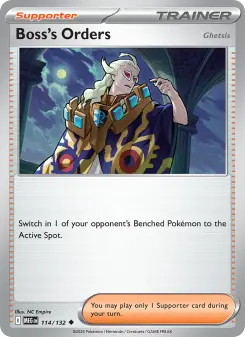
The individual rows make the point better than any band table. Boss's Orders in the Mega Evolution printing is $0.26 and appeared in 2,330 decks. Night Stretcher from Ascended Heroes is $0.24 at 84.5% of decks. Buddy-Buddy Poffin from the same set is $0.15 at 69.1%. Poké Pad from Perfect Order is $0.32 at 82.1%. Four of the most played cards in competitive Pokémon, all available for less than the sales tax on a booster pack. The pattern breaks in exactly one place worth naming: Fezandipiti ex at 61.8% of decks has a cheapest printing of $3.76, because it is a Pokémon rather than a trainer and its cheapest legal print is itself a mechanic card.
The same name, two economies
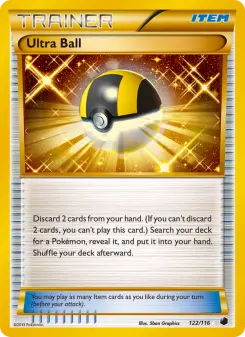
Meta share attaches to a card NAME, because a deck plays Ultra Ball regardless of which Ultra Ball you sleeve. That is a limitation in most analyses and an advantage in this one, because it lets us watch the two economies split inside a single name. Ultra Ball is in 79.8% of decks and its cheapest printing is $0.17. Its priciest printing, the Plasma Freeze full art, is $698.84. Same name, same text, same function, and a price ratio above 4,000 to one. Nobody is paying $698.84 for a search card. They are paying it for a 2013 full art, and the game is not in the room.
One name, two prices
| Card name | Share of decks | Cheapest printing | Priciest printing |
|---|---|---|---|
| Ultra Ball | 79.8% | $0.17 (Ascended Heroes) | $698.84 (Plasma Freeze) |
| Rare Candy | 34.5% | $0.16 (Pokémon GO) | $183.76 (Plasma Blast) |
| Shaymin | 37.4% | $0.03 (Prismatic Evolutions) | $91.89 (Platinum) |
| Boss's Orders | 90.1% | $0.26 (Mega Evolution) | $17.29 (Paldea Evolved) |
| Budew | 34.0% | $0.21 (Prismatic Evolutions) | $9.79 (Stormfront) |
| Meowth ex | 52.2% | $2.10 (Perfect Order) | $123.69 (Perfect Order) |
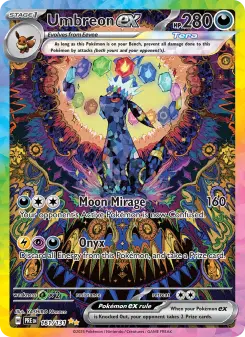
Run it the other way and the separation is starker. Take the 200 most expensive English printings we price, everything from $400 up. Twenty of them carry a name that appeared anywhere in the August 31 tournament sample, and the median meta share of those twenty names is 0.23%. The most valuable card whose name shows up at all is Umbreon ex from Prismatic Evolutions at $1,456.79, and its name appears in 0.04% of decks, which is one deck in the sample. Pikachu ex from Ascended Heroes at $1,033.08 sits at 0.12%. Mega Gengar ex at $975.64 sits at 0.27%. The one genuine exception is the Skyridge Alakazam at $1,200.97, whose name runs at 8.6% of decks purely because a fifty-cent modern Alakazam is a playable card and shares the name. That is the limitation of name-level matching, printed rather than hidden, and it is the only reason any expensive card in this list looks played.
The one place the game does move prices
The game does not set the ceiling, but it can take the floor away. In our year-long study of weekly price tape, Nothing Moves Together, the worst performers in a 741 card cohort include former format staples whose competitive life ended: Counter Catcher at minus 49.1%, Counter Gain at minus 48.3%, Field Blower at minus 43.2% and Max Potion at minus 29.5%, over a year when 85% of that cohort rose. Those are cards whose price was a player bid, and the player bid expired. A staple is worth twenty-six cents while it is legal and considerably less afterwards.
Prices here are single-day quotes, and quotes move less often than anyone assumes: see The Frozen Tape for how long the typical one sits unchanged.
Playability source: the moonstone playability snapshot table, which aggregates public tournament decklists into a per-card-name meta share for the standard format. This study uses a single dated cross-section, the snapshot of August 31, 2026, covering 656 card names, 2,586 decklists and 50 tournaments; five earlier samples, dated July 30, August 3, August 10, August 17 and August 24, 2026, are held but not pooled, because a card that stops being played simply stops appearing and pooling latest-available rows would mix dates. 655 of the 656 names match at least one English printing carrying a market price on September 2, 2026, matched case-insensitively; the earlier case-sensitive match undercounted, which is why the priciest-printings tally reads 20 here and 17 in an earlier draft. Prices are TCGplayer market prices, ask-derived. Meta share attaches to the card NAME rather than the printing, which is a genuine limitation: an expensive alternate art inherits the play rate of its cheap counterpart, and format legality is not stored per printing, so several of the priciest printings named here are not legal in the format their name is played in. The cheapest-versus-priciest design is our answer to that limitation rather than a workaround for it: the cheapest printing is the copy a player actually buys, the priciest is a collectible with the same text. Correlations are Pearson on logs. A floor of 0.0001 is added to meta share before the log, and it should be understood as inert rather than protective: every name in this sample appears in at least one decklist, the smallest observed share is 0.0004, and the floor changes the correlations by 0.001 or less. The real truncation is upstream of it. Names that no deck played are absent from the snapshot entirely, so the regressor is censored from below and the correlations describe the played population, not all cards. The 200 priciest printings are ranked on the same September 2 price snapshot. Not financial advice.