A set index is usually dismissed as a proxy for one or two chase cards. Measured across 41 fixed-basket set indices built from 2,494 English cards, that is half right and the wrong half is the interesting one. The top five cards held a median 57.2% of a set's value at the start of the window, but carried a median of only 45.6% of the value that set added over it. In 32 of 41 sets the top five contributed a smaller share of the move than of the level, and a median 94.9% of every basket's cards rose. The set index describes something broader than its own chase cards.
How a fixed basket is built
Our set-value series is a sum over the cards we price, which means it moves when the card list moves and when the printing we quote changes, and that makes it useless for asking which cards drove a change. So this study does not use it. For every English card whose own weekly price series reaches back to February 10, 2025 and forward past September 1, 2026, we froze the constituent list at the window open. A set qualifies when at least ten of its cards clear that bar. That is 2,494 cards in 41 sets, after one row per TCGplayer product id is kept. No card can join a basket mid-window and none can leave, so every number below is a statement about prices.
Two indices are computed per set. The value-weighted index is the basket's total value at close over its total at open, which is what a set index means. The equal-weighted index is the median of the individual card moves, which is what the typical card in the set did. The difference between them is the chase premium, expressed as a number.
Where a set's move actually came from, selected baskets
| Set | Cards in basket | Typical card | Set index | Top-5 share of value | Top-5 share of the move |
|---|---|---|---|---|---|
| Evolving Skies | 114 | +48.7% | +40.4% | 63.8% | 40.5% |
| Chilling Reign | 111 | +39.1% | +31.1% | 49.4% | 30.4% |
| Cosmic Eclipse | 94 | +101.6% | +119.6% | 33.3% | 32.2% |
| Hidden Fates Shiny Vault | 94 | +101.0% | +82.8% | 53.3% | 39.3% |
| Unbroken Bonds | 85 | +141.1% | +120.8% | 43.9% | 34.1% |
| Lost Thunder | 79 | +97.7% | +135.2% | 39.9% | 33.2% |
| Fusion Strike | 77 | +45.1% | +35.9% | 83.5% | 72.0% |
| Lost Origin | 70 | +38.6% | +27.8% | 83.4% | 84.2% |
| Team Up | 68 | +97.5% | +172.7% | 48.2% | 55.6% |
| Generations | 65 | +163.5% | +148.4% | 51.9% | 34.8% |
| Celebrations | 23 | +92.9% | +105.9% | 89.1% | 82.4% |
| Shining Legends | 27 | +91.7% | +150.8% | 82.2% | 86.2% |
Evolving Skies is the set most often described as two cards with a checklist attached, and its own basket disagrees in a specific way. Five cards hold 63.8% of the basket's value, but they carried 40.5% of its move, and the typical card in the set did better than the set index did. The Set That Ate the Modern Market is right about the level and this is the correction about the motion: the concentration is real and it is not what moved.
The chase premium, measured both ways
Across all 41 baskets the median equal-weighted move sits 2.0 percentage points below the median value-weighted move, and in 20 of 41 sets the typical card actually beat the set index. That is close to a coin flip, which is itself the finding: over this window, owning the median card of a set was about as good as owning the set. The tails are wide in both directions and they point at product type rather than at set quality. The three widest gaps in the whole population belong to split-checklist trainer kits rather than expansions, the two extremes being the SM Lycanroc kit at 266.9 points above its own index and the XY Pikachu Libre kit at 240.5 points below it, on baskets of 36 and 25 cards. The table below holds the expansions, five above their index and six below, contiguous at each end of the ordered list.
The widest expansion gaps between the typical card and the set index: five above, six below
| Set | Cards | Typical card | Set index | Gap |
|---|---|---|---|---|
| Hidden Fates | 17 | +118.4% | +84.6% | +33.8 points |
| Ultra Prism | 62 | +78.1% | +50.3% | +27.8 points |
| Celestial Storm | 62 | +116.0% | +89.1% | +26.9 points |
| Unbroken Bonds | 85 | +141.1% | +120.8% | +20.3 points |
| Hidden Fates Shiny Vault | 94 | +101.0% | +82.8% | +18.2 points |
| Lost Thunder | 79 | +97.7% | +135.2% | -37.5 points |
| Dragon Majesty | 35 | +61.7% | +100.0% | -38.3 points |
| Steam Siege | 44 | +68.4% | +112.4% | -44.0 points |
| EX Power Keepers | 25 | +115.0% | +170.8% | -55.8 points |
| Shining Legends | 27 | +91.7% | +150.8% | -59.1 points |
| Team Up | 68 | +97.5% | +172.7% | -75.3 points |
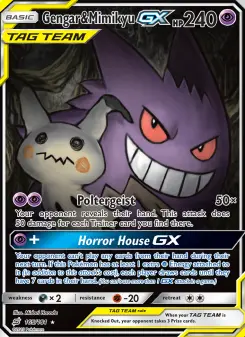
Where the set index beat the typical card, one card usually did it. In Team Up that card is Gengar and Mimikyu GX, which rose 266.1% while holding 19.9% of the basket's opening value and delivering 30.6% of its move. In Shining Legends it is Mewtwo GX at 54.2% of the value and 52.1% of the move. In Steam Siege it is Gardevoir EX, 22.6% of the value and 29.7% of the move.
The eight expansions whose single biggest contributor carried the most of the move
| Set | Card | Card move | Share of basket value | Share of the basket's move |
|---|---|---|---|---|
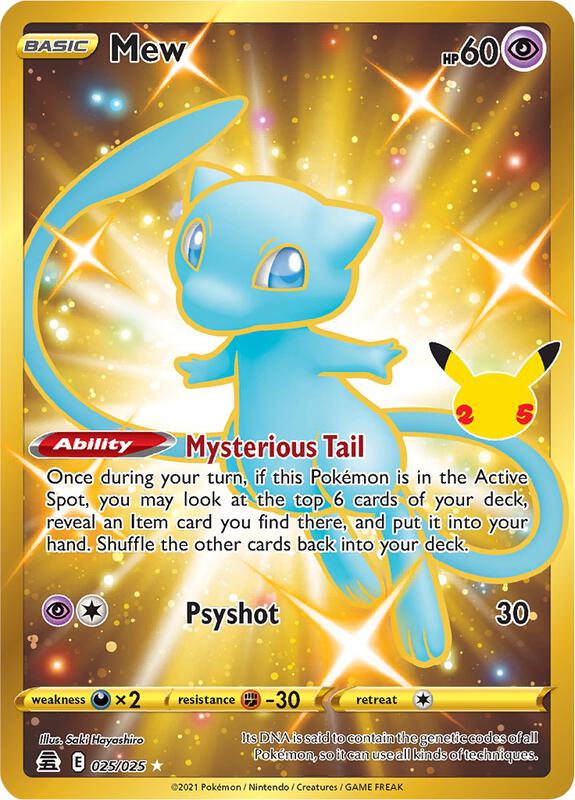
| Celebrations | Mew | +81.3% | 71.4% | 54.8% |
| Shining Legends | Mewtwo GX | +144.8% | 54.2% | 52.1% |
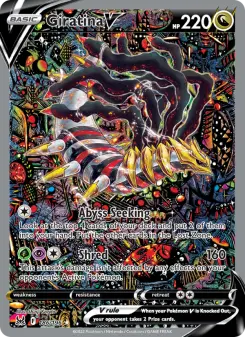
| Lost Origin | Giratina V | +22.1% | 65.0% | 51.7% |
| Fusion Strike | Gengar VMAX | +38.8% | 44.6% | 48.3% |
| Burning Shadows | Charizard GX | +85.5% | 43.4% | 46.0% |
| Sun and Moon | Umbreon GX | +175.3% | 12.0% | 38.2% |
| Team Up | Gengar and Mimikyu GX | +266.1% | 19.9% | 30.6% |
| Steam Siege | Gardevoir EX | +147.5% | 22.6% | 29.7% |
That table is the top of an ordered list of all 41 baskets with the trainer kits and the McDonald's collections taken out, and it stops where the list does, not where the story does. Three kits and two collections sit inside the range it covers, and one basket sits above all of it: the XY Pikachu Libre kit, where Pikachu Libre carried 71.6% of the move and is the only card in the population to carry more than 60% of its basket. Outside those, no single card carried more than 54.8% of its set's move, and the three that came closest, Mew at 54.8%, Mewtwo GX at 52.1% and Giratina V at 51.7%, did it by holding 71.4%, 54.2% and 65.0% of their baskets to begin with. A set index is not one card. On the evidence here it is the median card plus a modest chase tilt, and the tilt is smaller in motion than the concentration tables suggest.
What would overturn this
A window in which the top five cards carry more than 57.2% of the move, not less, would invert this. That is exactly what a drawdown might do: this window is one in which nearly every card rose, and broad advances flatten concentration by arithmetic. If a falling window shows the chase cards carrying the bulk of the decline while the body of the set sits still, then the correct statement is that a set index tracks its chase cards downward and its whole checklist upward, which is a different and more useful claim than either of the ones usually made. The measurement to run is the same one, on the next window that goes the other way.
What this study cannot show
Forty-one sets is a narrow population and it is not random: a set qualifies only when ten or more of its cards carry a weekly series reaching back to February 2025, which favours sets that were commercially interesting in early 2025. Eighteen of the 41 are Sun and Moon era, and no expansion released after September 2022 qualifies at all, so this says nothing about how a current set's index behaves. A basket of ten to 300 cards is not the set: a 264-card set represented by 77 cards is a sample, and the cards missing from it are the cheapest ones. Two of the 41 baskets are promo bins rather than expansions, and they are the two largest. Prices are asks. The top-5 share of the move can exceed 100% or go negative when a set's total change is small, so the median is reported rather than the mean, and the two extreme baskets in that condition are the trainer kits named above the gap table rather than rows inside it.
Population: English cards with a `ppthist:` weekly price series whose first reading falls on or before 2025-02-10 and whose last falls on or after 2026-09-01, joined to sets through `cards.set_name`, restricted to sets holding at least ten such cards, and deduplicated to one catalog row per TCGplayer product id: 2,494 cards in 41 sets. Constituents are frozen at each card's first reading on or after 2025-02-10 and closed at its last recorded reading. The value-weighted index is the sum of closing prices over the sum of opening prices. The equal-weighted index is the median of the per-card ratios, upper middle on even samples. Top-5 membership is by opening price, with ties broken by catalog id so the choice is reproducible; one basket, the SM Lycanroc trainer kit, has two twelve-cent commons tied at the fifth slot, and which one is taken moves its share of the move by one point and the 41-basket median with it. Share of the move is the five cards' summed dollar change over the basket's total dollar change, so it is undefined for a basket with no net change and unbounded for a basket with a small one; medians are used throughout for that reason. Prices are TCGplayer market asks for the flagship printing. Set-level concentration measured as a one-day cross section across a much wider population is in What 56,000 Cards Say About How Sets Hold Value; this study measures concentration of the CHANGE, which is a different quantity. Not financial advice.