The hobby's standing belief is that the Japanese print is cheaper. It is one of those beliefs that is true on average and wrong in most individual cases, which is the worst kind of belief to trade on. We matched eleven English sets to their verified Japanese counterparts, card by card on the shared English name, and got 755 pairs where both legs carry a live canonical price. The median Japanese card in that sample costs 0.909 times its English twin and only 52% of pairs are cheaper in Japanese, so the folk wisdom barely survives as a central tendency at all. Split the sample by what the English card costs and the sign flips outright: below about a quarter, the Japanese card is usually the MORE expensive one, and above a hundred dollars it costs about seventeen cents on the English dollar. This is not a discount applied to a market. It is a market with a flatter price ladder.
The specification, stated before the result
Both legs are canonical printing prices from the same daily TCGplayer sync, which means this is Japanese cards on a WESTERN marketplace measured against English cards on the same marketplace, not Tokyo against Los Angeles. That framing belongs in the first paragraph rather than the footnotes, because it decides what the result can be used for. The tempting model is a ratio model: regress the JP/EN ratio on the English price. It would produce a large negative coefficient and it would prove nothing, because the English price sits in the denominator of the dependent variable and the slope is guaranteed before a single card is measured. So we do not run it. The specification is the log of the Japanese price on the left and the log of the English price on the right, a form with no arithmetic obligation to slope any particular way and which could have come out at 1.00, meaning the two markets differ by a constant multiple. It does not. Across 755 matched pairs the coefficient is 0.732 with a standard error of 0.011, 24.7 standard errors below 1.00, and the fit explains 85.9% of where a Japanese price lands. Restrict the sample to the 563 pairs where each side has exactly one priced printing, removing every case where a set-size difference could let the join pick a cheaper base print on one side, and the coefficient is 0.728 with a standard error of 0.012. The result does not depend on the loose join.
The ladder, rung by rung
Japanese price relative to its English counterpart, by English price band, September 2, 2026
| English price band | Pairs | Median EN | Median JP | Median JP/EN | Share cheaper in JP |
|---|---|---|---|---|---|
| Under $0.25 | 382 | $0.12 | $0.15 | 1.360x | 27% |
| $0.25 to $1 | 87 | $0.68 | $0.46 | 0.742x | 68% |
| $1 to $5 | 109 | $2.12 | $1.64 | 0.766x | 61% |
| $5 to $20 | 78 | $11.11 | $4.38 | 0.368x | 88% |
| $20 to $100 | 63 | $36.80 | $10.30 | 0.253x | 98% |
| Over $100 | 36 | $274.63 | $48.11 | 0.170x | 94% |
The top two bands are thin and are stated with their counts for that reason: 63 pairs from $20 to $100 and 36 pairs above $100. They are also the two bands where the direction is least in doubt, at 98% and 94% of pairs cheaper in Japanese. The bottom band is the interesting one and it is the one an earlier draft got backwards. At 382 pairs it is the best-populated cell in the table, and its median ratio is 1.360x with only 27% of pairs cheaper in Japanese, meaning the Japanese copy of a card at the floor is usually the DEARER one, by a third. Twenty-two of those 382 pairs are exact ties, which is what a shared price floor looks like from close up; an earlier draft reported the whole band as a 1.000x tie, which was floor ties standing in for a distribution that is not centred on parity.
Base Set against Base Expansion Pack, in one set
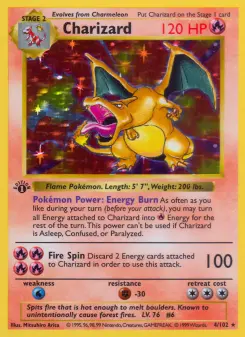
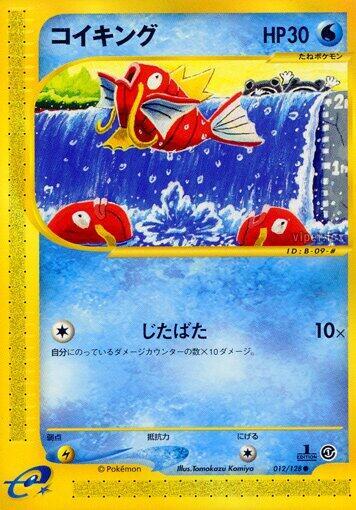
The whole effect is visible inside a single matched pair, which removes any worry that it is an artifact of mixing eras. Base Set against the 1996 Japanese Base Expansion Pack gives 35 matched cards. Fit the same specification on those 35 alone and the coefficient is 0.334 with a standard error of 0.049, a ladder three times flatter than the English one, inside one product. Charizard is $868.56 in English and $90.00 in Japanese, 0.10x. Blastoise is $225.89 against $24.99. Then walk down the checklist: Magikarp is $2.81 in English and $44.24 in Japanese, a 15.7x premium the other way. Haunter is $2.48 against $25.99. Vulpix is $0.87 against $10.21. The implied crossing point for this pair, where the two markets agree, is an English price of $20.52. Above it, buy Japanese. Below it, the English copy is the cheap one, often by a factor of ten.
Why the ladders differ
Two forces pull in opposite directions and both are supply stories. At the top, the English market carries the grading-driven bid: the registry, the population reports, the slab premium and the resale liquidity that comes with them are substantially English-market institutions, and they lift English chase prices without lifting Japanese ones. At the bottom, the Japanese leg is a low-depth import market for anyone buying it on a Western marketplace, and shipping, sourcing and listing friction put a hard floor under a Japanese common that an English common does not have to clear. A card that should cost four cents cannot be listed for four cents when a seller has to import and ship it. The result is a compressed ladder: the floor is raised and the ceiling is lowered, and every card in between gets priced on that narrower range.
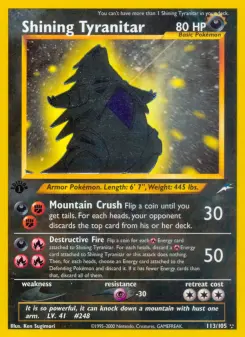
The era split makes the same point. The four Wizards-era pairs in the sample, Base Set, Gym Heroes, Gym Challenge and Neo Destiny, give 273 pairs with a coefficient of 0.618 and a standard error of 0.029, and the seven modern pairs give 482 with a coefficient of 0.514, standard error 0.024, on a noisier fit that explains 48.6% of the variance. The vintage cells contain the sample's largest verified gaps, and the Base Set exhibits above are part of that story rather than separate from it: Charizard alone opens a $778.56 gap. Elsewhere in the Wizards cells sit Shining Tyranitar at $4,249.99 in English against $400 in Japanese, Dark Scizor at $593.99 against $55.98, and Sabrina's Alakazam at $259.25 against $30.64. One thing about those English legs has to be said out loud. On the September 2 reading the printing our feed treated as canonical for the Wizards-era holos was, on several of them, the 1st Edition row rather than the Unlimited one: Shining Tyranitar's $4,249.99 is its 1st Edition Holofoil, and so is Sabrina's Alakazam's $259.25. Japanese sets carry no 1st Edition tier at all, so wherever that happens the comparison is the scarcer English printing against a plain Japanese one, and the vintage coefficient of 0.618 is flattered by exactly that much. Base Set is clean on this count, because those products carry a single blended holofoil row, which is why the Charizard and Blastoise exhibits above are unaffected. We measure the 1st Edition premium itself, and how far it runs, in the first edition census. Our Japan-only index covers the cards with no English leg at all; this piece is about the ones that have both.
The Gym Challenge leg is worth naming because it was wrong until this revision. An earlier version paired Gym Challenge with City Gym Decks, which is a Japanese DECK product rather than the expansion, and the correct counterpart is Challenge from the Darkness. Repairing it adds 26 pairs to the Wizards leg, taking it from 247 to 273, and moves the vintage coefficient from 0.596 to 0.618 on canonical prices. It also changes the exhibits: the Japanese Sabrina's Alakazam is $30.64 in the expansion, not the $22.65 deck copy an earlier draft quoted.
Both legs are canonical printing prices from moonstone's daily TCGplayer sync, read on September 2, 2026. That is the same instrument the card pages show, and a correction from an earlier draft of this piece, which read the flagship-printing field and therefore published English prices that its own card pages contradicted (Erika's Dragonair at $407.99 against the correct $117.63, for one). Those cache rows carry refresh stamps spanning July 29 to September 2, 2026, so this is a same-day comparison of two legs quoted by the same upstream marketplace rather than two independent instruments. Pairing method: English sets were matched to Japanese counterpart sets we verified individually, then cards were joined on the cleaned English card name within each set pair, taking the cheapest priced printing on each side. Rows whose names carry a pattern, jumbo, deck-kit or promo marker are excluded. That rule removes exactly ONE priced Japanese row from the eleven surviving pairs and therefore changes no coefficient here; the rationale an earlier draft gave for it, that such rows inflate the Japanese leg, is not supported, since across the whole Japanese catalog the marked rows carry a median price of $0.98 against $2.00 for everything else. The rule survives because it was the reason one candidate pair was dropped, not because it is doing work in the sample that remains. Two candidate pairs were dropped outright and are named so the exclusions are auditable: Paldean Fates, because the English set in our catalog is a shiny subset while its Japanese counterpart is a full set, so a name join crosses print tiers; and 151, because the exclusion left it with only two usable rows. Eleven set pairs and 755 card pairs survived. The strict robustness subsample keeps only names with exactly one priced printing on each side, n=563. Both regressions put the Japanese price on the left and the English price on the right; neither dependent variable contains its own regressor. Standard errors are classical and do not adjust for clustering within set pairs, which would widen them. Japanese legs are marketplace quotes on thinner listing depth than the English legs, so read the gap as a shape rather than an executable trade at size. Nothing here is financial advice.