The reverse holo is the printing people throw in the bulk box. On 4,528 products where the same dump priced both a reverse holofoil and an ordinary printing on the same day, read September 4, 2026, the reverse was worth more 95.54% of the time, and worth more than double on 50.13%. The median ratio was 2.03. This is not a rare card story. It is a story about the most common cards in every set.
One correction before the era table, because the published version of it did not survive its own audit. The table printed with this piece gave the EX era 112 pairs, which cannot be true beside the paragraph below it: Team Rocket Returns and Delta Species are both EX-era sets and the prose counts 95 and 107 pairs in them, 202 between them. No rule we can run against production reproduces the published rows. The table below is therefore rebuilt from a September 22, 2026 read, on the full coverage, with every era present rather than the six that happened to be printed.
The premium by era, rebuilt September 22, 2026 (reverse against its base printing)
| Era | Pairs | Median reverse / base |
|---|---|---|
| EX | 1,504 | 10.75x |
| HeartGold SoulSilver | 360 | 5.02x |
| Diamond & Pearl | 1,261 | 4.25x |
| WotC | 568 | 4.01x |
| Black & White | 1,129 | 2.92x |
| XY | 1,212 | 2.47x |
| Sun & Moon | 1,873 | 2.00x |
| Sword & Shield | 2,034 | 1.92x |
| Scarlet & Violet / Mega | 2,665 | 1.82x |
| Other | 189 | 4.27x |
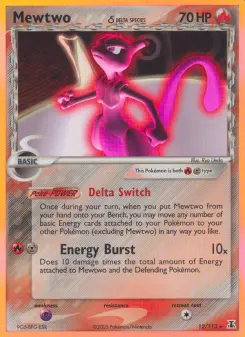
The era gradient is the mechanism. A modern set prints reverse holos of everything and they are easy to find, so the premium settles near 2x. The older the set, the fewer survived in condition, and the ratio climbs. EX Team Rocket Returns runs 12.68x across 95 pairs, with a median reverse of $65.00 against a median base of $5.82. EX Delta Species runs 8.49x across 107 pairs. At the other end, Champion's Path is 1.48x and only 75.9% of its pairs are above parity. The WotC row is the one to read carefully: at 4.01x it looks tame, and it is carried entirely by Legendary Collection, whose 110 cards run a median 48.22x while the three e-Card sets beside them sit at 3.20x to 3.50x. An earlier version of this piece published that WotC row as 11.15x on 110 pairs, which is the Legendary Collection card count exactly, and titled the article on it. A single set is not an era, and the title no longer says it is.
The cards that look like typographical errors
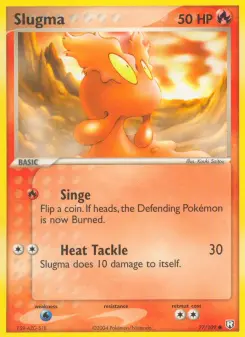
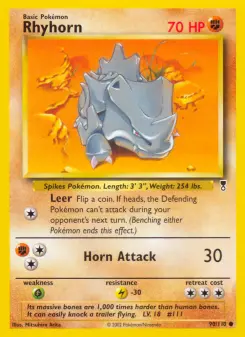
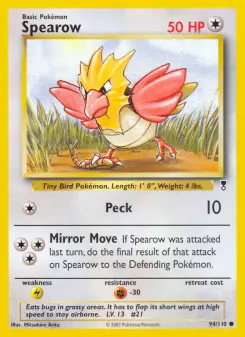
On the September 4, 2026 read, Rhyhorn from Legendary Collection was $0.48 as a normal printing and $92.46 as a reverse holo, a ratio of 192.6. Spearow in the same set was $0.56 against $100.00. Slugma $0.53 against $65.00. Magby $3.30 against $124.99. Bagon $1.11 against $57.50. Every one of these is a card most people would not look at twice in the ordinary printing. Those asks move, and the backfill has since put far more of the set on the board: by September 22 Rhyhorn read $0.59 against $69.93, a ratio of 118.5, and the widest gap we price is Dratini at 333x, $1.10 against $366.66. Treat the anchors as dated readings rather than as a standing ranking.
A later census of the same comparison, published September 28, 2026, is Are Reverse Holo Pokémon Cards Worth More?. It reads the premium lower than the recompute above, at 2.67x on 10,820 pairs, because on the per-printing store the printing coherence test this methodology reports as removing zero rows rejects 245 pairs, several of them the widest named on this page. That disagreement between two sources is stated in that article and is not resolved by either.
The pairs worth looking at, priced September 4, 2026
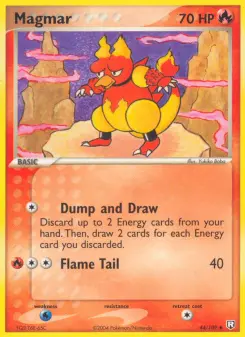
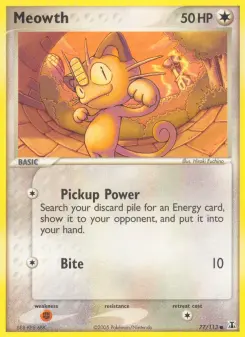
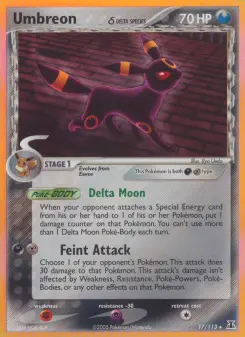
Population: per printing rows inside the daily TCGplayer dump, read September 4, 2026, restricted to products carrying a reverse holofoil printing and either a holofoil or a normal printing, both with a market price above zero. That is 4,528 pairs, 4,491 of which match a catalog card. Those per printing rows are a current-state store with no history, so the September 4 population cannot be rebuilt: a per printing backfill has since carried the same rule to 12,858 pairs, 12,795 of them catalog-matched, and every recomputed figure in this piece is dated September 22, 2026 where it appears. The pooled median moved 2.03x to 2.44x on that coverage, which the printings census adjudicates as a sample effect rather than a method one. The era table published on September 4 is not reproducible under any rule and has been rebuilt on current coverage, because its EX row of 112 pairs contradicted this article's own counts of 95 and 107 pairs in two EX-era sets. Both legs come from the same dump row on the same day at the same venue, so there is no time or venue misalignment. The codebase's own printing incoherence filter, which rejects a printing whose market price is below a third of its own listing floor, was applied and removed zero rows. Figures are medians and share above parity rather than means, because thin printings are noisy. Bucketing is by era and set only: we deliberately did not bucket by price band, because the base price is the ratio's denominator and banding on it would create a mechanical relationship. No regression is run.