A Pokemon card is not one product. The 21,908 distinct physical English printings in our catalog resolve to **34,433 separately priced products** on September 23, 2026: **64.3%** of the 20,912 English cards the marketplace prices are sold in two or more finishes, and 75 of them in three. Which one you own decides the price, and on the widest same-product pair in the catalog it decides it by 333 times.
The counter-intuitive part is where the multiple printings sit. They are concentrated at the bottom of the catalog. 95.75% of uncommons come in more than one finish, against 0.16% of Ultra Rares and not one of the 499 Illustration Rares or 228 Special Illustration Rares.
How many finishes, and what they are called
Printings per card
| Printings the marketplace prices | Cards | Share |
|---|---|---|
| One | 7,466 | 35.70% |
| Two | 13,371 | 63.94% |
| Three | 75 | 0.36% |
| Total cards | 20,912 | 100% |
The seven printing labels and what they ask
| Printing | Priced instances | 25th | Median | 75th | 90th |
|---|---|---|---|---|---|
| Reverse Holofoil | 12,491 | $0.31 | $0.82 | $7.58 | $36.31 |
| Normal | 12,188 | $0.17 | $0.32 | $1.11 | $5.99 |
| Holofoil | 8,076 | $1.78 | $6.72 | $27.48 | $102.64 |
| 1st Edition | 675 | $3.04 | $6.83 | $16.83 | $32.17 |
| Unlimited | 675 | $1.14 | $2.45 | $7.12 | $14.23 |
| 1st Edition Holofoil | 164 | $91.95 | $151.91 | $259.25 | $496.24 |
| Unlimited Holofoil | 164 | $38.53 | $65.73 | $146.24 | $382.44 |
Those seven labels are the entire vocabulary of English printing identity. Everything else a seller writes on a listing, holo, foil, shiny, pack-fresh, is a description of one of these seven or of a condition.
What each printing does to the price
Every ratio below divides two prices recorded for the same marketplace product on the same day, so there is no time or venue misalignment. This is a census of every English card where both legs are priced, not a sample.
Printing premiums, same-product pairs
| Base printing | Compared printing | Pairs | Median multiple | 25th | 75th | Compared printing wins |
|---|---|---|---|---|---|---|
| Normal | Reverse Holofoil | 10,857 | 2.79x | 1.83x | 5.73x | 98.55% |
| Holofoil | Reverse Holofoil | 1,671 | 1.23x | 0.98x | 1.65x | 72.89% |
| Unlimited | 1st Edition | 675 | 2.66x | 2.01x | 3.63x | 98.81% |
| Normal | Holofoil | 229 | 1.81x | 1.14x | 3.23x | 81.22% |
| Unlimited Holofoil | 1st Edition Holofoil | 164 | 2.38x | 1.84x | 2.91x | 94.51% |
Three earlier moonstone studies measured pieces of this table on smaller samples. Two reproduce closely; the third moved with its coverage rather than with its method. The Reverse Holo Is Not Filler put the reverse premium at 2.03x on 4,528 pairs, pooling reverse-against-normal with reverse-against-holo; separated here on 12,528 pairs they are 2.79x and 1.23x. Pooling is not what moved the number: recomputed today on the same pooling the figure is 2.45x, and the gap against 2.03x is the per-printing backfill that nearly tripled the sample rather than the split. The Reverse Holo Beats the Holo on Penny Cards put the reverse over holo at 1.21x winning 75% of 350 cards; on 1,671 cards it is 1.23x winning 72.89%. We Remeasured First Edition put the first edition premium at 2.59x on 838 pairs; on 839 pairs split by finish it is 2.66x unholo and 2.38x holo, with 17 inversions. One of those inversions is the Neo Destiny Shining Charizard the earlier study excluded and disclosed, whose 1st Edition Holofoil row still reads $19.99 against a $1,495 Unlimited Holofoil; this census keeps it, because it is a census, and says so.
The reverse holo premium over the normal printing, by era
| Era | Pairs | Median multiple |
|---|---|---|
| EX 2003-2007 | 1,319 | 12.59x |
| Diamond & Pearl to HGSS 2007-2011 | 1,480 | 5.10x |
| WotC 1999-2003 | 513 | 4.45x |
| BW and XY 2011-2017 | 2,148 | 2.88x |
| Sun & Moon 2017-2019 | 1,641 | 2.13x |
| Sword & Shield 2020-2022 | 1,774 | 2.06x |
| SV and Mega 2023-2026 | 1,982 | 1.86x |
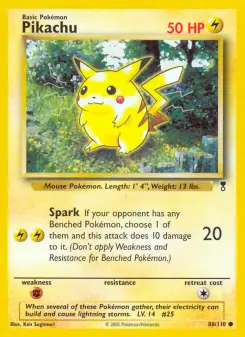
The gradient is supply. A modern set prints a reverse of nearly everything and they are easy to find, so the premium settles under 2x. The older the set, the fewer survived, and the ratio climbs. The extreme sits in Legendary Collection, whose reverse holos were a new idea in 2002 and are now the scarce half of a common card: Dratini asks $1.10 as a normal and $366.66 as a reverse, 333x; Pikachu asks $6.38 and $1,574.99; Charmander asks $2.03 and $616.33.
Reverse holofoil premium over the normal printing, by era
The cheap cards are the ones with options
Share of cards sold in more than one finish, by rarity tier
| Tier | Cards priced | Sold in 2+ finishes | Share |
|---|---|---|---|
| Uncommon | 4,707 | 4,507 | 95.75% |
| Holo Rare | 744 | 647 | 86.96% |
| Rare | 3,805 | 3,282 | 86.25% |
| Common | 5,789 | 4,882 | 84.33% |
| Secret / Hyper Rare | 777 | 74 | 9.52% |
| No rarity printed | 406 | 35 | 8.62% |
| Promo | 1,159 | 14 | 1.21% |
| Shiny / Radiant | 362 | 1 | 0.28% |
| Ultra Rare | 2,436 | 4 | 0.16% |
| Illustration Rare | 499 | 0 | 0.00% |
| Special Illustration Rare | 228 | 0 | 0.00% |
Almost every card the modern game treats as a chase comes in exactly one finish, and almost every card it treats as filler comes in two. That inverts the intuition that expensive cards are the complicated ones: the identification problem a buyer actually faces is concentrated in the bulk, where two physically different cards share a name, a number and an artwork and differ by 2.79x at the median.
Printings per card by era
| Era | Cards priced | Printings | Printings per card | Sold in 2+ finishes |
|---|---|---|---|---|
| EX 2003-2007 | 1,823 | 3,415 | 1.87 | 84.42% |
| Diamond & Pearl to HGSS 2007-2011 | 2,193 | 3,970 | 1.81 | 81.03% |
| WotC 1999-2003 | 1,783 | 3,191 | 1.79 | 78.97% |
| BW and XY 2011-2017 | 3,619 | 6,071 | 1.68 | 67.73% |
| Sun & Moon 2017-2019 | 3,024 | 4,900 | 1.62 | 62.04% |
| Sword & Shield 2020-2022 | 3,662 | 5,698 | 1.56 | 55.54% |
| SV and Mega 2023-2026 | 4,424 | 6,777 | 1.53 | 52.76% |
| Promos and side products | 384 | 411 | 1.07 | 7.03% |
How many printings a popular card really has
A buyer who searches a species name is choosing from more objects than the search results suggest. The species match below is a word-boundary match on the card name after folding case, accents and punctuation, so "Dark Charizard", "M Charizard EX" and "Charizard & Braixen-GX" all count and Charmander does not.
English physical cards, sets and separately priced printings
| Species | Cards | Sets | Printings | Cheapest ask | Median | Dearest ask |
|---|---|---|---|---|---|---|
| Pikachu | 237 | 103 | 271 | $0.19 | $16.69 | $1,899.99 |
| Charizard | 117 | 56 | 135 | $0.35 | $82.46 | $1,501.23 |
| Mewtwo | 95 | 45 | 111 | $0.54 | $39.46 | $3,000.00 |
| Eevee | 98 | 60 | 131 | $0.20 | $6.45 | $800.00 |
| Rayquaza | 63 | 34 | 76 | $0.38 | $144.00 | $2,500.99 |
| Snorlax | 59 | 45 | 87 | $0.23 | $25.44 | $733.99 |
| Gengar | 58 | 39 | 81 | $0.43 | $77.89 | $1,940.59 |
| Umbreon | 50 | 31 | 64 | $0.36 | $104.00 | $2,368.34 |
| Blastoise | 48 | 29 | 66 | $0.34 | $59.99 | $975.00 |
| Lugia | 47 | 28 | 50 | $0.58 | $47.75 | $4,500.00 |
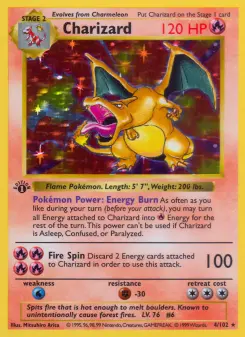
"A Charizard card" describes 135 separately priced objects spread across 56 sets, from a $0.35 printing to a $1,501.23 one. That is why a price guide answering with a single number is answering a different question from the one asked, and why The 10,872 Cards That Look Like Other Cards exists.
How a buyer tells them apart
First, the set symbol and the collector number, together. The number alone is not unique: 6,915 English cards, 31.56% of the catalog, share a name with another card in the same set. Second, the finish. A reverse holo has the foil on the card body and a plain artwork window; a holo has it the other way round. Third, on WotC-era cards only, the 1st Edition stamp to the left of the artwork, which is the difference between two rows in the table above and a median 2.66x. Fourth, the copyright line, which dates the print and separates Base Set from later reprints of the same artwork.
Those four checks, in that order, resolve every distinction the seven printing labels encode. Anything harder is a twin, and Same Picture, Ten Times the Price is the field guide to those, with The Twin Problem behind it.
The two sources do not always agree
Two independent sources describe printing identity here. The card catalog, TCGdex, declares which finishes a card was printed in. The marketplace prices the products that exist. Where both speak, they agree on 73.48% of 20,018 cards, and the disagreement is concentrated rather than random.
Catalog declaration against marketplace printings, by era
| Era | Cards compared | Agree | Marketplace prices more | Catalog declares more |
|---|---|---|---|---|
| Sword & Shield 2020-2022 | 3,543 | 99.29% | 0.08% | 0.62% |
| SV and Mega 2023-2026 | 4,303 | 95.51% | 0.60% | 3.88% |
| Diamond & Pearl to HGSS 2007-2011 | 2,123 | 95.20% | 0.75% | 4.05% |
| WotC 1999-2003 | 1,782 | 93.60% | 0.11% | 6.29% |
| EX 2003-2007 | 1,749 | 61.75% | 35.85% | 2.40% |
| Sun & Moon 2017-2019 | 2,928 | 39.92% | 59.94% | 0.14% |
| BW and XY 2011-2017 | 3,420 | 28.48% | 71.52% | 0.00% |
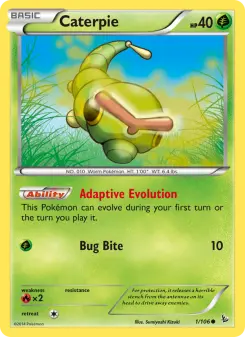
In four eras the two sources agree on better than 93% of cards. In the other three the catalog is missing the reverse holofoil: Caterpie from Flashfire is declared as normal-only and priced by the marketplace at $0.24 normal and $0.68 reverse. Every printing figure in this study is therefore computed from the marketplace side, which is complete, and the catalog declaration is reported only as this comparison.
What this study cannot show
It counts printings the marketplace prices, which is not the same as printings that were manufactured. A finish that exists but never trades, or trades only outside the venue we read, does not appear. Promotional stamps are a known case: a Pokemon Center stamped card is usually a separate product rather than a finish of the same one, so it is counted as a different card here. The Stamp Tax measures those directly.
It uses asks on both legs of every ratio. Asks and sold prices diverge most on thin products, and the 1st Edition rows are the thinnest in the table at 675 and 164 pairs. The direction of the premium is robust; the exact multiple on a single card is not.
Japanese cards are excluded entirely. Printing identity is not synced for them, and the Japanese game uses a different set of finishes.
What would overturn it
A run of sold comps showing the reverse holofoil at or below parity with the normal printing across a modern set would overturn the central premium, which currently wins 98.55% of 10,857 pairs. On the structural finding, a current-era Illustration Rare or Special Illustration Rare that the marketplace prices in two finishes would break the claim that the chase tier is single-printing: the count today is zero out of 727.
Population: the 21,908 distinct physical English printings defined in How Many Pokemon Cards Are There?, which is deduplicated on both the identity key and the marketplace product id so no product is counted twice. 20,912 of them carry per-printing rows in the nightly TCGplayer product dump that belong to their own product id; a printing row pointing at a different product, which the export writes when a product has no printings of its own, is discarded rather than credited to the card, because reading those quoted a [Staff] prerelease price as an ordinary card's price when the rule was first written. A printing counts when its own product owns the row and the row carries a market figure above zero: 34,434 owned printing rows exist and 34,433 are priced, the exception being the Normal row on Team Rocket Returns Dark Ampharos. The marketplace side is backfilled continuously, so these are one read rather than a stable total: a backfill batch landing while this study was being checked added several hundred newly priced products in a matter of minutes, and every marketplace figure here is taken from the single read before it. Rarity tiers are the eleven defined in Pokemon Card Rarity Chart and nowhere else, so Classic Collection, Jumbo, Pikachu Rare and Futuristic Rare sit in Ultra Rare here exactly as they do there. Pair ratios divide two market figures from the same dump row on the same day; both legs must be above zero. Multiples are medians, upper-middle on even samples, never means, because thin printings are noisy. Era buckets come from set name. The catalog-declaration comparison reads `cards.variant_flags`, TCGdex per-card printing identity as synced on 2026-09-06, decoded to a count of declared finishes, and compares it to the number of printing rows the marketplace prices for the same product; cards with no synced flags, 4.5% of the population, are excluded from that comparison only. Species counts fold case, accents and punctuation and match on word boundaries, never substrings. Prices are asks, not sold prices.