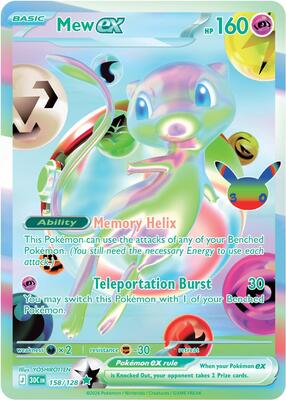
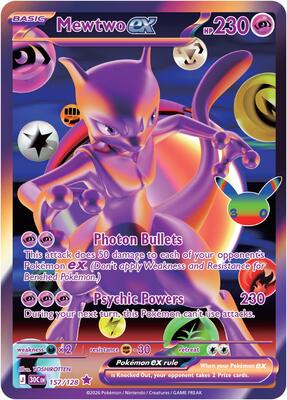
Start with the thing that is true and that almost nothing written about this set says out loud: there are no official pull rates for 30th Celebration. The Pokémon Company published none in Japanese and none in English, and TCGplayer, whose Infinite studies supply the measured odds on most of the set pages on this site, ran no study for it. Every percentage you have read, every one-in-N, every confident claim about a Futuristic rare per four boxes, traces back to somebody counting their own packs. That is not worthless. It is just a different kind of evidence, and it deserves to be labelled as one and checked against itself.
What is actually confirmed
The set's shape is not in question and it is worth laying out first, because the shape is what makes the missing odds matter so much. Two cards carry the top rarity. Not ten, not twenty. Two.
30th Celebration, confirmed structure
| Element | Confirmed |
|---|---|
| English pack | 5 foil cards plus a foil basic energy |
| Japanese pack | 6 foil cards, a different structure from the English pack |
| Guaranteed in every pack | one Pikachu from a 30-card subset, plus the energy |
| Base set | 103 cards |
| Illustration rares | 20 cards |
| Special illustration rares | 10 cards |
| Futuristic rares | 2 cards, Mew ex and Mewtwo ex |
| Classic Collection reprints | 30 cards |
| Booster box | none; the pack SKU is a 6-pack Booster Bundle |
That last row matters more than it looks. This set follows the Celebrations model rather than the normal one: there is no 36-pack booster box to buy, so the usual per-box arithmetic has nothing to attach to. The cheapest way to buy packs on our sealed desk is the Booster Bundle at $114.45 for six, which is $19.07 a pack, just under the single pack at $19.57. The Elite Trainer Box is $161.69.
Where the counts agree
Two community counts publish a full tier breakdown with a stated sample size: one of 652 packs assembled from several openings, one of 420. On everything except the top tier they land within a pack of each other, which is the sort of agreement that makes a number worth carrying.
Community pull-rate counts, 30th Celebration
| Tier | 652-pack count | 420-pack count | Agreement |
|---|---|---|---|
| Holo Pikachu | every pack | every pack | guaranteed slot |
| Double rare (ex) | 1 in 4.6 | 1 in 4 | within a pack |
| Illustration rare | 1 in 5.4 | 1 in 5 | within a pack |
| Classic Collection reprint | 1 in 10 | not reported | one source |
| Special illustration rare | 1 in 18 | 1 in 19 | within a pack |
| Futuristic rare | 1 in 82 | 1 in 105 | 28% apart |
Read the first five rows and you would conclude the odds for this set are well established. Read the last one and you should conclude the opposite, because the last one is the only row anybody is actually buying packs for.
Where they do not, and why it is the only row that matters
Across the counts we could find, the Futuristic rare tier is quoted at 1 in 82, 1 in 100, 1 in 105 and 1 in 134. The widest pair differs by 63%. That is not a rounding disagreement, it is the difference between two quite different products, and it comes from exactly where you would expect: the tier is rare enough that even a 652-pack sample contains only about eight of them. Eight events is not a rate, it is an anecdote with a denominator. The counts are honest about this; the pages quoting them onward usually are not.
There is a second problem underneath the first, and it is the one we would most want a study to settle. The Japanese and English packs are not the same product: six foil cards against five foil cards plus an energy. One of the two full counts is dated two months before the English set existed, which means it cannot have been measured on English packs. Whether the two printings share a seeding rate is an open question, and applying a Japanese-measured rate to an English box is an assumption nobody has tested. We carry the numbers because they are the best evidence available. We are not going to pretend they are the same evidence a 5,000-pack TCGplayer study provides.
What the disagreement costs you
Here is why the spread is not academic. Two cards share the Futuristic rare tier, so if they are seeded evenly, the expected number of packs to see one SPECIFIC one is double the tier rate. Priced at the cheapest pack route on our desk, that is what chasing Mew ex 158/128 costs under each of the circulating rates.
Expected cost of pulling Mew ex, by which community rate you believe
| If the tier is | A specific Futuristic rare is | At $19.07 a pack (bundle) | At $19.57 a pack (single) |
|---|---|---|---|
| 1 in 82 packs | 1 in 164 packs | $3,128 | $3,209 |
| 1 in 100 packs | 1 in 200 packs | $3,815 | $3,914 |
| 1 in 105 packs | 1 in 210 packs | $4,006 | $4,110 |
| 1 in 134 packs | 1 in 268 packs | $5,112 | $5,245 |
Every row of that table is worse than buying the card. The cheapest listed copy of Mew ex 158/128 is $1,289.90 right now. The most optimistic pull rate anyone publishes makes the expected chase cost 2.4 times that, and the most pessimistic makes it 4.0 times. You keep everything else you open, which is a real offset and the reason people rip anyway, but nothing in the rest of the set is close to covering a two-to-three-thousand-dollar gap: below the three headline cards the whole set quotes at $56 and under. The honest summary is that opening this set to get the Mew is a worse trade than buying the Mew, under every rate on offer, and the rates only argue about how much worse.
The comparison that makes this concrete is a set with a real study behind it. Mega Charizard X ex, the Phantasmal Flames chase, is measured at 1 in 1,260 packs from a 5,000-pack TCGplayer study, which our page turns into 400 expected packs and $4,421 of boxes against a $704.77 card. That is a far worse ratio, and we can state it with a confidence interval. Here we cannot state one at all. The problem with 30th Celebration is not that the odds are bad. It is that nobody knows what they are.
The sealed market's own answer
We track 47 sealed products for this set. Over the last 30 days, 34 of them are down, 10 are up and 3 have not moved. The falls are led by the small sealed items, the single-card-hunting formats: a Tech Sticker Collection down 52.0%, an ex Tin down 50.2%. What is rising is the display and collection end, the Ultra-Premium Collection up 49.1% and an Umbreon ex Battle Deck up 47.3%. That is a market pricing the set as something to keep rather than something to open, which is the same conclusion the table above reaches by arithmetic.
What we changed
The set is now in our pull-rate table and its odds render on the 30th Celebration page, with three things that other pages quoting these numbers do not carry. The source line says plainly that The Pokémon Company published nothing and TCGplayer ran no study, so the basis is community counts. The sample line names both counts and their sizes rather than a single tidy figure. And the Futuristic rare disagreement is recorded in the entry's own notes, 1 in 82 through 1 in 134. The panel itself prints the midpoint, 1 in 100, because the table has one slot per tier; the range is carried where the next person to touch this data will read it, not on the page.
Adding the set surfaced a bug worth naming, because it had been silently suppressing data rather than showing wrong data, which is the harder kind to notice. Our pull-rate lookup strips a leading set prefix so the curated table can be keyed on a plain name, then queried the catalog with the stripped value while the catalog stores the raw one. For this set the two spellings differ, so the entry could never be reached and the page rendered no pull-rate panel at all. Thirteen English sets carry a prefixed name and were exposed to the same failure. The lookup now matches both spellings, and while checking it we found 151 had the same problem one step further out: it is displayed as “Sv: Scarlet & Violet 151” while the catalog files it under “151”, so a set with a full 1,500-pack TCGplayer study behind it had been rendering no odds panel at all. Sets can now declare the other names they are shown under, as an explicit list rather than fuzzy matching, so a near-miss can never attach one set's study to another.
One more correction went in with it. The expected-per-box column divided by 36 packs for every set. This set has no booster box, so that column was quoting a quantity that cannot be purchased. Sets can now declare their own pack count, and this one declares six, the Booster Bundle. If you want the price side of this rather than the odds side, the quote behind that price covers what the Mew ex quote is actually made of, and the rip tax and no box pays for itself cover the general case.
Pull-rate figures are community pack-opening counts, not a published study, and not official odds: The Pokémon Company published no rarity odds for this set in either language before or after its September 16, 2026 worldwide release, and TCGplayer Infinite ran no study for it. Two counts publishing a full tier breakdown with a stated sample size are used: one of 652 packs compiled from several openings (201, 124, 100, 76, 58 and 33-pack sessions plus smaller ones) and one of 420 packs whose own publisher writes that it may not be accurate or reliable. Two further Futuristic rare figures, 1 in 100 and 1 in 134, come from a separately reported 750-pack community tracking effort and are included in the quoted range but not in the tier table. THE SAMPLES MAY NOT DESCRIBE THE SAME PHYSICAL PRODUCT: the Japanese pack holds 6 foil cards and the English pack 5 foil cards plus a foil basic energy, and the 652-pack count is dated two months before the English release, so it cannot have been measured on English packs. Whether seeding is shared between printings is untested. The specific-card derivation doubles the tier rate on the assumption that the tier's two cards are evenly seeded, which no source confirms. Sealed prices, the 47-SKU count and the 30-day changes are moonstone's own sealed tracking read on September 16, 2026; card prices are TCGplayer market and low prices read the same day. Expected chase costs are the expected pack count multiplied by a pack price and are gross: they do not credit the value of everything else opened along the way, which is real and is discussed in the body. Phantasmal Flames figures come from the TCGplayer Infinite study already carried in our pull-rate table (5,000+ packs) and our own page's derivation from it.