
Ask what share of Pokémon cards get a PSA 10 and there are two true answers that differ by seventeen points. Counting slabs, half of everything PSA has graded on the cards we track is a ten. Counting cards, the middle registry is a third tens. The gap is not a rounding error, it is the whole structure of the grading market: a small number of easy, heavily submitted modern cards dominate the slab count, while the typical card in the catalog is a good deal harder than the average slab suggests.
The number to cite, and the number to cite beside it
Across the 15,565 PSA registries moonstone records with a trusted ten count and nine count, 49.97% of all 22,274,556 slabs are tens, but the median registry is only 33.33% tens and holds more nines than tens on 56.51% of cards, as of September 22, 2026. Quote the first figure when you are talking about the supply of slabs. Quote the second when you are talking about the odds on a card.
The shape of the registry, two ways of counting (15,565 registries)
| Grade band | Pooled share of all 22,274,556 slabs | Median registry's share |
|---|---|---|
| PSA 10 | 49.97% | 33.33% |
| PSA 9 | 30.13% | 37.79% |
| Below a PSA 9 | 19.90% | 20.50% |
The three medians in the right column do not add to 100% and are not meant to. Each is the median across registries of that registry's own share, so they describe the typical card on three separate axes rather than partitioning one card. The pooled column does partition, and it sums to 100%.
The middle column is a population-weighted average, and the weights are extreme. 11,129,998 of the 22.3 million slabs are tens, and a disproportionate share of them sit on a few thousand modern cards that gem above 80%. That is why the pooled rate looks like a coin flip while the median card does not.
How far the ten share spreads
Ten share across 15,565 registries
| Percentile | Share of the registry that is PSA 10 |
|---|---|
| 5th | 3.81% |
| 10th | 7.26% |
| 25th | 17.91% |
| 50th | 33.33% |
| 75th | 50.00% |
| 90th | 66.67% |
| 95th | 78.95% |
Only 3,679 of the 15,565 registries, 23.64%, are majority tens. Sorted into deciles by ten share, the bottom decile runs from 0.08% to 7.26% and carries a median 71.06% of its slabs below a nine. The top decile runs from 66.67% to 97.91% and carries 3.25% below a nine. Those are two different products. One is a condition lottery, the other is a certification service.
Sorted by ten share and cut into ten equal slices
| Decile | Registries | Ten share range | Median nine share | Median share below a nine | Median registry size |
|---|---|---|---|---|---|
| 1 (hardest) | 1,556 | 0.08% to 7.26% | 24.89% | 71.06% | 398 |
| 2 | 1,557 | 7.26% to 14.29% | 40.00% | 49.28% | 88 |
| 3 | 1,556 | 14.29% to 21.43% | 44.45% | 37.50% | 79 |
| 4 | 1,557 | 21.43% to 27.87% | 47.83% | 27.27% | 60 |
| 5 | 1,556 | 27.87% to 33.33% | 45.45% | 23.81% | 43 |
| 6 | 1,557 | 33.33% to 40.00% | 43.20% | 19.91% | 96 |
| 7 | 1,556 | 40.00% to 47.37% | 40.38% | 15.93% | 136 |
| 8 | 1,557 | 47.37% to 53.95% | 39.13% | 10.45% | 72 |
| 9 | 1,556 | 53.95% to 66.67% | 32.11% | 7.83% | 287 |
| 10 (easiest) | 1,557 | 66.67% to 97.91% | 16.67% | 3.25% | 1,109 |
The sub-nine column is the one nobody publishes, and it is the column that decides whether grading is a gamble. At the median registry a fifth of everything sent came back below a nine, worth a fraction of the raw card. On 4,656 registries, 29.91% of the population, it is a third or more.
Bigger registries are easier registries
The ten share rises with registry size, from a median 33.33% under 100 slabs to 58.95% above 10,000. Both directions of causation are plausible and both are probably running: easy cards attract submissions, and cards that attract submissions are modern cards with better print quality. Either way it means that any study which floors its universe at a submission count is measuring the easy end. Applying a 500-slab floor to this population leaves 4,553 registries, 70.75% of them excluded, and lifts the pooled ten share to 50.85% and the median registry's to 39.26%.
Registry shape by registry size
| Registry size | Registries | Median ten share | Median nine share | Median below a nine | Pooled ten share |
|---|---|---|---|---|---|
| Under 100 | 7,110 | 33.33% | 40.21% | 24.53% | 31.19% |
| 100 to 500 | 3,902 | 34.75% | 38.12% | 20.51% | 34.44% |
| 500 to 2,000 | 2,521 | 33.43% | 33.64% | 19.95% | 36.49% |
| 2,000 to 10,000 | 1,518 | 45.12% | 32.48% | 12.37% | 45.66% |
| 10,000 and up | 514 | 58.95% | 28.87% | 7.64% | 56.86% |
By era the ordering is close to a print-quality timeline, with one inversion. Diamond & Pearl is the hardest block on our tape at a median 8.97% tens and 57.14% of its slabs below a nine, harder than the WotC era at 22.54%. The gem rate curve found the same inversion and it is worth restating: the oldest cards are not the hardest cards. The Japanese catalog is the easier one throughout, at a median 58.57% tens against 31.18% for English, which is the registry-side view of the flatter Japanese ladder in the flatter ladder.
Registry shape by era, eras with 50 or more registries
| Era | Registries | Median ten share | Median nine share | Median below a nine | Slabs |
|---|---|---|---|---|---|
| Diamond & Pearl | 629 | 8.97% | 31.37% | 57.14% | 125,078 |
| HeartGold SoulSilver | 241 | 10.00% | 35.79% | 50.98% | 68,641 |
| Black & White | 535 | 10.00% | 35.81% | 50.82% | 115,145 |
| XY | 837 | 18.49% | 36.36% | 42.11% | 709,144 |
| WotC | 1,398 | 22.54% | 37.01% | 36.61% | 1,727,858 |
| EX | 1,686 | 24.05% | 36.84% | 34.62% | 416,057 |
| Scarlet & Violet | 2,553 | 34.47% | 49.22% | 14.54% | 4,117,054 |
| Sun & Moon | 1,763 | 40.00% | 39.38% | 18.21% | 1,450,428 |
| Mega | 888 | 45.00% | 37.80% | 10.00% | 1,407,620 |
| Sword & Shield | 2,293 | 46.63% | 38.29% | 12.99% | 3,212,033 |
| Other | 2,704 | 53.62% | 28.52% | 12.50% | 8,565,420 |
The registries where the ten barely exists
Restrict to registries of 2,000 slabs or more, where the shares are stable, and the hardest ten are every one of them English. Lugia from Neo Genesis has produced 15 tens and 495 nines from 12,373 slabs. Team Aqua's Kyogre EX from Double Crisis has produced 11 from 5,925. On both, more than nineteen slabs in twenty graded below a nine.
The largest sub-nine shares, registries of 2,000 slabs or more
| Card | Set | Registry | Tens | Nines | Below a nine | Share below a nine |
|---|---|---|---|---|---|---|
| Team Aqua's Kyogre EX | Double Crisis | 5,925 | 11 | 233 | 5,681 | 95.88% |
| Lugia | Neo Genesis | 12,373 | 15 | 495 | 11,863 | 95.88% |
| Team Magma's Groudon EX | Double Crisis | 6,057 | 19 | 240 | 5,798 | 95.72% |
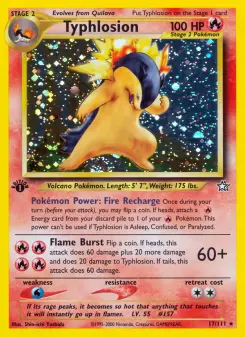
| Typhlosion | Neo Genesis | 4,270 | 4 | 206 | 4,060 | 95.08% |
| Charizard G | DP Black Star Promos | 3,953 | 19 | 196 | 3,738 | 94.56% |
| Vaporeon | Jungle | 16,649 | 35 | 963 | 15,651 | 94.01% |
| Venusaur | Wizards Black Star Promos | 5,462 | 9 | 334 | 5,119 | 93.72% |
| Pikachu EX | XY Black Star Promos | 9,118 | 62 | 612 | 8,444 | 92.61% |
| Rayquaza EX | XY Black Star Promos | 2,258 | 8 | 167 | 2,083 | 92.25% |
| Slowking | Neo Genesis | 3,326 | 9 | 268 | 3,049 | 91.67% |
What this study cannot show
Absent is not zero, and enforcing that rule costs coverage that has to be stated. 2,435 otherwise trusted registries were excluded because the reading carried no PSA 9 count, so their nine share is unknown rather than zero. 2,788 more were excluded because the latest reading could not support a gem claim, which is the rule that stops a dropped ten count being scored as a 0% gem rate. 749 registry keys were dropped because two products both claim them. None of those three groups is evidence of anything about the cards in it.
The sub-nine figure is a residual, not a reported number. It is the registry total minus the ten count minus the nine count, so any grade the provider miscounts lands in it, and it silently contains every 8, every 7, every qualified grade and every authentic-only slab. It cannot be broken down further from this source. A registry is also a lifetime cumulative count that includes resubmissions and crossovers, so a ten in it is not necessarily a card that gemmed on its first attempt, and a card resubmitted until it gems inflates both the total and the ten count. Finally, this is a snapshot: the gem rate drift shows the rate a card gems at today is not the rate its lifetime registry records.
What would overturn this
The central claim is the gap between the two ways of counting. If a recompute on the same table with the same three exclusion rules returned a pooled ten share and a median registry ten share within five points of each other, the finding is wrong and the weighting argument collapses with it. The secondary claim is equally direct: nines must outnumber tens on a majority of registries. A recompute returning that on under half of the population would overturn it. Related work on the same tape, all of it about the rate rather than the shape: the gem rate curve, fifteen tens from 12,323 tries, hard to gem.
Source: `population_snapshots`, our daily recording of the PSA registry line served for each tracked product, latest reading per registry key as of September 22, 2026. Three exclusions, each applied because printing the row would state a fact we do not have. The shared-line rule drops any key whose readings ever coincided with another key's on both total and gem rate, because one registry line served against two products cannot be attributed to either. The continuity rule cuts a series at any reading that contradicts population physics and withholds a line whose identity just changed. The trusted-count rule refuses a reading whose ten count is absent, rather than reading absence as a 0% gem rate. A reading must then carry a PSA 9 count, and its tens plus nines must not exceed its total. That leaves 15,565 registries and 22,274,556 slabs. Rows are collapsed to one per registry key. No floor on registry size is applied, and the article reports what a 500-slab floor would do, because that floor is what separates this result from the pooled rate published in fifteen tens from 12,323 tries, which measured 5,325 cards above that floor. Pooled shares divide the summed counts; median shares take the median across registries of each registry's own share, upper-middle on even samples. One ordering detail is load-bearing rather than cosmetic and so is stated: the ten share is heavily tied, because a small registry lands on a simple fraction, and 544 registries sit at exactly 33.33% while 598 sit at exactly 50.00%. Eight of the nine decile cuts therefore fall inside a block of tied registries, and which side of the cut a tied registry falls on changes the interior columns of the decile table by up to half a point. Ties are broken by registry key ascending, so the table is reproducible; the decile counts and the ten-share ranges do not depend on that choice, and the headline figures do not come from this table. The sub-nine band is total minus tens minus nines. Absolute per-card counts are printed only for registries that passed the shared-line test. Not financial advice.