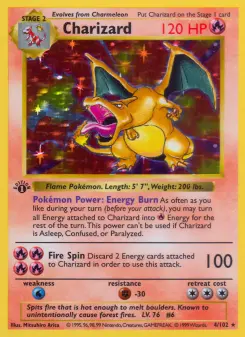
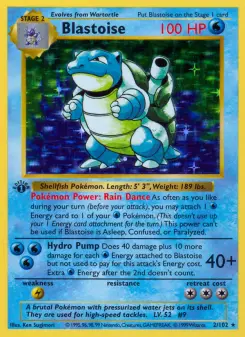

Here is where the belief comes from. Charizard (Base Set) carries a TCGplayer Near Mint market price of $928.06 and Blastoise (Base Set) one of $222.69, both read on 11 October 2026, both filed by the provider as Holo Rares from Base Set, both on the same Holofoil printing label. Fire wins by 4.17 times. Do that comparison across every set, rarity and printing where our data holds a Fire card and a Water card side by side, 632 of them, and Fire's edge is two cents.
Three notes we already publish circle this without touching it. The Species Premium ranks 302 Pokemon names by what the creature is worth inside its own set and rarity cohort. The Casting Premium argues a Charizard's advantage is decided before the card is printed. Painter or Pokemon puts numbers on it: the creature explains 40% of a card's rank, the artist 14%. None of them could have measured the energy type, because the energy type is not in the catalog those studies read. It arrives on a different table, attached to a different key, and it had to be joined to a price before anyone could rank it.
The raw table, which is wrong
Across all 21,754 rows, Dragon leads at a median $2.92 and Fighting trails at $0.80. That is 3.65 times, and it is the number you would publish if you downloaded the provider's product file and grouped by Card Type. It survives nothing. Dragon is 69.8% holofoil printings against 39.9% for Fighting, and 280 of its 725 rows are Ultra Rares or promos. Hold rarity still and Dragon falls to eighth of eleven among Commons at $0.25, which is exactly what Fighting's Commons are worth. The 3.65 times is a statement about which Dragon cards got printed, not about dragons.
Median Near Mint quote by energy type
So we cut the same eleven types ten different ways: everything, then within each of Common, Uncommon, Rare, Holo Rare, Ultra Rare and Promo, then within the Normal printing, within the Holofoil printing, and among the 10,150 products that have only one printing at all. A type that is genuinely dear should be near the top of most of them. Nothing at the top of the table holds up. The bottom does. Metal is in the bottom four of all ten cuts and never ranks above eighth. Darkness is bottom four in nine. Fighting is bottom four in eight and never ranks above seventh. Fairy ranks first in six of the ten, and that is the result we trust least: it rests on 284 rows, and a bootstrap puts its median anywhere between roughly $1.46 and $4.20.
Where each type ranks of eleven, cut seven ways
| Type | Everything | Common | Rare | Holo Rare | Ultra Rare | Normal | Holofoil |
|---|---|---|---|---|---|---|---|
| Dragon | 1 | 8 | 10 | 10 | 4 | 9 | 2 |
| Fairy | 2 | 1 | 2 | 11 | 1 | 1 | 1 |
| Lightning | 3 | 4 | 4 | 6 | 7 | 2 | 7 |
| Fire | 4 | 5 | 7 | 3 | 3 | 6 | 3 |
| Water | 5 | 3 | 3 | 4 | 6 | 4 | 5 |
| Psychic | 6 | 7 | 5 | 2 | 2 | 5 | 4 |
| Colorless | 7 | 2 | 1 | 1 | 8 | 3 | 6 |
| Metal | 8 | 11 | 11 | 9 | 9 | 10 | 10 |
| Darkness | 9 | 10 | 9 | 8 | 5 | 11 | 8 |
| Grass | 10 | 6 | 6 | 5 | 10 | 7 | 9 |
| Fighting | 11 | 9 | 8 | 7 | 11 | 8 | 11 |
Read the Dragon row and the Colorless row against each other. Dragon goes 1, 8, 10, 10, 4, 9, 2. Colorless goes 7, 2, 1, 1, 8, 3, 6. One of them looks expensive because of what it is made of and the other looks cheap for the same reason. Neither row is a price signal. Three cuts are missing from the table to keep it readable: Uncommon, Promo, and the single printing cut. The bottom four counts in the paragraph above are over all ten.
Fire against Water, held still
The honest test for the reader's question is a matched one. Put every Fire and Water row into a bucket keyed by set, printed rarity and printing label, keep only the 632 buckets that hold at least one of each, and compare the two medians inside each bucket. Those buckets hold 1,857 Fire rows and 2,775 Water rows. Fire's median is the higher one in 339 of them, 53.6%, Water's in 287, and 6 are dead level. The median gap is two cents. Half of them, 317 of 632, differ by a dollar or less, and 183 differ by ten cents or less.
Unmatched, the two distributions sit on top of each other. Fire's median is $1.82 with a 95% bootstrap interval of $1.49 to $2.12; Water's is $1.745 on $1.50 to $2.00. Draw one card at random from each side and Fire is dearer 51.2% of the time, counting the 0.3% of the 6,261,508 pairs that tie as half a win each. Count a tie for nobody and it is 51.0%. Fire's median is higher in slightly more than half the buckets, and whether that beats chance depends on how you break a tie inside a two card bucket, so we do not claim it does. What we will claim is the size: if a type premium exists here, it is two cents on a card quoted at $1.745, and nobody has ever made a buying decision on two cents.
The two cents is one Pokemon
Of Fire's 2,057 rows, 155 have Charizard in the product name, counting the V, VMAX, EX and tag team printings. Those 155 rows hold 39.4% of the sum of all Fire quotes. Do the same thing to Water and its most concentrated name, Gyarados, accounts for 9.0% across 77 rows, with Blastoise a hair behind at 8.9% across 61. Strip each type's most concentrated name and Fire's median falls from $1.82 to $1.365 on its remaining 1,902 rows while Water's falls from $1.745 to $1.60 on 2,967. The ordering reverses. Fire is the cheaper type the moment one creature leaves the room.
The matched test says the same thing more precisely. Only 61 of the 632 buckets hold any Charizard row at all. Remove those rows and rebuild: Fire's median is higher in 312 of 619 buckets, 50.4%, and the median gap is half a cent. Sixty one buckets out of 632 carried the entire result. This is not a Fire story at all, and Lightning makes the point louder: 374 rows with Pikachu in the name hold 41.7% of everything quoted under Lightning. And Fire's prices are thin where its median sits: $1.52 at the 48th percentile, $2.12 at the 52nd, 82 rows covering those 60 cents. Drop the 77 dearest Fire rows and the median falls from $1.82 to $1.535; drop the 77 cheapest and it climbs to $2.095. That is a weak instrument for a two cent effect, which is why the bucket count and the random draw probability are in the stat row and the raw medians are not.
Share of a type's summed quoted prices held by its single most concentrated name
What this measure is not
Every figure here is a quote, not a sale. A TCGplayer Near Mint market price is the provider's figure for the card, built out of recent sales and listings together, and it is not a sale anybody witnessed. It can also sit still for a long time: Mew Star (Dragon Frontiers), the dearest Water row in the whole population at a TCGplayer Near Mint $3,500.00, carries a reading dated 1 July 2026 and appears on the frozen list in The Round Number Tell. Our own daily market series for that product holds 43 readings, 30 August to 12 October 2026, and every one of them is $3,500.00. No sold record sits behind it for us to test the number against. Condition matters as well, and only the Near Mint quote is here, because a card's price and a Lightly Played copy's price are different things.
The window has a soft left edge and we would rather print it than hide it. Each row is that product's latest Near Mint reading as of 12 October 2026. The median reading is 4 days old and 95.4% are within a week, but the oldest in the population dates to 21 July 2025, 448 days back, on two rows. The 21,754 rows carry 134 distinct observation dates. Rerun the whole ranking on the 21,324 rows quoted in the last 30 days and the order of the eleven types does not change: Fire $1.62, Water $1.605, a cent and a half apart. One adjacency in that cut is held by nothing: Darkness and Grass both read $0.89, and they sit in order on the type name.
Coverage is the real limit. Our provider mirror holds 50,058 Near Mint quotes, and only 29,008 of them join a row in the provider's product file at all; the other 21,050 have no product row to read a type from, so they are absent rather than typeless. Of the 29,008 that do join, 1,121 carry no Card Type entry, which leaves 27,887 rows with a type string of some kind. The field itself is messy: 96 distinct strings across those joined rows, of which only eleven are energy types. We dropped 4,691 trainer family rows, 1,257 energy card rows, 126 rows whose type names two types at once such as Fire Water, and 59 legacy or misspelled values, 46 of them still carrying Dark, the old spelling of Darkness. None of those are counted as zero anywhere here.
Two judgement calls you should be able to overrule. The 282 rows from the Jumbo Cards group stay in, at a median $6.945 against $1.31 for the other 21,472, because they are products people buy and price; take them out and Fire reads $1.71 against Water's $1.67, which changes nothing. And the eleven type labels come from the provider, not from us, so a card the game calls Fire that the provider typed as Colorless is filed where the provider filed it. We did not audit the labels against the printed cards.
Read 2026-10-12 against the production Turso database. Universe: tcgcsv_products, 32,868 rows, joined on product_id to condition_quotes rows with condition = 'NM' (50,058 of 170,451 quote rows; the condition column stores codes, so 'Near Mint' matches nothing). 29,008 quotes join to a product, keyed one row per product_id so no product can count twice; 21,050 NM quotes have no product row and are excluded as absent. Energy type is the extendedData 'Card Type' entry inside tcgcsv_products.extended: 28,340 of 32,868 products carry one, 97 distinct values across the whole product file and 96 across the rows that join a quote. From the 29,008 joined rows we excluded 1,121 with no Card Type, 4,691 trainer family labels (Trainer, Supporter, Item, Stadium, Tool, Technical Machine and their variants), 1,257 energy card labels, 126 strings naming two types at once (six of those 126 read Rocket's Secret Machine, a trainer label our rule caught in the dual bucket; excluded either way) and 59 legacy or misspelled values (Dark 46, Normal 7, Electric 2, Lighnting 2, TM 2). That leaves the 21,754 rows ranked here. Medians are the mean of the two middle values on an even sample, which is the convention every figure here was computed on; taking the upper middle value instead moves the Fire over Water bucket count from 339 to 344 and the median bucket gap from two cents to three, and moves three of the eleven type medians by half a cent, Water to $1.75, Psychic to $1.61 and Metal to $1.16. A median that lands on a half cent is printed to the tenth of a cent rather than rounded, so no rounding rule is doing any work in the figures above. The mean of the 632 signed bucket gaps is $8.83 on this convention and $10.37 on the upper middle one, which is why the median gap is the figure quoted. Matched buckets are keyed on (group_id, printed rarity, printing label) and require at least one Fire and one Water row: 632 buckets, 1,857 Fire rows, 2,775 Water rows. Bootstrap intervals are 20,000 resamples with replacement at the same median convention, so endpoints wobble a cent or two by seed: three seeds put Fire's upper endpoint at $2.12 twice and $2.13 once, and moved Fairy's endpoints by two cents. The ten cuts are: everything, Common 6,002, Uncommon 3,433, Rare 3,226, Holo Rare 1,717, Ultra Rare 2,066, Promo 3,017, Normal printing 11,534, Holofoil printing 8,856, and products with exactly one printing 10,150. Rank ties inside a cut are broken on the type name, which is why Dragon sits above Fighting among Commons at an identical $0.25. Species shares are substring matches on the provider's product name within a single type. Candidates are the first word of a product name of three letters or more, which is the rule that makes the chart reproducible: with no length floor the single letter M, from Mega cards named M Charizard EX, wins eight of the eleven types and takes 63.0% of Psychic. A match takes tag teams, alternate printings and any longer name containing the shorter one, so Mew's 209 rows include 126 Mewtwo rows and Sylveon's 18 include four Gardevoir and Sylveon GX rows. The random draw probability between Fire and Water splits tied pairs in half; strict dominance is 51.0% against 51.2%. Summed quoted prices are sums of asking prices and are not realised value. The 209 provider groups in the population all sit in the provider's English catalog; a handful of tournament deck and promo groups inside it hold cards printed in Japan, and we did not separate those out. No price floor and no top N anywhere: the population is the catalog.