

Grading conversations treat the number as the currency. A nine is a nine, a ten is a ten, and a 9.5 is the consolation prize you get from the grader nobody wanted. Our daily graded tape now carries seven rungs per card, PSA 9 and 10, CGC 9, 9.5 and 10, BGS 9 and 9.5, which is enough to settle it. It turns out the number is nearly meaningless on its own. A BGS 9.5 and a CGC 10 are the same asset by price. A CGC 9.5 is a different universe. And the size of the jump to the top rung is a property of the grading company, not of the card.
The cliff is the grader's, not the card's
Start with the shape of each company's own ladder, measured as the ratio between its top rung and the rung below it, on cards where both rungs carry real sold tape.
How steep is the last step? (moonstone graded tape through August 29, 2026)
| Step | Cards | Median ratio |
|---|---|---|
| PSA 10 over PSA 9 | 344 | 3.60x |
| CGC 10 over CGC 9 | 167 | 2.34x |
| BGS 9.5 over BGS 9 | 34 | 1.85x |
| CGC 10 over CGC 9.5 | 77 | 1.76x |
PSA's last step pays 3.60 times. CGC's pays 2.34. BGS's half step pays 1.85. This is the same phenomenon we measured in the eight-to-one stamp from the other direction: the money is not in the grade, it is in how hard the gate was to pass and how many buyers have organised themselves around that gate. A market that pays 3.6x for the top PSA rung and 2.3x for the top CGC rung is telling you the two tens are not the same object, whatever the plastic says. And the size of that top step is itself a function of the price tag, not just the label: PSA gem multiples compress hard as raw prices rise, which the multiple ladder measures rung by rung across 306 cards.
Where the half point beats the whole point
Now the head-to-head. On 91 cards where both a BGS 9.5 and a CGC 10 carry at least eight verified sales, the median BGS 9.5 sells for 1.07 times the CGC 10, and it wins on 52 of the 91. Against the PSA benchmark on the 90 cards holding all three, the CGC 10 lands at 51.1% of the PSA 10 median and the BGS 9.5 at 53.6%. A nominally lower grade from a third company is, at the median, the more valuable slab. The gaps at the extreme are not small.
BGS 9.5 versus CGC 10: the eight widest and the six narrowest of the 91 cards
| Card | BGS 9.5 (comps) | CGC 10 (comps) | Ratio |
|---|---|---|---|
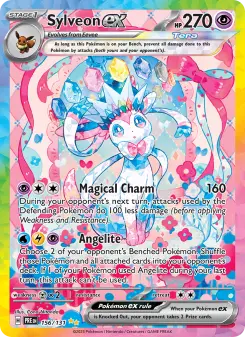
| Sylveon ex, Prismatic Evolutions | $1,112.78 (9) | $489.50 (28) | 2.27x |
| Greninja ex, Twilight Masquerade | $650 (14) | $323 (53) | 2.01x |
| Jolteon ex, Prismatic Evolutions | $350 (17) | $176.51 (25) | 1.98x |
| Mega Latias ex, Mega Evolution | $195.90 (8) | $109.50 (51) | 1.79x |
| Deoxys VMAX, Crown Zenith Galarian Gallery | $110 (11) | $67 (60) | 1.64x |
| Mew ex, Paldean Fates | $1,912.50 (42) | $1,196.50 (172) | 1.60x |
| Victini, White Flare | $940 (8) | $594.99 (17) | 1.58x |
| Umbreon ex, Prismatic Evolutions | $3,649.97 (74) | $2,332.50 (81) | 1.56x |
| Latias ex, Surging Sparks | $220.62 (8) | $417.50 (42) | 0.53x |
| Ivysaur, Mega Evolution | $38 (9) | $78.50 (59) | 0.48x |
| Charizard VMAX, Darkness Ablaze | $72.50 (24) | $153.75 (41) | 0.47x |
| Pikachu, 151 | $64 (11) | $170 (81) | 0.38x |
| Team Rocket's Moltres ex, Destined Rivals | $110 (11) | $349.99 (49) | 0.31x |
| Charmeleon, 151 | $42 (8) | $188.75 (29) | 0.22x |
The winners cluster in exactly one place: modern chase cards with heavy BGS submission traffic, where a black-label-adjacent 9.5 is a recognised trophy and a CGC 10 is a common outcome. The losers cluster somewhere just as specific: cards where CGC's ten is itself unusually well bid. 151 supplies two of the worst rows in the table above, and it is the same set whose CGC 10 prints ABOVE its PSA 10 on the Pikachu, $170 against $141.50, so the denominator is doing the damage rather than the BGS grade.
The floor: a BGS 9.5 outranks a PSA 9
On the 95 cards where a BGS 9.5 and a PSA 9 both carry real tape, the BGS 9.5 sells at a median 1.63 times the PSA 9, and it falls below the PSA 9 on only six of the 95. That is the number that should change behaviour, because the usual mental model says a slab that is not a PSA 10 is a failed submission. On this tape the ladder actually reads: PSA 10, then a wide gap, then BGS 9.5 and CGC 10 sitting together at roughly half, then PSA 9, then CGC 9.5 at about a quarter of the top. Charizard V from Champion's Path is the extreme case, a $366.39 BGS 9.5 on 28 comps against a $380.50 PSA 10 on 100, a 96% ratio: on that card the half point is priced as a near-substitute for the whole thing.
The exceptions matter as much. Charmeleon from 151 prints a $42 BGS 9.5 against a $92.50 PSA 9, 45 cents on the PSA 9 dollar, and Pikachu from the same set prints $64 against $101.25. Both sit on eight and eleven BGS comps respectively, which is thin, and both are cards whose PSA registries have minted tens at industrial pace per our drift study. When a card's own PSA ladder is compressed, there is no premium left for a third grader to borrow.
Source: the moonstone daily graded snapshot table, latest snapshot per card and grade as of August 29, 2026, covering 518 cards across PSA 9 and 10, CGC 9, 9.5 and 10, and BGS 9 and 9.5. The snapshot tape is not daily on every card: 360 of the 518 carry an August 28 or 29 reading, while 158 were last read earlier, 109 of them on August 12 and three as far back as July 21. Every cross-grader figure quoted here (the 91-card head-to-head, the 90-card three-grader panel, the 73-card CGC 9.5 cut and the 95-card BGS-against-PSA-9 cut) rests entirely on August 28 and 29 readings; the stale legs sit only in the PSA 10 over PSA 9 row of the ladder table, 56 of its 344 pairs, and dropping them moves that row from 3.60x to 3.68x on 288 pairs. Gates: PSA rungs require 20+ verified sold comps, CGC and BGS rungs 8+, since third-party tape is thinner by construction; all figures are medians of individually verified sold listings, never asks. Ratios divide sold medians recorded in the same window; comp windows can differ by days across graders, which adds noise in both directions on fast-moving cards. Cards are keyed to the moonstone catalog for linking; 509 of the 518 resolve. Sample sizes are printed beside every quoted figure precisely because several BGS rows sit near the gate. Not financial advice.