**399 distinct illustrator credits** account for the 20,367 English physical cards that carry one, 92.97% of the catalog, and **25 of those credits drew half of it**. The concentration has collapsed over eight eras: the ten busiest artists of the WotC era drew 74.66% of its cards, and the ten busiest of the current era draw 19.98% of theirs.
The name on the card also does almost nothing to the price. Across **107 credits with at least 40 priced English cards**, measured on September 23, 2026, the median card asks **0.99x** the median of the cards in its own set and rarity cohort that the same artist did not draw. The 10th percentile artist sits at 0.81x and the 90th at 1.23x. Almost the entire spread people attribute to artists is the set and the rarity.
The supply curve
Illustrator credits by output
| Cards drawn | Credits | Cards | Share of catalog | Median ask | 90th percentile ask |
|---|---|---|---|---|---|
| 1 | 46 | 46 | 0.23% | $5.48 | $210.48 |
| 2 to 5 | 75 | 238 | 1.17% | $2.03 | $53.56 |
| 6 to 20 | 122 | 1,487 | 7.30% | $0.37 | $43.22 |
| 21 to 50 | 67 | 2,240 | 10.99% | $0.58 | $38.60 |
| 51 to 100 | 40 | 2,800 | 13.74% | $0.43 | $23.74 |
| 101 to 250 | 34 | 5,266 | 25.84% | $0.60 | $18.68 |
| 251 to 500 | 10 | 3,382 | 16.59% | $0.82 | $50.08 |
| 501 or more | 5 | 4,923 | 24.15% | $2.21 | $53.98 |
Five credits hold a quarter of the catalog. At the other end, 121 credits have five cards or fewer between them, 1.40% of the catalog, and the median card of the 46 one-card credits, $5.48, is higher than the median of any band above it. That is not an artist effect. One-card credits are guest artists on promos and anniversary sets, which are expensive products for reasons that have nothing to do with who drew them.
Cumulative share held by the busiest credits
| Credits | Share of credited cards |
|---|---|
| Top 1 | 8.55% |
| Top 5 | 24.15% |
| Top 10 | 34.09% |
| Top 25 | 50.72% |
| Top 50 | 67.04% |
| Top 100 | 82.87% |
| Top 200 | 94.98% |
The busiest twenty
Credits by output, English physical catalog
| Credit | Cards | Sets | Eras | Median ask | Dearest ask |
|---|---|---|---|---|---|
| 5ban Graphics | 1,743 | 104 | 6 | $4.28 | $1,501.23 |
| Ken Sugimori | 1,116 | 108 | 8 | $1.48 | $718.66 |
| Mitsuhiro Arita | 732 | 134 | 8 | $3.14 | $1,399.99 |
| Kouki Saitou | 667 | 133 | 8 | $0.75 | $809.33 |
| Kagemaru Himeno | 665 | 132 | 8 | $1.43 | $799.69 |
| Masakazu Fukuda | 480 | 110 | 7 | $0.94 | $4,500.00 |
| Ryo Ueda | 458 | 94 | 7 | $6.35 | $1,013.27 |
| Atsuko Nishida | 418 | 108 | 8 | $1.54 | $1,500.00 |
| Midori Harada | 355 | 86 | 8 | $0.72 | $1,940.59 |
| Toyste Beach | 314 | 71 | 5 | $0.28 | $725.00 |
| Shin Nagasawa | 303 | 82 | 6 | $0.54 | $94.69 |
| Naoki Saito | 277 | 90 | 7 | $0.85 | $599.98 |
| Naoyo Kimura | 266 | 104 | 8 | $0.60 | $4,500.00 |
| Akira Komayama | 258 | 91 | 6 | $0.40 | $800.00 |
| Tomokazu Komiya | 253 | 95 | 8 | $1.68 | $199.99 |
| Keiji Kinebuchi | 219 | 31 | 5 | $0.89 | $289.99 |
| kawayoo | 218 | 85 | 6 | $0.60 | $516.63 |
| Sumiyoshi Kizuki | 212 | 86 | 8 | $0.85 | $249.00 |
| Yuka Morii | 211 | 82 | 8 | $3.75 | $388.45 |
| Hajime Kusajima | 206 | 48 | 5 | $3.59 | $800.00 |
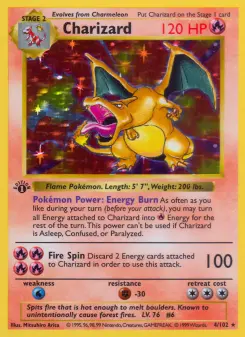
The busiest credit in the English catalog is a studio, not an illustrator. 5ban Graphics is a design house credited on 1,743 cards, 8.55% of everything credited, and its work is the machine-rendered full-art and gold treatments rather than painted artwork. Counting studio and art-team credits together, 2,306 cards, 11.32% of the credited catalog, carry no named individual at all. Mitsuhiro Arita, who painted Charizard, appears on 732 cards across 134 sets and all eight eras, the widest set spread of any credit in the catalog, with Kouki Saitou second at 133.
The roster grew and the concentration broke
Illustrator roster by era
| Era | Credits | Cards | Cards per credit | Top-ten share |
|---|---|---|---|---|
| WotC 1999-2003 | 61 | 1,756 | 28.8 | 74.66% |
| EX 2003-2007 | 63 | 1,772 | 28.1 | 61.96% |
| Diamond & Pearl to HGSS 2007-2011 | 85 | 2,113 | 25.0 | 58.20% |
| BW and XY 2011-2017 | 82 | 3,379 | 41.2 | 51.55% |
| Sun & Moon 2017-2019 | 114 | 2,913 | 25.6 | 39.79% |
| Sword & Shield 2020-2022 | 154 | 3,486 | 22.6 | 26.59% |
| SV and Mega 2023-2026 | 264 | 4,733 | 17.9 | 19.98% |
Four times the roster and less than half the output per artist. This is the same structural change Painter or Pokemon measured from the other direction, as a collapse in how much chase work sits in a few hands. Measured as raw supply it is just as steep.
Top-ten illustrator share of each era's cards
Does the name move the price?
The test: for every credited card, compare its ask to the median ask of the other cards in the same set and the same printed rarity that this credit did not draw. A cohort needs six such cards to count. A credit needs 40 cards to be reported. The leave-one-out step matters: a cohort median that includes the artist's own work drags every prolific artist toward parity by arithmetic rather than by art.
The distribution of artist premium, 107 credits
| Statistic | Value |
|---|---|
| 10th percentile credit | 0.81x |
| Median credit | 0.99x |
| 90th percentile credit | 1.23x |
| Credits above parity | 41.12% |
Four fifths of the measurable roster sits between 0.81x and 1.23x their own cohort. Knowing who drew a card, given that you already know its set and its rarity, moves your estimate by less than a quarter either way for eight artists in ten. The exceptions are real and few.
The credits that do move the number: the ten highest and the five lowest of the 107
| Credit | Cards measured | Median against cohort |
|---|---|---|
| Hikaru Koike | 47 | 7.86x |
| Yuka Morii | 207 | 2.53x |
| Shizurow | 59 | 2.45x |
| Tomokazu Komiya | 252 | 1.65x |
| Sachiko Adachi | 42 | 1.48x |
| Kanako Eo | 96 | 1.39x |
| Ryo Ueda | 418 | 1.36x |
| Ryota Murayama | 59 | 1.25x |
| Megumi Mizutani | 138 | 1.24x |
| Shibuzoh. | 104 | 1.23x |
| Shin-ichi Yoshikawa | 41 | 0.75x |
| SATOSHI NAKAI | 59 | 0.69x |
| Eske Yoshinob | 170 | 0.65x |
| Hisao Nakamura | 68 | 0.65x |
| Keiji Kinebuchi | 216 | 0.47x |
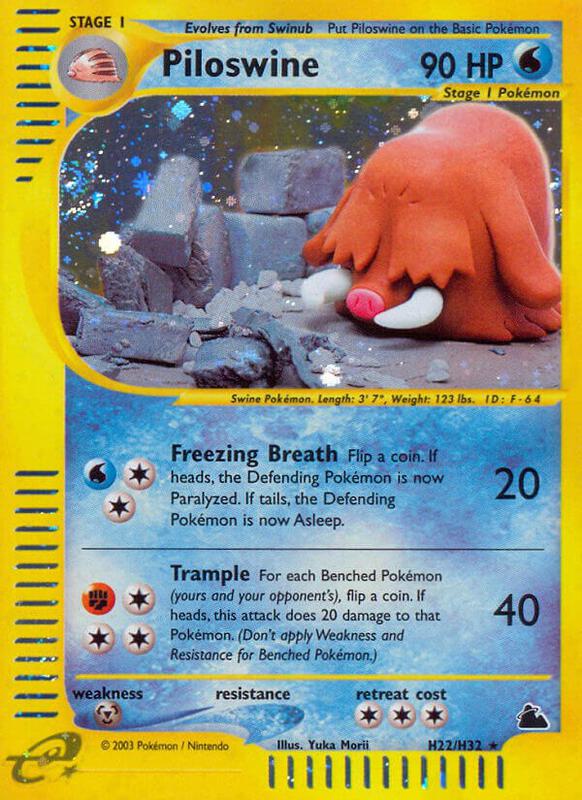
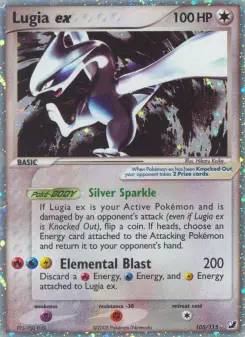
Read the top of that list carefully, because it is a casting effect wearing an artist's name. Hikaru Koike has 47 English cards, 33 of them EX-era and 34 of them carrying the `ex` mechanic, Lugia ex at $2,500.00, Rayquaza ex at $460.73, Blastoise ex at $425.00, and the catalog files all of those under the printed rarity "Rare" alongside ordinary non-holo rares. The cohort is wrong, not the artist. Yuka Morii is the cleaner case: a clay-model style distinctive enough that buyers seek it out, 211 cards across 82 sets and all eight eras, with Piloswine from Skyridge asking $388.45. Keiji Kinebuchi at the other end drew 219 cards concentrated in 31 sets, and his Gengar at $289.99 is the exception inside a body of work that prices below its cohort.
What this study cannot show
1,541 English cards, 7.03% of the catalog, carry no illustrator credit at all, and they are not a random sample: 133 sit in the SWSH Black Star Promos run, 102 in Trading Card Game Classic, 99 in ME05: Pitch Black, and several hundred across eight Trainer Kit products including XY Trainer Kit: Latias & Latios. Promos and starter products are systematically under-credited, so this roster under-counts artists who worked mainly on them.
The 399 figure folds case, accents, punctuation and spacing before counting, which merges six spelling pairs that would otherwise have read as twelve people. It does not merge misspellings. Seven folded credits sit within an edit distance of two of a much larger credit and carry one to three cards each; by eye they are typos of it, and merging them by hand would give 392. We publish 399 because the hand merge is a judgement, and it moves the concentration curve by less than a third of a percentage point either way.
It cannot separate an artist from the assignments they are given. An illustrator handed the chase slot will price above cohort whether or not their work is the reason, and the Hikaru Koike row above is exactly that failure made visible.
What would overturn it
A cohort definition finer than set and rarity, one that separates the mechanic slot from the ordinary rare, which still shows a median artist premium meaningfully above parity, would overturn the central finding. So would a sold-price version of the same test landing outside the 0.81x to 1.23x band for a majority of the 107 credits. The finding is that artist identity adds little once set and rarity are known, and the way to break it is to hold those two fixed more carefully than we do and find the effect anyway.
Population: the 21,908 distinct physical English printings defined in How Many Pokemon Cards Are There?; 20,367 carry a non-empty `illustrator` field, backfilled from TCGdex. A credit line holding two names joined by " + " or " & " is split and counted for both, except an "Illus. & Direc." art-team line which is left whole; three credit lines in the catalog hold two names. Names are then folded by Unicode NFKD decomposition, accent stripping, lowercasing and removal of all non-alphanumeric characters, which turns 406 raw spellings into 399 credits: six spelling pairs merge, and one fragment of a joined credit line that is pure kanji folds to the empty string and is dropped rather than counted as a person. The most-used raw spelling is displayed. "Cards measured" in the premium table is the number of a credit's cards that sit in a cohort large enough to use, which is at or below its total card count. Prices are TCGplayer market asks resolved by the site's own per-card rule, on 2026-09-23. The premium test compares each credited card's ask to the median ask of cards in the same set and the same printed rarity label drawn by a different credit, requiring at least six such cards; a credit is reported when at least 40 of its cards clear that bar, which is 107 credits. Medians are upper-middle on even samples. Era buckets come from set name and a credit is counted once per era it appears in. No regression is run and no era is weighted.