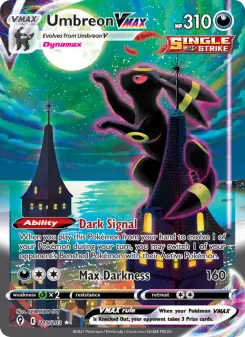
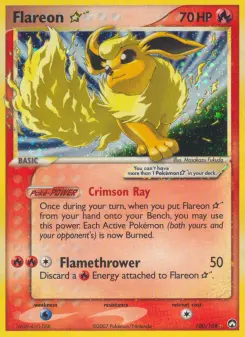
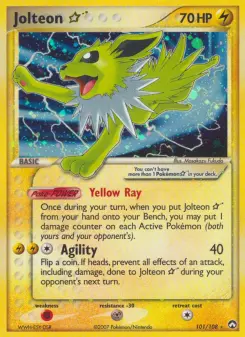
Ask a Pokemon collector to rank the Eeveelutions and you will get Umbreon first and an argument about the rest. On raw price that is correct, and it is not close: the median Umbreon printing asks $73.03 against $8.54 for Glaceon, and Umbreon out-asks the cards printed beside it by 8.19x, the widest of the eight. Then you change the question from what a card costs to what grading it adds, and the order turns over. Across the 20 to 26 printings of each Eeveelution where we hold both a raw ask and a PSA 10 sold median, Umbreon multiplies 6.95x, last of eight. Flareon multiplies 22.29x, first. The most wanted Eeveelution is the one whose raw price has already priced the slab in.
Two rankings that disagree
Two things are measured here and they are different kinds of number, so the article says which every time. The raw figure is an ASK, the most recent daily market listing price for the product. The graded figure is a SOLD median, the middle of the verified completed PSA 10 sales we record for that card, and it carries its comp count. The multiple divides the second by the first, which is the standard grading premium and is exactly the construction how much a PSA 10 adds applies across 8,676 products in both languages. On English products alone that catalog median is 15.68x, which is the line the eight are measured against.
Median PSA 10 sold median over raw ask, by Eeveelution
The eight Eeveelutions on both axes, sorted by grading multiple, ranks 1 to 8
| Rank | Species | Median ask | Cohort premium | Median PSA 10 sold | Printings priced in both | Grading multiple |
|---|---|---|---|---|---|---|
| 1 | Flareon | $14.73 | 3.07x | $597.50 | 21 | 22.29x |
| 2 | Jolteon | $19.77 | 2.35x | $727.00 | 21 | 19.09x |
| 3 | Vaporeon | $15.89 | 2.59x | $505.00 | 21 | 18.38x |
| 4 | Espeon | $27.16 | 3.68x | $425.00 | 21 | 13.83x |
| 5 | Glaceon | $8.54 | 2.23x | $155.00 | 20 | 12.85x |
| 6 | Sylveon | $23.94 | 4.82x | $194.50 | 21 | 8.75x |
| 7 | Leafeon | $11.69 | 2.01x | $124.99 | 21 | 8.64x |
| 8 | Umbreon | $73.03 | 8.19x | $597.02 | 26 | 6.95x |
Read the two middle columns against the last one. The cohort premium column is how much each species out-asks the cards printed beside it in the same set at the same rarity, and it puts Umbreon first at 8.19x and Sylveon second at 4.82x. The grading multiple column puts those same two last and sixth. The three species at the top of the grading column, Flareon, Jolteon and Vaporeon, sit fourth, sixth and fifth on cohort premium. That is not a coincidence, and the comp column says why.
The comp count is the explanation
The median Umbreon printing in this study has 121 verified PSA 10 sales behind its median. The median Flareon printing has 13. A card with a hundred recorded slab sales has a raw price that already knows what the slab is worth, because the two markets are watching each other daily. A card with a dozen does not, and the gap stays open. This is the mechanism the Umbreon standard named as absorption on a single card, measured here across a whole family: Umbreon sits at 121 comps and 6.95x, Sylveon at 88 and 8.75x, Glaceon at 37 and 12.85x, Espeon at 31 and 13.83x, and the three thinly traded ones sit at 13 to 15 comps and 18.38x to 22.29x. The rank correlation across the eight is -0.814, and it is a tendency rather than a ladder: Leafeon has 26 comps, fewer than Espeon or Glaceon, and the second-lowest multiple of the eight at 8.64x. One species in eight runs the wrong way, and it is printed here rather than left out of the list.
The same logic explains why the median PSA 10 SOLD price does not rank the way the raw price does. Jolteon's median PSA 10 sale is $727.00, the highest of the eight, ahead of Flareon at $597.50 and Umbreon at $597.02. Umbreon has the dearest raw cards and the third dearest slabs, because its slabs are the ones people actually sell.
Three ways this could be wrong
The first objection is thin comps. A median taken over three verified sales is not a price, and the top of this ranking is the thin-comp end by construction. So the whole table was rebuilt using only printings with ten or more verified PSA 10 sales. The order at the extremes holds: Vaporeon 18.38x, Flareon 16.34x, Jolteon 15.49x, Espeon 11.26x, Sylveon 8.75x, Leafeon 8.64x, Umbreon 6.06x, Glaceon 5.35x. Umbreon is still in the bottom two and the three thin-traded species are still in the top three.
The second objection is Evolving Skies. Umbreon VMAX from that set is the deepest-traded printing in Evolving Skies on our tape, at 506 verified PSA 10 sales, and if it alone is dragging the species down the finding is about one card. Remove every Evolving Skies printing from all eight species and recompute: Flareon 26.25x, Jolteon 20.55x, Leafeon 19.32x, Vaporeon 18.96x, Glaceon 17.22x, Sylveon 15.88x, Espeon 14.16x, Umbreon 11.33x. Every multiple rises and Umbreon is still last of eight.
The third objection is that this is an ask problem, not a grading result: Umbreon's raw asks may simply be too high. That is possible and this study cannot rule it out, because the raw leg of every multiple here is a listing rather than a sale. What can be said is that the ask is not obviously stale. Umbreon's raw asks are supported by the deepest graded tape of the eight, and if the asks were fantasy the slabs would not clear at $597.02 on a median of 121 comps.
The grading ranking under two rebuilds, all eight species in each
| Species | As published | 10 or more verified comps | Excluding Evolving Skies |
|---|---|---|---|
| Flareon | 22.29x (1st) | 16.34x (2nd) | 26.25x (1st) |
| Jolteon | 19.09x (2nd) | 15.49x (3rd) | 20.55x (2nd) |
| Vaporeon | 18.38x (3rd) | 18.38x (1st) | 18.96x (4th) |
| Espeon | 13.83x (4th) | 11.26x (4th) | 14.16x (7th) |
| Glaceon | 12.85x (5th) | 5.35x (8th) | 17.22x (5th) |
| Sylveon | 8.75x (6th) | 8.75x (5th) | 15.88x (6th) |
| Leafeon | 8.64x (7th) | 8.64x (6th) | 19.32x (3rd) |
| Umbreon | 6.95x (8th) | 6.06x (7th) | 11.33x (8th) |
What this study cannot show
A grading multiple is not a grading return. It ignores the fee, the shipping, the wait and the chance of a 9, and is grading Pokemon cards worth it exists because those four change the answer. A species with a 22x multiple on cheap cards can still lose money per submission if the gem rate is low, and nothing here measures gem rate. It is also not the cash. The same Umbreon printings that rank last on the multiple add a median $502.05 between the raw ask and the PSA 10 sold median, third of the eight behind Jolteon at $684.92 and Flareon at $544.11, while Leafeon adds $91.66. Last on the multiple is not last on the paycheque, and every Charizard's PSA 10 premium ranked measures the same split inside one species.
Raw is an ASK and graded is a SOLD median, and the multiple divides one by the other, so it inherits both problems at once. Printings without a recorded PSA 10 sale are excluded rather than scored, because absent is not zero: Umbreon has 46 priced printings and 26 carrying a PSA 10 median, Flareon 40 and 21. What the missing ones would have done is unknown, and they skew toward the cheap modern reprints, which is the end of the distribution where multiples are highest.
The eight species are unequal populations. Umbreon brings 26 printings to the graded table and Glaceon 20, so the medians are not equally precise, and the ten-comp rebuild is the check on that rather than a second opinion. This is also a single day's cross-section and says nothing about whether the gap has been widening.
What would overturn this
The claim is an inversion: Umbreon first on raw ask and cohort premium, last on grading multiple. A recompute on the same day's tape that placed Umbreon anywhere above sixth on the multiple, under any of the three constructions printed here, would overturn it. The mechanism claim is separate and weaker: that comp depth explains the ordering. A recompute returning a rank correlation between a species' median comp count and its multiple materially weaker than the -0.814 measured here would leave the inversion standing but remove the explanation. The relationship is already not monotone, because Leafeon breaks it, so a strict ladder is not what is being claimed. Related work: the Umbreon standard, how much a PSA 10 adds and the species premium.
Sources: the `cards` catalog, the daily `price_history` tape and `graded_snapshots`, all read on day 20718, September 22 2026. Products are deduplicated on the TCGplayer product id and graded keys are looked up across every catalog id claiming that product plus the product id itself, because the provider keys some rows by card id and some by product id. RAW is an ASK: the most recent daily market figure for the product. GRADED is a SOLD median: the latest `graded_snapshots` row for grade PSA 10 with a median above zero, carrying its verified comp count. The grading multiple is the PSA 10 sold median divided by the raw ask, computed per printing, and the species figure is the median of those per-printing multiples, upper-middle on even samples. A printing enters only if it carries both figures, which gives 21 printings for Flareon, Jolteon, Vaporeon, Espeon, Sylveon and Leafeon, 20 for Glaceon and 26 for Umbreon; printings with no recorded PSA 10 sale are excluded rather than scored as zero. The cohort premium column is the same construction as the species premium: a card's ask divided by the leave-one-out median ask of every other English product in its set at its printed rarity, with a ten-other-member floor, and the species figure is the median across its printings. Median ask is taken over every priced English printing of the species, which is a wider population than the graded one and is stated as such. The English catalog comparison of 15.68x is the median multiple across the 4,677 English products carrying both figures; the 8,676 figure quoted from the published premium study covers both languages, which is why the two differ. Species attribution uses the 1,025-name `pokemon_indices` table with both sides folded to one canonical key; Eevee is reported separately and is not one of the eight. Not financial advice.