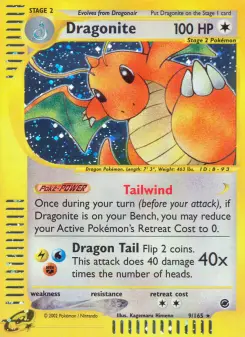
Expedition Base Set was printed in 2002 and is the first English set with no chase card worth the name. All 165 of its cards carried an asking price on September 23, 2026, summing to $9,857.67, and the dearest one, a Dragonite at $799.69, is 8.1% of the set. Of the nineteen expansion sets in this study, the three e-Card sets and the sixteen EX-era sets, only Skyridge spreads its value more evenly. The median Expedition card asks $13.49, which is more than five times the median EX-era card, and 95 of the 165 ask $10 or more. Not one reaches $1,000.
A set built out of its middle
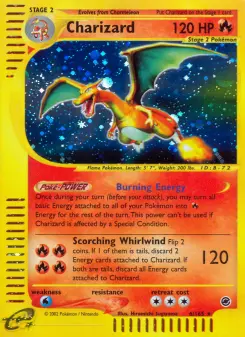
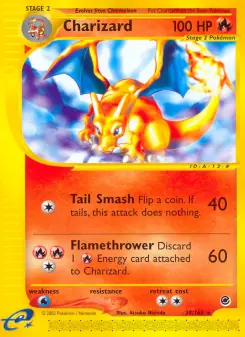
Expedition is the first English expansion printed with the e-Reader dot code down the side, and its checklist is shaped unlike anything before or after it. Numbers 1 to 32 are the holofoils, contiguously and with nothing else in that block. Numbers 33 to 70 repeat most of the same Pokémon as non-holo rares, sometimes twice, so Charizard appears at 6 as a holo and again at 39 and 40 as two separate non-holo cards at two separate prices. Two more rares sit at 158 and 159, the special Darkness and Metal energies. The remaining 93 cards are commons and uncommons. The result is a set where the money sits in a broad band rather than at the top.
All 165 Expedition Base Set cards by asking price band
| Band | Cards | Summed ask | Share of set value |
|---|---|---|---|
| Under $1 | 5 | $3 | 0.0% |
| $1 to $4.99 | 36 | $95 | 1.0% |
| $5 to $9.99 | 29 | $220 | 2.2% |
| $10 to $24.99 | 32 | $511 | 5.2% |
| $25 to $49.99 | 18 | $615 | 6.2% |
| $50 to $99.99 | 19 | $1,435 | 14.6% |
| $100 to $249.99 | 17 | $2,787 | 28.3% |
| $250 to $999.99 | 9 | $4,190 | 42.5% |
| $1,000 and over | 0 | $0 | 0.0% |
The nine bands hold all 165 cards. Compare the top row of that table to any EX-era set: Expedition's five sub-dollar cards are 3.0% of its checklist, against 24.7% of the EX era as a whole. There is very little bulk in this set, and that is a property of what got printed rather than of what has since gone up. The set's cheapest card is a Potion at 46 cents.
The twenty dearest Expedition Base Set cards, September 23, 2026
| # | Card | No. | Rarity | Ask | Share of set | Gem rate | PSA 9 sold median |
|---|---|---|---|---|---|---|---|
| 1 | Dragonite | 9 | Holo Rare | $799.69 | 8.11% | 1.50% | $4,450 (7) |
| 2 | Gengar | 13 | Holo Rare | $725.50 | 7.36% | 3.35% | $3,985 (9) |
| 3 | Mew | 19 | Holo Rare | $500.00 | 5.07% | 1.40% | $13,300 (5) |
| 4 | Mewtwo | 20 | Holo Rare | $409.05 | 4.15% | 3.24% | $3,990 (7) |
| 5 | Charizard | 6 | Holo Rare | $408.33 | 4.14% | 1.23% | $6,950 (11) |
| 6 | Blastoise | 4 | Holo Rare | $400.00 | 4.06% | 4.78% | $3,000 (8) |
| 7 | Feraligatr | 12 | Holo Rare | $331.83 | 3.37% | 3.20% | not recorded |
| 8 | Tyranitar | 29 | Holo Rare | $311.00 | 3.15% | 3.40% | $1,420 (13) |
| 9 | Pichu | 22 | Holo Rare | $305.00 | 3.09% | 3.83% | $1,200 (7) |
| 10 | Alakazam | 1 | Holo Rare | $233.32 | 2.37% | 5.94% | $600 (5) |
| 11 | Typhlosion | 28 | Holo Rare | $203.33 | 2.06% | 3.75% | not recorded |
| 12 | Venusaur | 30 | Holo Rare | $199.85 | 2.03% | 8.19% | $592 (9) |
| 13 | Gengar | 48 | Rare | $180.88 | 1.83% | 15.63% | not recorded |
| 14 | Meganium | 18 | Holo Rare | $180.01 | 1.83% | 4.36% | not recorded |
| 15 | Butterfree | 5 | Holo Rare | $180.00 | 1.83% | 2.37% | not recorded |
| 16 | Ampharos | 2 | Holo Rare | $175.00 | 1.78% | 2.54% | not recorded |
| 17 | Raichu | 25 | Holo Rare | $174.99 | 1.78% | 5.03% | $1,000 (4) |
| 18 | Charizard | 39 | Rare | $169.54 | 1.72% | 18.20% | $309 (8) |
| 19 | Pidgeot | 23 | Holo Rare | $158.31 | 1.61% | 5.79% | not recorded |
| 20 | Clefable | 7 | Holo Rare | $157.65 | 1.60% | 5.03% | not recorded |
Ranks 1 to 20 are contiguous, and eighteen of them are holofoils from the 1 to 32 block. Two rows in that table are the same Pokémon at two different numbers and they show what a printing distinction is worth here: Charizard 6, the holofoil, asks $408.33 and gems 1.23% of the time across 3,644 recorded PSA submissions, while Charizard 39, the non-holo, asks $169.54 and gems 18.20% across 2,050. They are not two conditions of one card and they are not two printings of one product. They are two cards, and a price quoted for "Expedition Charizard" that does not name the number is quoting one of three different things, the third being Charizard 40 at $126.59.
The rarity split, and where the value actually is
Expedition Base Set by catalogue rarity
| Rarity | Cards | Summed ask | Median card | Share of set value |
|---|---|---|---|---|
| Holo Rare | 32 | $7,081 | $174.99 | 71.8% |
| Rare | 40 | $1,716 | $21.39 | 17.4% |
| Common | 55 | $730 | $6.37 | 7.4% |
| Uncommon | 38 | $331 | $6.66 | 3.4% |
The four rows sum to 165 cards. The 32 holofoils are 19.4% of the checklist and 71.8% of the money, and the median one asks $174.99, which is the part a collector feels: buying the holo run of Expedition is not a chase-card purchase, it is thirty-two separate purchases of a hundred dollars or more. The full bill for completing any set in the catalogue is measured in What Completing a Set Actually Costs, and Expedition is one of the sets where the answer is dominated by a middle tier rather than by a single card. The two bottom rows are worth reading together: the 55 commons total more than the 38 uncommons because there are more of them, while the median uncommon at $6.66 is slightly dearer than the median common at $6.37. In a 2002 set the common slot is not bulk.
This cardboard gems, and the EX era that followed it does not
117 Expedition cards carry 100 or more recorded PSA submissions, 67,418 of them in total, returning 9,508 tens. The median Expedition card in that group gems 29.1% of the time. The median EX-era card over the same bar gems 9.4%. Expedition released on September 15, 2002 and the first EX set nine months later, on June 18, 2003, and across that boundary the rate falls by a factor of three, with the older cardboard the easy one. What produced the gap is not something this data can attribute, and the companion study says so at length. Our whole-catalogue study The Gem Rate Curve finds the same shape from the other direction, putting the hardest era at Diamond and Pearl rather than at the 1999 cards everyone assumes; the full era comparison for this window is in EX Era PSA 10 Gem Rates.
The three e-Card sets against the era that followed
| Set | Cards | Priced | Summed ask | Median card | Dearest card's share | Median gem rate |
|---|---|---|---|---|---|---|
| Expedition Base Set | 165 | 165 | $9,857.67 | $13.49 | 8.1% | 29.1% |
| Aquapolis | 186 | 185 | $17,517.07 | $17.86 | 25.7% | 27.3% |
| Skyridge | 182 | 178 | $20,620.14 | $31.39 | 6.7% | 37.1% |
| All sixteen EX-era sets | 1,694 | 1,688 | $87,845.77 | $2.48 | n/a | 9.4% |
Expedition is the only one of the three with a reading on every card. Four Skyridge holofoils and one Aquapolis holofoil carried no reading on the census day, so those two summed asks are over 178 and 185 cards rather than 182 and 186. Expedition is also the cheapest of the three and the one with the least concentrated top. Aquapolis looks more like an EX set in that respect, because it holds Lugia 149 at $4,500, which is tied for the dearest English card we price. Skyridge is the flattest of the nineteen sets in this study at 6.7%, and it is also the one with the deepest graded record of the three, 89 of its 182 cards carrying a PSA 10 sold median against 61 of Expedition's 165. The three e-Card sets are the last English expansions printed before the EX run and the first after the Neo block, whose own value question is answered in Which Neo Set Holds Its Value.
What would overturn this
The claim to break is the flatness, not the total. If the ask on the set's holofoils is systematically stale while the bottom of the checklist is current, the 8.1% top share is an artifact of who has relisted recently rather than of the set, and the evidence here runs toward that objection rather than away from it. Over the sixteen days from September 7 to September 23, both of them complete tape days, 85 of the 165 Expedition cards changed price at all, but only 7 of the 32 holofoils did, against 35 of the 55 commons. The top of this set is exactly where the ask is stalest, and a reader should treat the holo figures as the softer half of the table. A second break would be a sold-price census: nine Expedition cards ask $250 or more and not one of them carries a PSA 10 sold median, so if verified sales come in far below those asks the set's summed value falls with them. A third would be a coverage error. If a printing of these cards exists that we quote as one product, the set is worth more than $9,857.67 and the concentration changes shape.
What this study cannot show
Every price here is an ask on one day, not a sale. Expedition Base Set carries a recorded release date of September 15, 2002, but our daily tape begins on August 30, 2026 and the per-card weekly series for its cards begins on the same day, so no figure in this piece is windowed to its launch or measured against its age and no return, drawdown or since-launch number is available at any horizon. The set's value series does exist under the key `expedition`, and the "Full Set" figure on its page happens to agree with our tape at $9,858, but that is two instruments agreeing rather than one figure: on other sets in this window they disagree, and only the tape is quoted here. Gem rates are recorded PSA registry counts, which are a sample of what somebody chose to pay to grade and not of what was printed; on a 24-year-old card that selection is strong and it runs toward the copies that looked good enough to submit. PSA 9 sold medians are shown with their sale counts because several sit on four to nine sales. Nothing here is investment advice.
Population: all 165 `cards` rows with `lang = 'en'` and `set_name = 'Expedition Base Set'`, deduplicated on `tcg_id`, which collapsed zero rows. Prices are `price_history.price` on day 20719, which is 2026-09-23 and the fullest of the tape's 25 days at 52,378 catalogue rows; all 165 carry a row on it, so nothing is excluded and there is no residual. `price_history` records each product's CANONICAL printing under the shared price rule in `packages/core`, deliberately not the dump's flagship figure, so a multi-printing product is quoted at the printing the market trades rather than at its dearest row. Summed ask is the sum over the 165. Medians take the upper middle value on even samples. Share of set is the card's ask divided by $9,857.67. The set page at `/set/expedition` was fetched on 2026-09-23 and its title read back as "Expedition Card Prices · $9,858 Full Set"; the catalogue spelling `/set/expedition base set` returns 404 and is never linked. `/research/set-screen/expedition base set` also resolves. A set page's headline Full Set figure comes from the recorded `sethist2:` value series, which is a different instrument from the daily tape: it happens to agree for Expedition, but `/set/skyridge` titles $20,720 against our day-20719 sum of $20,620.14 and `/set/power keepers` titles $4,794 against $4,352.03, so no set page figure is quoted anywhere in this piece. Comparison-set counts are over the cards carrying a reading on day 20719: 185 of 186 in Aquapolis, where Tyranitar H28 has none, and 178 of 182 in Skyridge, where Gengar H09, Gyarados H10, Moltres H20 and Umbreon H30 have none. All five are holofoils. Gem rates come from `population_snapshots`, latest day per key read across both the catalogue-id and TCGplayer-id keyspaces, and pass `gemRateIsTrustworthy()` from `@cardapp/core/server` with the recorded PSA 10 sold count supplied; the 29.1% figure is the median over the 117 Expedition cards carrying 100 or more recorded submissions, and the bar is stated because the median over all 165 including cards with a handful of submissions is not the same number. PSA 9 and PSA 10 medians come from `graded_snapshots`, latest row per card and grade across both keyspaces with the fresher row taken, and are SOLD medians over verified sales, printed with their sale counts; the cron writes a median only on three or more sales, so "not recorded" means fewer than three rather than none. The EX-era comparison column is the same treatment applied to the sixteen sets in EX Era Pokémon Cards Value. The sixteen-day change count compares day 20703 to day 20719, both complete days, over all 165 cards, which carry a reading on both. Scripts: apps/web/scripts/vex-build.mts, vex-sets.mts and vex-figures.mts; figures in apps/web/.scratch-vintage-ex/figures.json. Nothing here is investment advice.