
Neo Destiny holds more value than the other three Neo sets put together: $10,269.47 of ask across 113 priced cards, $90.88 a card, against $18.75 for Neo Genesis. It also holds the most evidence, and that is the part of the question worth answering. 69.0% of Neo Destiny's ask sits on cards with a PSA 10 sold median backed by ten or more recorded sales, against 46.4% for Neo Discovery, 11.6% for Neo Genesis and 1.7% for Neo Revelation. What this study cannot tell you is which of the four rose or fell, because on September 7, 2026 every priced card in Neo Genesis and Neo Discovery, and 97% of Neo Revelation and 96% of Neo Destiny, changed price on the same day with no card joining or leaving. That is our instrument moving, not the market, and we publish no Neo percentage at all because of it.
The four sets on one day
Every figure in this table is an ask on September 23, 2026, the daily dump's market figure for the canonical printing, which for every Neo card is the Unlimited Holofoil, and every card in all four sets carries one. The four sets hold 365 English cards and $18,048.10 between them. Neo Destiny holds 56.9% of that on 31.0% of the cards.
The four Neo sets, asks on September 23, 2026. All 365 cards are priced, every one of them at its Unlimited Holofoil printing
| Set | Cards | Summed ask | Ask per card | Median card | Cards at $100 or more | Cards under $1 | Top five share |
|---|---|---|---|---|---|---|---|
| Neo Genesis | 111 | $2,081.52 | $18.75 | $2.15 | 7 | 26 | 54.8% |
| Neo Discovery | 75 | $2,357.50 | $31.43 | $5.34 | 3 | 17 | 61.8% |
| Neo Revelation | 66 | $3,339.61 | $50.60 | $5.83 | 9 | 15 | 59.9% |
| Neo Destiny | 113 | $10,269.47 | $90.88 | $7.47 | 19 | 13 | 46.4% |
| All four | 365 | $18,048.10 | $49.45 | $4.39 | 38 | 71 | not additive |
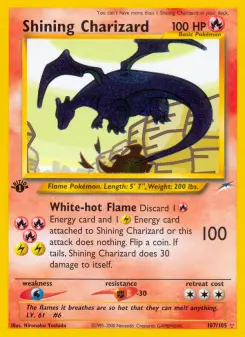
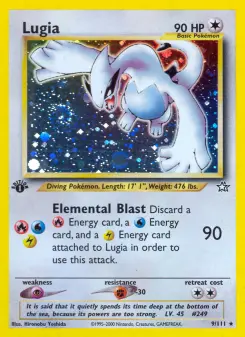
Neo Destiny is both the largest and the least concentrated: its top five cards hold 46.4% of its value while Neo Discovery's top five hold 61.8%. A reader looking for what that concentration means across the whole catalog should read One Card, 60% of a Set, which measures it across 129 sets, and Hundred Dollar Cards by Set for the count in the sixth column. The dearest card in each set is Lugia at $518.99, Umbreon at $752.74, Shining Gyarados at $718.66 and Shining Charizard at $1,495.00.
Why there is not one percentage in this article
Our daily card tape runs 25 days, from August 30 to September 23, 2026. It contains exactly one event. On September 7 the summed ask of Neo Genesis fell from $4,963.93 to $2,050.12 and the summed ask of Neo Destiny fell from $19,941.07 to $9,952.22, both in a single reading. The number of priced cards is identical on both sides of that step in all four sets: 111 Neo Genesis cards before and after, 75 Neo Discovery, 66 Neo Revelation, 113 Neo Destiny. No card joined the basket and none left it. What moved is how every constituent is quoted, and it moved for all of them at once.
The single-day step of September 7, 2026, per set. The priced-card count is identical either side
| Set | Priced cards, both days | Cards whose ask changed | Summed ask Sep 6 | Summed ask Sep 7 | Basket move | Median card move |
|---|---|---|---|---|---|---|
| Neo Genesis | 111 | 111 | $4,963.93 | $2,050.12 | -58.7% | -60.5% |
| Neo Discovery | 75 | 75 | $5,324.67 | $2,357.50 | -55.7% | -67.3% |
| Neo Revelation | 66 | 64 | $5,766.92 | $3,322.08 | -42.4% | -60.9% |
| Neo Destiny | 113 | 109 | $19,941.07 | $9,952.22 | -50.1% | -59.9% |
Card by card it is unmistakable. Lugia read $1,085.03 on every day from August 30 to September 6, $518.99 on September 7, and $518.99 on every day since. Umbreon read $1,500.00 then $752.74 and has not moved since. Meanwhile Shining Charizard held $1,495.00 for all 25 readings without a single change. A market does not halve 359 cards in one reading and then stop. This is the same event `basketChangeOverDays` in our pricing library was written to suppress, and it is why a set index reading like this one is never published as a market move. The mechanism is described in We Remeasured First Edition With Four Times the Data and First Edition Is Worth 2.63x: which printing of a vintage card a feed quotes is a choice, and changing that choice reprices the whole set.
After the step the tape is not just quiet, it is frozen. Between September 18 and September 23 not one of the 365 Neo cards changed price: 111 flat, 75 flat, 66 flat, 113 flat. So the 25 days of daily tape hold one instrument change and nothing else, and no window inside them can support a percentage. The four set pages linked above print a different number again, because they quote the `sethist2` index rather than this tape: Neo Genesis reads $2,330 against our $2,081.52, Neo Discovery $1,878 against $2,357.50 and Neo Revelation $2,872 against $3,339.61, all three from a series that stopped on July 20, 2026, while Neo Destiny reads $10,269 against our $10,269.47 because its series is current. Every figure in this study is the card tape, and the instrument is named beside each one for that reason.
The other two instruments fail differently and both are worth naming, because a competitor quoting a Neo trend is almost certainly quoting one of them. Our set-value series stops on July 20, 2026 for Neo Genesis, Neo Discovery and Neo Revelation, two months before this study's date, and runs to September 20, 2026 for Neo Destiny, where it carries the same September 7 step and so returns no change at all from the guarded helper. Our weekly per-card series is worse: 363 of the 365 Neo cards have one at all, and every one of those 363 has a first reading of August 30, 2026, under four weeks of history that reaches nothing. Any Neo figure covering 2025 that anyone publishes, including ours, is not coming from these tables.
What does hold value, measured on sales rather than asks
The graded tape is a separate instrument, built from recorded sales rather than listings, so a change in which printing the ask feed quotes cannot touch it. It is also the only place in this study where the four sets can be ranked on something other than size. The column that matters is the last one: the share of a set's ask that sits on cards which actually have a recorded PSA 10 sale behind them, on ten or more comps. On that measure Neo Destiny is the most evidenced set in the Neo block by a wide margin and Neo Revelation is the least, and the ordering does not follow set size.
Graded coverage by set. PSA medians are sold prices and are not split by printing; the ask underneath the multiple is the Unlimited one, and the gated columns require ten or more recorded sales
| Set | Cards | With a PSA 10 row in the feed | PSA 10 on 10+ sales | PSA 9 on 10+ sales | Median PSA 10 over ask | Share of set ask with a PSA 10 sale |
|---|---|---|---|---|---|---|
| Neo Genesis | 111 | 21 | 8 | 25 | 93.25x | 11.6% |
| Neo Discovery | 75 | 38 | 6 | 26 | 43.88x | 46.4% |
| Neo Revelation | 66 | 37 | 4 | 20 | 42.24x | 1.7% |
| Neo Destiny | 113 | 56 | 15 | 28 | 16.46x | 69.0% |
Neo Revelation's 1.7% is the number to sit with. Thirty-seven of its 66 cards carry a PSA 10 sold median of some sample size, which is good coverage by count, but almost none of its money does: Shining Gyarados at $718.66 carries a PSA 10 median on four sales, below the gate, and Shining Magikarp at $445.00 carries no PSA 10 row at all. The set's value is concentrated in exactly the cards nobody has recorded selling in a ten. Neo Destiny inverts that: Shining Charizard reads $23,900.00 on eleven PSA 10 sales, Shining Mewtwo $14,275.00 on twenty, Shining Tyranitar $10,900.00 on twenty-eight and Dark Gengar $12,750.00 on eleven. Those four are the first, second, third and fourth dearest cards in the set, and the fifth, Shining Steelix at $562.50, carries a PSA 10 median on twenty-three sales as well, so all five clear the gate.
The falling multiple across the four sets is not a Neo finding, it is the ordinary shape of the PSA 10 premium: the dearer the raw card, the smaller the multiple. That relationship is measured across 4,106 cards in Easy Grades Are Cheap Grades and across whole sets in PSA 10 Premium by Set. What is specific to Neo is that the largest multiple, 93.25x, belongs to the set with the cheapest median card, and it is computed over eight cards rather than over the set. Read every one of these four multiples as a ceiling rather than a measurement: the denominator is the Unlimited ask and the numerator is a sold median the provider does not split by printing, so wherever a 1st Edition slab sits inside that median the ratio is too high. Every card in all four sets carries both printings, which is what makes the caveat unavoidable here.
What this cannot show
This study contains no change over time of any kind, and that is a property of the data rather than a choice. Twenty-five days of daily tape with one instrument change in the middle and five frozen days at the end cannot produce a trend; a set-value series that stops two months ago cannot produce a current one; and a weekly per-card series whose first reading is August 30, 2026 cannot reach 2025. So this piece answers the question as a level and an evidence question and not as a return question. Separately, every raw figure is an ask, a single live listing on most of these cards, and the sold side is only visible where a graded comp exists. Gem rates are not published here because the set-level reading belongs to Hard to Gem and the Neo registry lines are shared by several products each, so no slab count appears. On set-level returns generally, Do Pokémon Sets Gain Value With Age measures 100 sets over a common window and excludes, for exactly this reason, every set carrying a step like the one above.
What would overturn this
A Neo Revelation PSA 10 comp appearing on ten or more sales for Shining Gyarados would move that set's 1.7% into double figures on its own, because one card holds 21.5% of the set's ask. A repaired set-value series that runs continuously from 2025 through September 2026 without the September 7 step would make a Neo return figure computable and could reverse the ordering entirely, since the ranking here is on level and evidence rather than on performance. And a reader who can show that the September 7 step was 359 cards genuinely repricing rather than one feed changing which printing it quotes would overturn the reason we published no percentage.
Population. Every English card in Neo Genesis, Neo Discovery, Neo Revelation and Neo Destiny in the catalog after deduplicating on `tcg_id`: 111, 75, 66 and 113 rows, 365 in total, and all 365 carry an ask on the evaluation day. No price floor, no top-N window, no exclusions. Prices. `price_history` on day 20719, 2026-09-23, which held 52,378 priced products; these are ASKS, the daily dump's market figure for the canonical printing rather than the dearest one, not sales. The 25-day tape runs day 20695 to 20719. Days 20704 to 20713 are partial across the catalog (35,700 to 50,400 rows against 52,378 on a full day), so the September 7 comparison is taken between day 20702 and day 20703, both full days at 51,888 and 51,897 rows, and the frozen-window check between day 20714 and day 20719, at 52,166 and 52,378 rows, with every day in between checked as well. `Median card move` in that table is the median of the per-card percentage moves across the cards whose ask actually changed, not the move of the median card; taken instead over every card priced on both days it reads -60.5%, -67.3%, -59.9% and -59.6%. Printing. All 365 Neo cards carry two printings, a 1st Edition Holofoil and an Unlimited Holofoil, and the day-20719 ask equals the Unlimited figure on 364 of them; the exception is Shining Gyarados, whose day-20719 tape value of $718.66 predates the $782.55 its `pptcard` row now carries for the Unlimited printing; the 1st Edition figure on that row is $1,000.00, so the tape is not quoting it either. That is what the September 7 step is: the feed moved from the 1st Edition figure to the Unlimited one, card by card, which is why Umbreon reads $1,500.00 then $752.74 and Lugia $1,085.03 then $518.99, the exact printing pair our own dump records for each. Graded medians are NOT split by printing, so every PSA-over-ask multiple in this study divides an unsplit sold median by an Unlimited ask and is an upper bound rather than a like-for-like comparison. Graded. `graded_snapshots`, latest day per card key and grade, read across the catalog-id and TCGplayer-id keyspaces and resolved by taking the fresher row. These are SOLD medians. Stale-row rule, applied across this whole batch: after the fresher-keyspace read, any median dated before day 20695 (2026-08-30, the start of the current daily tape) is dropped, because the graded feed rotates roughly a seventh of the catalog a day and an older row is a reading from a different week. It removed zero rows across all 365 Neo cards, and no Neo graded median predates day 20695: of the 395 PSA 10 and PSA 9 rows behind these four sets, 387 are dated day 20719 and the other eight run from day 20704 to day 20718, three of them gated (neo2-13 Umbreon at day 20716, neo4-8 Dark Porygon2 at day 20715 and neo4-13 Light Azumarill at day 20718). Collision test, run on every graded row used in this study: several products can share one PSA registry line, so a sold count at a grade is compared against the registry count at that grade whenever the registry row passes the trustworthiness check, and a row recording more than two sales per graded copy is withheld. One sale per copy is not a ceiling, because a slab can be sold more than once, so this is a declared threshold and not an impossibility; the stricter one-sale-per-copy bar is counted beside it below. Of the 33 gated Neo PSA 10 rows, 32 pass, one (neo3-54 Smoochum) sits on a registry row the trustworthiness check rejects and so cannot be tested, and none is withheld; the single failure in the four sets, neo4-33 Dark Exeggutor at three sales, does not clear the ten-sale gate and never entered a figure. Sensitivity: the stricter one-sale-per-copy bar withholds one additional row, neo3-37 Seaking at seven sales against four tens, which is also under the ten-sale gate, so no figure in this study differs between the two thresholds. Every gated column requires a sample of ten or more recorded sales; the ungated `With a PSA 10 row in the feed` column is printed beside it so the reader can see what the gate costs. `Median PSA 10 over ask` is the median across the gated cards of the PSA 10 sold median divided by that card's day-20719 ask, computed per card and then taken as a median, never as a ratio of sums. `Share of set ask with a PSA 10 sale` is the summed ask of the gated cards over the summed ask of the set. Set index. `sethist2:neo genesis`, `sethist2:neo discovery`, `sethist2:neo revelation` and `sethist2:neo destiny` were read and each confirmed to be the set the sentence means. Their last readings are 2026-07-20, 2026-07-20, 2026-07-20 and 2026-09-20. `basketChangeOverDays` returns null for Neo Destiny over 30, 90, 180 and 365 days because of the September 7 step, and `trendOverDays` returns -49.4% over 30 days, which is the figure this study exists to not publish. Weekly series. `ppthist:<tcgId>` exists for all 111 Neo Genesis, 73 of 75 Neo Discovery, 66 Neo Revelation and 113 Neo Destiny cards, and every one of them has a first reading of 2026-08-30. Median convention: upper-middle on even samples. One reconciliation note: the daily tape is a once-a-day snapshot and a card page can refresh between snapshots, so a page read later may quote a different figure; Shining Gyarados read $718.66 on the day-20719 tape and $782.55 on its card page when we loaded it the same afternoon, and the table prints the tape.