The folklore is that a reprint kills the original. Measured across 687 reprint pairs covering 446 distinct artworks in 72 English sets, it does not. When an artwork is reprinted at the same rarity tier, the original trades at a median 1.13x the reprint and is the dearer of the two only 58.2% of the time. When it is reprinted one tier up, the original is worth a median 0.32x the newer card. What a reprint does to the original depends almost entirely on the tier it lands on, and barely at all on the fact of the reprint.
Finding a reprint without trusting a name
There is no reprint field in any catalog we have, so one has to be constructed, and a name match is not good enough. Mitsuhiro Arita drew Charmander more than once; a Skyridge Magcargo and a Temporal Forces Magcargo share a name and an illustrator and are completely different pictures. So the bar is three-part: the two cards share a card name, share an illustrator credit, and their stored SigLIP card embeddings exceed a cosine of 0.70. Calibration pairs bracket that bar: Base Set Charizard against its Base Set 2 print scores 0.78 and Charizard against Blastoise in the same set scores 0.44.
Within an artwork group only one print per set is kept, the dearest one, because vintage catalog rarity does not distinguish a holo from a non-holo of the same picture. Both Jungle Pidgeots are labelled Rare, and an undeduplicated list compares a holo in one set against a non-holo in another and reads as a five-fold swing in both directions. Two manual passes over two different random forties at the bar found one clear failure between them, the Alph Lithographs, which share a name and an illustrator credit while being four different pictures. The second forty contained no clear failure at all, which puts the precision of the bar somewhere around one error in forty rather than below it, and left three uncertain cases where a full-art print was matched to the regular print of the same picture.
The tier is the whole story
687 reprint pairs, split by where the reprint landed on the rarity ladder
| Reprint tier against the original | Pairs | Median original over reprint | Share where the original is dearer | Median original | Median reprint |
|---|---|---|---|---|---|
| Same tier | 543 | 1.13x | 58.2% | $0.79 | $0.73 |
| One or more tiers up | 85 | 0.32x | 20.0% | $1.33 | $5.95 |
| One or more tiers down | 52 | 3.80x | 90.4% | $2.27 | $0.40 |
Being first is worth about thirteen percent. Being rarer is worth about three times. On the 543 same-tier pairs the median original and the median reprint are 79 and 73 cents, two numbers that are not meaningfully different, and the original wins fewer than six times in ten. On the 85 pairs where the reprint landed on a scarcer tier, the original is the cheaper card in four cases out of five. A collector deciding whether an announced reprint is bad news for the copy they hold should be asking what rarity it is being reprinted AT, not whether it is being reprinted.
Where the reprint premium is real
The wide same-tier gaps are concentrated in one window: 14 of the 16 widest are pairs where both printings appeared between 1999 and 2002, as Base Set, Jungle and Fossil artwork was reissued into Base Set 2 and Legendary Collection, and as basic energies from Gym Heroes and Gym Challenge were reissued into Neo Genesis. The table below is the top of that ordered list, printed without gaps, with Charizard appended for contrast rather than because it ranks.
The fourteen widest same-tier gaps, in order, and Charizard for contrast
| Card | Original | Ask | Reprint | Ask | Original over reprint |
|---|---|---|---|---|---|
| Fire Energy | Gym Heroes | $3.47 | Neo Genesis | $0.40 | 8.68x |
| Venomoth | Jungle | $37.46 | Base Set 2 | $4.72 | 7.94x |
| Fire Energy | Gym Heroes | $3.47 | Gym Challenge | $0.47 | 7.38x |
| Water Energy | Gym Challenge | $4.22 | Neo Genesis | $0.61 | 6.92x |
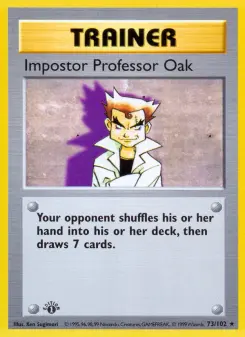
| Impostor Professor Oak | Base Set | $24.73 | Base Set 2 | $3.76 | 6.58x |
| Hypno | Fossil | $41.96 | Legendary Collection | $6.48 | 6.48x |
| Voltorb | Base Set | $3.99 | Base Set 2 | $0.62 | 6.44x |
| Magneton | Fossil | $19.99 | Legendary Collection | $3.27 | 6.11x |
| Electrode | Jungle | $25.48 | Legendary Collection | $4.34 | 5.87x |
| Archeops | Noble Victories | $10.96 | Plasma Blast | $1.87 | 5.86x |
| Fighting Energy | Gym Challenge | $2.22 | Neo Genesis | $0.40 | 5.55x |
| Mr. Mime | Jungle | $38.28 | Base Set 2 | $6.91 | 5.54x |
| Pidgeot | Jungle | $54.77 | Legendary Collection | $10.12 | 5.41x |
| Snorlax | Jungle | $151.06 | Base Set 2 | $27.97 | 5.40x |
| Charizard (rank 91 of 543) | Base Set | $919.98 | Base Set 2 | $512.90 | 1.79x |
Charizard is the instructive row, and it is in the table because it fails to rank rather than because it does: it is the dearest original on the page at $919.98 and it sits 91st of 543 same-tier pairs on the multiple, at 1.79x over its own reprint. Where a card is wanted for the picture rather than for the print run, the reprint inherits most of the demand. Where the card is wanted because it is a 1999 artifact, as with Impostor Professor Oak at 6.58x, the reprint inherits much less of it. The four energy rows near the top of the table make the same point without any chase demand attached at all: nobody wants a Gym Heroes Fire Energy for the picture, and it still trades at 8.68x the Neo Genesis print of the same art.
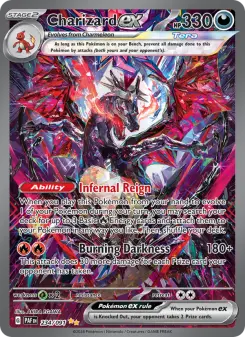
The reverse case is just as real and lives in the modern era. Charizard ex from Obsidian Flames trades at $99.45 while the same special illustration rare in Paldean Fates trades at $276.03. Same artwork, same tier, and the reprint is worth nearly three times the original because the reprinting set is the scarcer product. Nothing about being first protected the original there.
Which sets reprint and which get raided
Sets by reprint role, pairs above the artwork bar
| Set doing the reprinting | Pairs | Set being reprinted | Pairs |
|---|---|---|---|
| Legendary Collection | 162 | Base Set | 158 |
| Base Set 2 | 127 | Base Set 2 | 77 |
| Ascended Heroes | 91 | Jungle | 55 |
| Prismatic Evolutions | 49 | Fossil | 25 |
| Call of Legends | 31 | Twilight Masquerade | 20 |
| Neo Genesis | 24 | Mega Evolution | 20 |
| Gym Challenge | 20 | Temporal Forces | 19 |
| Paldean Fates | 18 | Stellar Crown | 18 |
Two reprint cultures show up in that table. The 1999 to 2002 one reissued whole checklists: Legendary Collection and Base Set 2 between them account for 289 of the 687 pairs. The modern one reissues recent cards into anniversary and subset products within a year or two, which is why Ascended Heroes and Prismatic Evolutions appear as reprinters of sets released months earlier. The second kind is the reason the median gap between the two printings is under two years.
What would overturn this
Raising the artwork bar should not move the same-tier ratio much: if a stricter embedding cosine, or a hand-verified reprint list, produced a same-tier median past 1.5x, then the bar used here is admitting enough near-misses to matter and the finding is soft. A holo-aware rarity field would be the sharper test, because the deduplication rule used here is a proxy for one. And if a sold-price panel rather than an ask panel shows originals clearing at a wider premium than asks suggest, then what this study measured is a listing convention rather than a price.
What this study cannot show
This is a cross section, not an event study. It compares what an original and its reprint are worth today, and it cannot say what the original did on the day the reprint was announced, because our per-card tape reaches back to 2025 for only about 2,800 English cards and the reprints here span twenty-seven years. The artwork bar is a proxy with a measured failure mode. Two independent hand passes over two different random forties at the bar found one clear failure between them, the five Alph Lithograph pairs, which share a name, a credit and a frame while being four different pictures; the second pass found no clear failure and three uncertain cases where a full-art print was matched to the regular print of the same picture, which is the tier split doing its job rather than a mismatch. Cross-era reprints that changed the card frame score below the bar and are undercounted, which is why very few pairs separated by more than ten years survive. Rarity labels are the catalog's, and vintage labels do not separate holo from non-holo, which the one-print-per-set rule mitigates rather than fixes; a few modern secret rares are labelled Rare and will sit in the wrong tier bucket. All prices are asks. Japanese prints are excluded entirely, so nothing here speaks to the Japanese reprint pattern measured in Japanese Slabs and Same Card, Two Oceans.
Population: English catalog cards carrying both a name and an illustrator credit, grouped by lowercased name plus illustrator. Within a group, one print is kept per catalog set, the one with the highest last recorded market ask. Every ordered cross-set pair from a group is a candidate; a candidate becomes a reprint pair when both sets carry a release date from `report:spread:setsmeta`, both cards carry a stored `emb3` SigLIP embedding, and the cosine between those embeddings is at least 0.70. That leaves 688 pairs over 447 artworks in 72 sets, from 1,251 candidates; 687 of them over 446 artworks carry a price on both sides and are the population every figure here is computed on. The artwork group key is the card name lowercased plus the illustrator credit lowercased, with no other folding, so the four catalog rows spelling Farfetch'd with a curly apostrophe form their own group; folding apostrophe variants adds 5 pairs to the 688 and moves the same-tier median ratio by one hundredth, which is why it is disclosed rather than applied. The original is the print from the earlier-released set. The rarity ladder collapses 43 of the catalog's 46 English rarity labels into seven tiers, printed in the tables as same, up and down; the three with no place on a scarcity ladder (None, Jumbo and Code Card) are left off it, which is why 680 of the 687 pairs carry a tier on both sides. A second ladder drawn independently, collapsing the same labels into six tiers instead of seven, returns the same 543, 85 and 52 pair counts and the same three medians, so the split is not an artifact of where the tier lines were put. Ratios are original ask over reprint ask; medians take the upper middle value on even samples and are used throughout because the ratio distribution has extreme tails in both directions. Prices are the last recorded TCGplayer market ask from the daily `price_history` tape as of 2026-09-22, the same figure the card pages publish. Not financial advice.