Three weeks ago we published a forensic piece about one set, 30th Celebration, where six cards sat at exactly $49.99 for up to seventeen straight days and the whole set had produced zero recorded sales. The obvious next question is how much of that we do to the entire catalog. We now have the answer, because between August 30 and September 19 we recorded 994,132 daily price readings across 52,542 cards. Restrict to the 35,507 cards that produced a reading on all 21 days, and 7,795 of them, 22.0%, returned the identical number every time. Not a small drift. Not a rounding wobble. One price, twenty-one days.
Most of the catalog barely moves, and a fifth does not move at all
The shape here matters more than the headline. 7,795 cards produced exactly one distinct price across the window. Another 6,836 produced exactly two, and 5,396 produced three. Take the first two groups together and 41.2% of fully-covered cards changed price at most once in three weeks; add the third and 56.4% changed at most twice. At the other end, no card in the catalog produced more than 17 distinct prices out of 21 days, and 271 cards are tied at that ceiling with another 429 at sixteen. There is no card in our data that reprices daily.
Distinct prices produced over 21 days
The expensive end is the frozen end
Here is the result we did not expect. If a frozen price is a symptom of nobody trading a card, you would expect it to be a bulk problem: worthless commons nobody bothers to reprice. It is the opposite. Sort by average price over the window and the frozen share climbs almost monotonically from $5 upward, reaching 51.5% above $500. The cards our readers care most about, and pay the most for, are the cards whose published price is most likely to be a number that has not been tested in three weeks.
Frozen share by price level, 21-day window
| Average price | Cards | Never moved | Frozen share | Avg distinct prices |
|---|---|---|---|---|
| Under $1 | 14,270 | 2,281 | 16.0% | 3.67 |
| $1 to $5 | 6,081 | 745 | 12.3% | 6.03 |
| $5 to $20 | 8,144 | 2,284 | 28.0% | 4.92 |
| $20 to $100 | 5,234 | 1,727 | 33.0% | 3.97 |
| $100 to $500 | 1,572 | 652 | 41.5% | 2.96 |
| $500 and up | 206 | 106 | 51.5% | 2.32 |
The $1 to $5 band is the liveliest thing in the catalog, at 12.3% frozen and 6.03 distinct prices per card. That band is where bulk-adjacent modern singles live: thousands of listings, constant undercutting, an algorithmically repriced floor. The under-$1 band is slightly more frozen than that, at 16.0%, because a card that costs 15 cents has nowhere left to go. But from $5 upward the trend is one direction only. By the time you reach four figures, a price is a standing ask that nobody has met.
Where the freeze lives, and where it does not
Break the frozen share out by set and the split is clean enough to be a rule. Promotional sets, especially Japanese ones, are almost entirely frozen. Sets with a real collector market and a deep sales history are not frozen at all. Fourteen sets with at least 60 fully-covered cards produced zero frozen cards between them.
The most frozen sets, and the least
| Set | Fully-covered cards | Never moved | Frozen share |
|---|---|---|---|
| bw-p promotional cards | 75 | 62 | 82.7% |
| Mysterious Mountains | 63 | 51 | 81.0% |
| pcg-p promotional cards | 89 | 71 | 79.8% |
| xy-p: XY promos | 121 | 95 | 78.5% |
| The Town on No Map | 71 | 55 | 77.5% |
| sm-p: Sun & Moon promos | 193 | 142 | 73.6% |
| Base Set | 101 | 0 | 0.0% |
| Base Set (Shadowless) | 102 | 0 | 0.0% |
| Base Set 2 | 130 | 0 | 0.0% |
| Fossil | 62 | 0 | 0.0% |
| Gym Heroes | 132 | 0 | 0.0% |
| Jungle | 64 | 0 | 0.0% |
The WotC originals are the tell, and not for the reason you would guess. Base Set is not a set of expensive cards: 68 of its 101 fully-covered cards average under $5, and its median card is $2.56. Jungle and Fossil sit higher, at medians of $9.62 and $7.32, so they are not quite the bargain bin Base Set is. What all three share is that not one of their fully-covered cards held a single price for three weeks. Match them against Japanese promos band for band and the contrast is total: in the $5 to $20, $20 to $100 and $100-plus bands, these three sets are 0.0% frozen and the Japanese promo sets are frozen roughly three times in four. Age does not freeze a card and neither does price. Absence of buyers does, and a 1999 common that thousands of people still trade has more buyers than a promo that was never really for sale. Japanese promotional runs are thinly listed, rarely sold and almost never repriced, so their published number is closer to a historical artifact than a quote.
The expensive cards that did not move at all
386 fully-covered cards above $200 returned the identical price on all 21 days, and 32 of those are four-figure cards. Six of them are below. The number beside each is not a range, because there is no range. It is the single value we recorded every day for three weeks.
Four-figure prices that never moved

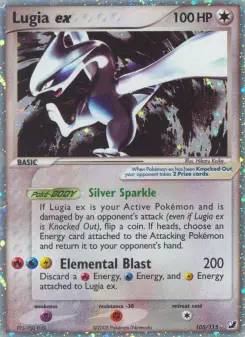
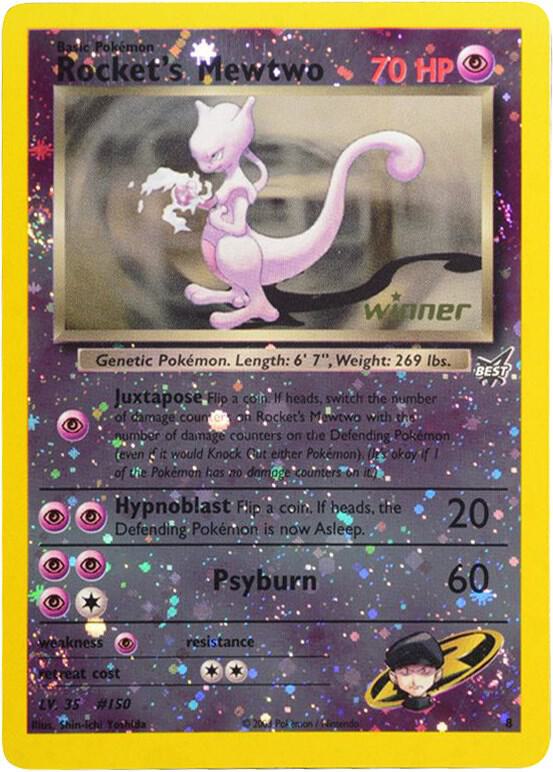
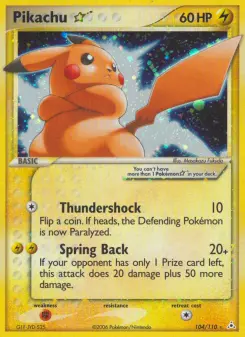
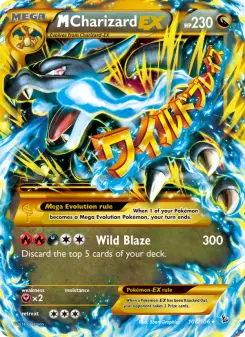

Round numbers recur in that list for a reason. $3,500.00, $2,500.00, $2,400.00: these are seller-chosen asks, not transaction prints. A market that has cleared a trade rarely lands on a figure ending in three zeros. The ask is lying to you made this argument structurally; this is the same argument with a 21-day stopwatch on it.
What a card that actually trades looks like
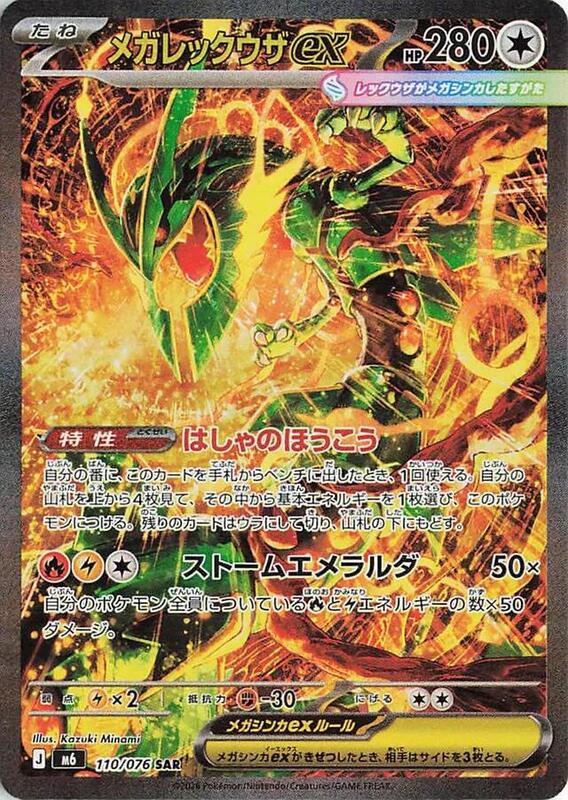
For contrast, the cards that reach the 17-price ceiling above $20 are almost all recent high-value chase cards from sets still in active distribution. Five of the 271 ceiling-holders are below. Mega Rayquaza ex produced 17 distinct prices and ranged from $376.15 to $600.55, a 59.7% spread inside three weeks. Cynthia's Garchomp ex from Destined Rivals also hit 17 distinct prices but in a tight $226.27 to $238.83 channel, which is what a liquid, well-supplied card looks like: constant small repricing, no drama. Both are real markets. Only one is volatile.
Cards at the 17-price ceiling, above $20
| Card | Set | Distinct prices | Low | High |
|---|---|---|---|---|
| Mega Rayquaza ex | M6: Storm Emeralda | 17 | $376.15 | $600.55 |
| Cynthia's Garchomp ex | Destined Rivals | 17 | $226.27 | $238.83 |
| Mega Darkrai ex | Pitch Black | 17 | $191.25 | $212.58 |
| Mega Greninja ex | Chaos Rising | 17 | $164.07 | $184.57 |
| Moltres & Zapdos & Articuno GX | SM Black Star Promos | 17 | $153.05 | $160.17 |
How to read a price once you know this
The practical rule is short. Before you treat a published price as a market price, ask how many times it changed recently. On a card page, a number that has held for three weeks is a seller's opinion; a number that has moved eight times is a market's opinion. The gap between those two things is widest exactly where the money is, which is the uncomfortable half of this study. If you are buying a $500-plus card, there is a coin-flip chance that the price you are anchoring to has not been tested since before you started looking.
The second rule is for sellers. A frozen price at the top of the market is not evidence that your copy is worth that. It is evidence that nobody has agreed to that number recently, and 106 of the 206 cards above $500 are in that position right now. Our liquidity work put trade frequency on trophies at roughly four times a year. Twenty-one days is a twentieth of a year. Finding nothing in that window is not surprising, and treating the unchanged ask as a valuation is the mistake.
Source: our price_history table, 994,132 rows covering 52,542 distinct cards on 21 consecutive days from August 30 to September 19, 2026, recorded from TCGplayer market values. Daily coverage is not uniform across the catalog (between 35,700 and 52,261 cards were priced on any given day), so every frozen-share figure in this article is computed only on the 35,507 cards that produced a reading on all 21 days; that restriction is what makes 'never moved' checkable rather than an artifact of missing days. 'Distinct prices' counts unique values, so a card that moved and moved back counts two. Price bands use the mean price across the window. Set-level figures require at least 60 fully-covered cards in the set and use the set names as recorded on the price series. Nothing here is financial advice.