The oldest argument in this hobby is that reprints kill value. It is why people flinch when a beloved card gets a new illustration, and why nobody expects the 214th English Pikachu to be worth anything. We tested it the only way it can be tested: count how many separately priced printings each Pokemon has, then ask whether the heavily printed ones ask less than the cards beside them. They do not. Across 302 species the rank correlation between printing count and cohort premium is +0.425, pointing the wrong way for the reprint argument. The species printed twenty to twenty-nine times sit at parity, 0.99x. The seven species printed sixty or more times sit at 3.19x, and all seven are above parity.
The direction of the arrow
This is a correlation and the causation almost certainly runs backwards through it. The Pokemon Company prints the Pokemon people want, so a high printing count is a record of demand that already existed, not a treatment applied to a random card. Nothing here shows that printing a card more makes it worth more. What it does show is the thing the reprint argument actually claims, and it shows that claim failing: if flooding the market destroyed the premium, the most-printed creatures would be the ones trading nearest their neighbours, and they are the furthest from them.
Median cohort premium by how often the species is printed
Cohort premium by printing count, all 302 species, rows sum to 302
| Printings | Species | Median sets | Median premium | Middle half | Above parity |
|---|---|---|---|---|---|
| 20 to 29 | 197 | 19 | 0.99x | 0.79x to 1.31x | 86 of 197 |
| 30 to 39 | 71 | 27 | 1.33x | 1.00x to 2.00x | 52 of 71 |
| 40 to 59 | 27 | 34 | 1.95x | 1.18x to 3.44x | 22 of 27 |
| 60 or more | 7 | 52 | 3.19x | 1.44x to 4.68x | 7 of 7 |
The fifteen most-printed Pokemon
The top band holds seven species and the table below names all of them: Pikachu, Eevee, Charizard, Mewtwo, Raichu, Unown and Meowth. All seven clear parity, and the two at the bottom of the band are worth reading because they disagree with each other. Unown's 67 printings come from only 17 sets, so it is printed in bulk inside a few sets rather than reprinted across the catalog, and it sits at 1.44x. Meowth's 64 come from 52 sets, the widest spread in the band, and it sits lower still at 1.40x. Set count on its own does not separate those two, which is why the set-count correlation is reported beside the printing-count one rather than instead of it.
Most-printed species, ranks 1 to 15 of 302
| Rank | Species | Printings | Sets | Cohort premium | Median ask |
|---|---|---|---|---|---|
| 1 | Pikachu | 187 | 84 | 4.68x | $12.86 |
| 2 | Eevee | 85 | 53 | 3.86x | $4.92 |
| 3 | Charizard | 83 | 47 | 8.96x | $52.49 |
| 4 | Mewtwo | 72 | 40 | 3.19x | $28.57 |
| 5 | Raichu | 69 | 52 | 2.14x | $8.74 |
| 6 | Unown | 67 | 17 | 1.44x | $2.00 |
| 7 | Meowth | 64 | 52 | 1.40x | $1.76 |
| 8 | Gyarados | 59 | 41 | 2.70x | $19.71 |
| 9 | Ninetales | 56 | 41 | 1.95x | $14.33 |
| 10 | Snorlax | 53 | 44 | 6.55x | $17.33 |
| 11 | Vulpix | 53 | 44 | 2.04x | $1.59 |
| 12 | Lucario | 52 | 39 | 2.45x | $10.31 |
| 13 | Rayquaza | 52 | 29 | 5.89x | $75.91 |
| 14 | Rotom | 52 | 32 | 1.11x | $0.48 |
| 15 | Charmander | 47 | 38 | 2.78x | $3.21 |
Pikachu, the extreme case
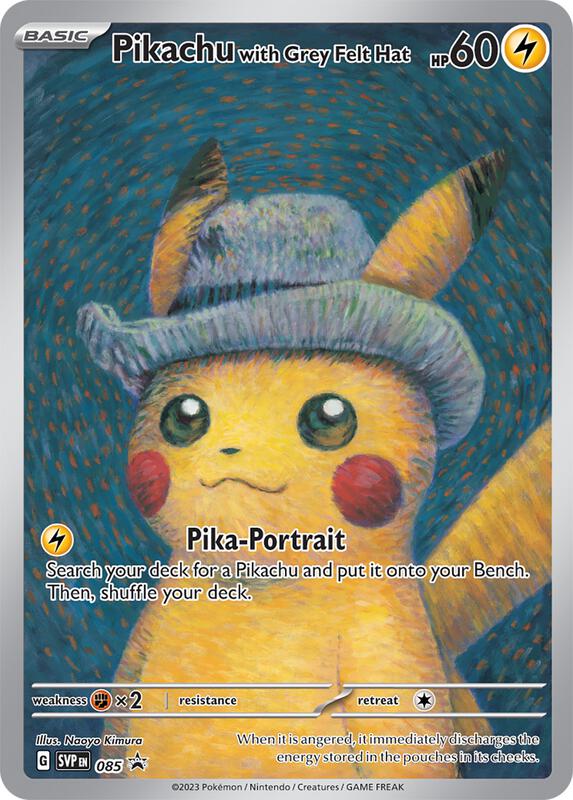
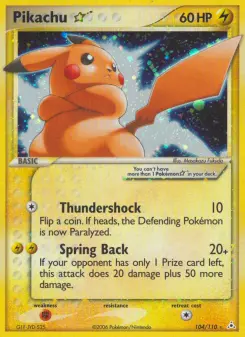
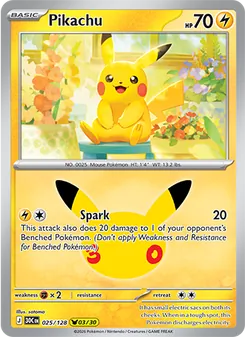
If any creature should have been printed into the ground it is this one. 214 English Pikachu printings carry an ask, across 94 sets, and 187 sit in a set-and-rarity cohort large enough to measure. The median one asks 4.68x the cards printed beside it, and 166 of the 187 clear their cohort. 21 do not. The market has been handed more Pikachu than any other creature in the game and still pays up for the next one.
The ten widest Pikachu premiums, ranks 1 to 10 of 187
| Rank | Card | Set | Ask | Cohort median | Premium |
|---|---|---|---|---|---|
| 1 | Pikachu with Grey Felt Hat | SVP Black Star Promos | $1,066.19 | $2.23 | 478.11x |
| 2 | Pikachu Libre | XY Trainer Kit: Pikachu Libre & Suicune | $63.40 | $0.25 | 253.60x |
| 3 | Special Delivery Pikachu | SWSH Black Star Promos | $461.25 | $3.34 | 138.10x |
| 4 | Surfing Pikachu | Rising Rivals | $388.58 | $3.98 | 97.63x |
| 5 | Pikachu Star | EX Holon Phantoms | $1,899.99 | $21.05 | 90.26x |
| 6 | Pikachu Libre | XY Trainer Kit: Pikachu Libre & Suicune | $22.47 | $0.25 | 89.88x |
| 7 | Pikachu | Rising Rivals | $328.45 | $3.98 | 82.53x |
| 8 | Pikachu | SVP Black Star Promos | $130.63 | $2.23 | 58.58x |
| 9 | Pikachu | Trading Card Game Classic | $51.29 | $0.95 | 53.99x |
| 10 | Flying Pikachu | Rising Rivals | $208.03 | $3.98 | 52.27x |
The bottom of the Pikachu ladder is where the flood is visible, and it is concentrated in one place. Of the 21 Pikachu printings that ask less than their cohort, 14 come from 30th Celebration, which by itself supplies 27 of the 187. A set that prints one creature twenty-seven times does dilute that creature inside that set. Outside it, the other 160 measured Pikachu printings include only 7 that fall short.
Three ways this could be wrong
The first objection is that promos rig it. A heavily printed creature appears in many promo sets, and a promo cohort can have a median ask near a dollar, which makes any decent card look enormous. So the whole ladder was rebuilt on numbered expansion sets only, dropping 48 set names: every Black Star Promo run, every trainer kit, every McDonald's collection, Trick or Trade, EX Battle Stadium, the anniversary and Classic collections, Southern Islands, the Kalos Starter Set and Pokemon Rumble. That removes 2,627 of the 21,422 priced English products and leaves 233 reportable species. The ladder holds: 1.00x, 1.71x, 2.07x, 2.14x, with a rank correlation of +0.31. Weaker, same sign, same order.
The second objection is that printing count is really set count, and a creature in more sets simply gets more chances at a chase slot. The two are separable here, and separating them weakens the set story: the rank correlation between the number of SETS a species appears in and its premium is +0.232, against +0.425 on printing count. Unown shows what a concentrated count looks like, 67 printings from 17 sets at 1.44x against Pikachu's 187 from 84 sets at 4.68x, though the two variables disagree on Meowth, which has the widest spread in the top band and its lowest premium.
The third objection is survivorship, and it is correct. A species only enters this study with twenty printings inside a large cohort, so the creatures measured here are the ones somebody wanted. That is the same point as the direction of the arrow, stated the other way round. It does not rescue the reprint argument, because the reprint argument is a claim about what happens WITHIN the popular names, and the popular names are exactly the ones sitting highest.
The ladder under two rebuilds
| Printings | As published, 302 species | Expansion sets only, 233 species |
|---|---|---|
| 20 to 29 | 0.99x, 197 species | 1.00x, 169 species |
| 30 to 39 | 1.33x, 71 species | 1.71x, 48 species |
| 40 to 59 | 1.95x, 27 species | 2.07x, 13 species |
| 60 or more | 3.19x, 7 species | 2.14x, 3 species |
| Rank correlation | +0.425 | +0.31 |
What this study cannot show
This is a cross-section, not an event study. It cannot tell you what happened to a specific card on the day its reprint was announced. The piece that comes closest, what a reprint does to the original card, is also cross-sectional and says so; it measures a different object, 543 matched pairs of an original print against its same-tier reprint, where the original trades at a median 1.13x the reprint. This study measures the species, not the pair.
The top band holds seven species on the published ladder and three on the expansion-only rebuild. A band of three species is thin and its 2.14x should be read as a direction rather than a level. Printing counts here are separately priced marketplace products, which is not print run: how many printings does a Pokemon card have shows the same English catalog resolving to 34,433 priced printings from 21,908 cards, mostly because a card is sold in more than one finish. Two finishes of one card count as two printings here, and no public data exists on how many of either were made.
Prices are ASKS from the daily tape, not sales. A promo listed at $1,066.19 against a $2.23 cohort is a listing, and the ratio inherits every problem an ask has. 27 Pikachu printings are dropped for sitting in a cohort of ten or fewer other cards, and not from where the phrase suggests: both trainer-kit Pikachus are measured and sit in the table above. Seven of the drops come from 30th Celebration, five from Celebrations and six from the POP Series promo runs, with no other set losing more than two. Several of the widest ratios in the Pikachu table sit above cohort medians of a quarter, where the denominator is doing as much work as the card is.
What would overturn this
The claim is the sign of the correlation. A recompute on the same day's tape returning a negative rank correlation between printing count and cohort premium, on the full population or on expansions alone, would overturn it outright. A recompute returning a positive correlation that vanishes once promo sets are removed would reduce it to a promo artefact, which is why that rebuild is printed rather than described. Related work: the species premium for the full 302-name ranking this ladder is built from, and same picture, ten times the price for what happens when two printings share one artwork.
Sources: the `cards` catalog and the daily `price_history` tape, read on day 20718, September 22 2026. Population, cohort and species attribution are identical to the species premium: products deduplicated on the TCGplayer product id, asks from the most recent daily market figure, cohorts of every other English product in the same set at the same printed rarity with a ten-other-member floor, species from the 1,025-name `pokemon_indices` table with both sides folded to one canonical key, and cards naming two or more species excluded. 20,246 products receive a ratio and 302 species carry twenty or more of them. A species' printing count in this study is the number of its printings INSIDE that measured population, not its raw catalog count, which is why Pikachu enters the ladder at 187 rather than 214; both figures are printed. Bands are closed intervals on that count and the four rows sum to 302. The correlation is Spearman's rank correlation with average ranks for ties, computed across the 302 species between printing count and median premium, and separately between distinct set count and median premium. The expansion-only rebuild removes 48 set names by an explicit list rule (any set name matching black star promo, trainer kit, McDonald, Trick or Trade, Battle Academy, Classic Collection, 30th Celebration, Trading Card Game Classic, Pokemon Rumble, Alternate Art Promos, First Partner, Best of game, Southern Islands, EX Battle Stadium or Kalos Starter Set; the Battle Academy clause matches no set in the priced English population and removes nothing), removes 2,627 products, and rebuilds every cohort inside the remaining 18,795 before recomputing; its species count falls to 233 because the twenty-printing bar bites harder on a smaller population. Medians are upper-middle on even samples, quartiles are nearest-rank, and ties break on the species key ascending. Not financial advice.