Every new-set thread says the same thing: the money is at the back, past the printed total. Our catalog can check both halves of that claim, because it holds the printed total and the card number for 19,467 priced English cards. The tier claim is as close to universal as anything we measure: in all 95 English sets that have any card numbered past the total, the median such card out-asks the median card inside the checklist, usually by a factor of about 70. The chase claim is much weaker. The single most expensive priced card in the set is one of those cards in 58 of the 95, which is 61.05%, and the exceptions are not obscure.
The tier rule is real and it is enormous
Pool every qualifying English card and the cards numbered past their set's printed total ask a median $10.76 against $0.52 for the cards inside the checklist, a factor of 20.69. Within a set the factor is usually larger still, because pooling mixes a 1999 common with a 2025 one: the median set in this study puts its past-the-total cards at 71.19 times its inside-the-checklist cards. There is no set among the 95 where the relationship runs the other way. If the myth were only about tiers, it would be one of the few in this series that passes cleanly.
The 18 largest of the 95 qualifying English sets by priced cards, with the tier gap and the set's dearest card (raw asks, September 22, 2026)
| Set | Priced cards | Past the total | Median ask past | Median ask inside | Factor | Dearest priced card | Is it past the total? |
|---|---|---|---|---|---|---|---|
| Ascended Heroes | 295 | 78 | $6.73 | $0.17 | 39.59x | Pikachu ex 276/217 | Yes |
| Fusion Strike | 284 | 20 | $7.31 | $0.17 | 43.00x | Gengar VMAX 271/264 | Yes |
| Paldea Evolved | 279 | 86 | $11.37 | $0.14 | 81.21x | Magikarp 203/193 | Yes |
| Cosmic Eclipse | 271 | 35 | $21.42 | $0.35 | 61.20x | Arceus & Dialga & Palkia GX 221/236 | No |
| Paradox Rift | 266 | 84 | $8.34 | $0.15 | 55.60x | Groudon 199/182 | Yes |
| Scarlet & Violet | 258 | 60 | $6.25 | $0.14 | 44.64x | Gardevoir ex 245/198 | Yes |
| Unified Minds | 258 | 22 | $22.62 | $0.34 | 66.53x | Mewtwo & Mew GX 242/236 | Yes |
| Surging Sparks | 252 | 61 | $5.78 | $0.13 | 44.46x | Pikachu ex 238/191 | Yes |
| Paldean Fates | 245 | 154 | $4.57 | $0.11 | 41.55x | Mew ex 232/91 | Yes |
| Destined Rivals | 244 | 62 | $6.06 | $0.17 | 35.65x | Team Rocket's Mewtwo ex 231/182 | Yes |
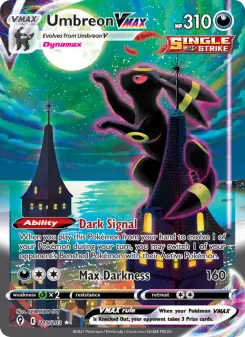
| Evolving Skies | 237 | 34 | $9.89 | $0.22 | 44.95x | Umbreon VMAX 215/203 | Yes |
| Lost Thunder | 236 | 22 | $26.34 | $0.64 | 41.16x | Mimikyu GX 226/214 | Yes |
| Unbroken Bonds | 234 | 20 | $38.28 | $0.42 | 91.14x | Gardevoir & Sylveon GX 205/214 | No |
| Chilling Reign | 233 | 35 | $9.30 | $0.22 | 42.27x | Blaziken VMAX 201/198 | Yes |
| Obsidian Flames | 230 | 33 | $5.10 | $0.16 | 31.87x | Charizard ex 223/197 | Yes |
| Twilight Masquerade | 226 | 59 | $7.54 | $0.16 | 47.13x | Greninja ex 214/167 | Yes |
| Temporal Forces | 218 | 56 | $12.17 | $0.15 | 81.13x | Gastly 177/162 | Yes |
| Lost Origin | 217 | 21 | $4.96 | $0.19 | 26.11x | Giratina V 186/196 | No |
The selection rule for that table is mechanical and stated so it can be reapplied: the 18 English sets with the most priced cards, among the 95 that qualify, ordered by that count with ties broken on the set name. Three of the eighteen already break the chase rule.
The chase rule breaks 37 times
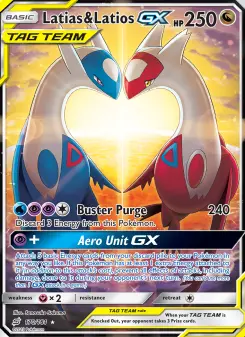
In 37 of the 95 sets the dearest priced card is numbered inside the checklist. Two different mechanisms produce that, and both are worth knowing, but they are not evenly weighted: only 7 of the 37 come from a set released in 2020 or later. Since 2019 it is the alternate-art ultra rare, a card that sits at its normal checklist number and outsells everything printed behind it: Giratina V at 186 of 196 in Lost Origin, Machamp V at 172 of 189 in Astral Radiance, Gardevoir & Sylveon GX at 205 of 214 in Unbroken Bonds. In the 2004 to 2006 block it is the gold-star and ex cards, which sit at the very end of the checklist without crossing it: seven of the ten dearest grails in this group are one or the other.
The ten dearest grails that are NOT past their set total, ranked by ask (ranks 1 to 10 of 37)
| Rank | Card | Set | Number | Raw ask | Median ask past the total in that set |
|---|---|---|---|---|---|
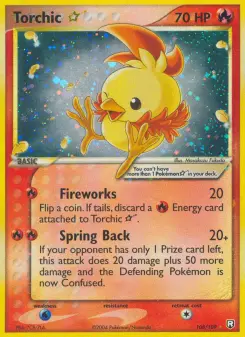
| 1 | Torchic ☆ | Team Rocket Returns | 108 of 109 | $4,500.00 | $326.30 |
| 2 | Latias & Latios GX | Team Up | 170 of 181 | $3,910.42 | $45.12 |
| 3 | Lugia ex | Unseen Forces | 105 of 115 | $2,500.00 | $370.00 |
| 4 | Pikachu Star | Holon Phantoms | 104 of 110 | $1,899.99 | $335.54 |
| 5 | Latias ☆ | Deoxys | 105 of 107 | $1,650.00 | $284.99 |
| 6 | Kyogre Star | Delta Species | 112 of 113 | $1,602.99 | $104.95 |
| 7 | Regirock ☆ | Legend Maker | 91 of 92 | $1,450.99 | $211.85 |
| 8 | Gengar ex | FireRed & LeafGreen | 108 of 112 | $1,399.99 | $180.88 |
| 9 | M Rayquaza EX | Ancient Origins | 98 of 98 | $1,092.54 | $21.37 |
| 10 | Black Kyurem-EX | Boundaries Crossed | 145 of 149 | $900.96 | $155.80 |
Torchic ☆ is the clearest row in that table. It is card 108 of a 109-card set. One number further along and it would be past the total and the myth would have another win. Instead it is the last-but-one card inside the checklist, it asks $4,500, and it out-asks both of the two cards its set does print past the total, at 13.79 times their median.
Three ways this could be wrong
First objection: the vintage sets are being excluded to flatter the result. They are excluded because the rule cannot apply to them: 39 English sets with 40 or more priced cards have NO card numbered past their printed total at all. Most are old expansions, including Base Set, Jungle, Fossil, Gym Heroes, Gym Challenge, Neo Genesis and Legendary Collection, but they are not only old: 14 of the 39 carry a release date of 2010 or later, among them seven Trainer Kits, Generations from 2016 and Trading Card Game Classic from 2023, and the largest of the 39 is SVP Black Star Promos at 214 priced cards. What the 39 share is a checklist with no tier above the printed total, not an era. Including them would not test the myth; it would test whether a set has secret rares. The 95 that qualify are the ones where the question has an answer.
Second objection: the dearest card in a set is a single observation and a noisy one. It is, which is why both halves of the finding are reported and why the tier half carries the stronger claim. The tier half rests on 1,940 cards against 17,527. The chase half rests on 95 single observations and the result is 61.05%, a number that ought to be read as roughly three in five rather than as a precise rate.
Third objection: the rule is decaying, so any pooled figure is a blend of eras. It is not decaying, it is strengthening. Among the 67 qualifying sets whose release date we hold, the dearest card is past the total in 4 of 9 sets released before 2011, 17 of 25 released between 2011 and 2019, and 26 of 33 released in 2020 or later. Twenty-eight qualifying sets carry no release date in our set feed and are excluded from that split alone.
What would overturn this
A recompute over the same catalog and the same evaluation day that found any set where the median card past the total asks less than the median card inside it would break the tier claim. A recompute finding the dearest card past the total in fewer than half the 95 sets, or in more than four fifths, would break the chase claim as stated. The definition to attack first is the boundary itself: this study calls a card past the total when the leading integer of its printed number exceeds the set's printed total, which is the same convention the checklist uses. Related: pokemon card rarity chart by value, the set inside the set, and the SIR versus IR scarcity tax.
Sources: `cards` for the card number and the set's printed total, and `price_history` read as the latest row per TCGplayer product id on or before day 20718 (September 22, 2026 UTC) for the raw ask. ALL PRICES HERE ARE ASKS, the same figure the card page prints; no sold median appears in this study. The population starts from 21,422 English products carrying an ask and applies two exclusions, both of which are stated rather than implied: 461 are dropped because no catalog row behind the product carries a printed total above zero, either because the field is null or because it is recorded as zero, and without a printed total a card cannot be scored against one. Those 461 sit in 14 sets and the largest blocks are ME05: Pitch Black (99 products, a 2026 expansion whose printed total our catalog does not hold for most of its cards), MEP Black Star Promos (78), Alternate Art Promos (54), EX Battle Stadium (48), First Partner Pack (33) and the three Trick or Trade bundles (30 each), so the drop is not confined to promo runs. A further 1,494 are dropped because the printed number has no leading integer to compare, which removes lettered promo numbers such as SWSH143. 19,467 products remain, 1,940 of them numbered past their set's printed total. EVERY COUNT IS DEDUPED ON THE TCGPLAYER PRODUCT ID: 1,212 ids are claimed by two catalog rows each, and the printed total used is the first positive one any row behind the product carries. A set qualifies for the set-level tests when it holds 40 or more of those products AND at least one of them is numbered past the total: 134 English sets clear the size bar and 95 clear both, with the 39 that hold no such card characterised in the article and ten of them named, rather than dropped silently. The dearest card of a set is the qualifying product with the highest ask, ties broken on the product id ascending. Medians use the upper-middle nearest-rank convention, the value at index floor(p x n) of the ascending sample. The 18-set table is the head of a single ranking of the 95 by priced-card count, ties broken on the set name, printed with no rank skipped. The era split uses release dates from our `setinfo:v4:` rows, which cover 67 of the 95 qualifying sets; the other 28 are excluded from that split only. Not financial advice.