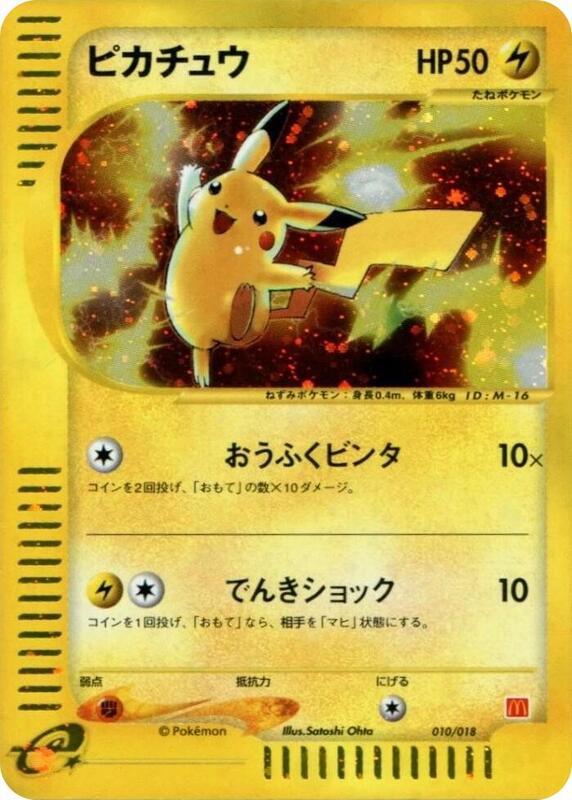
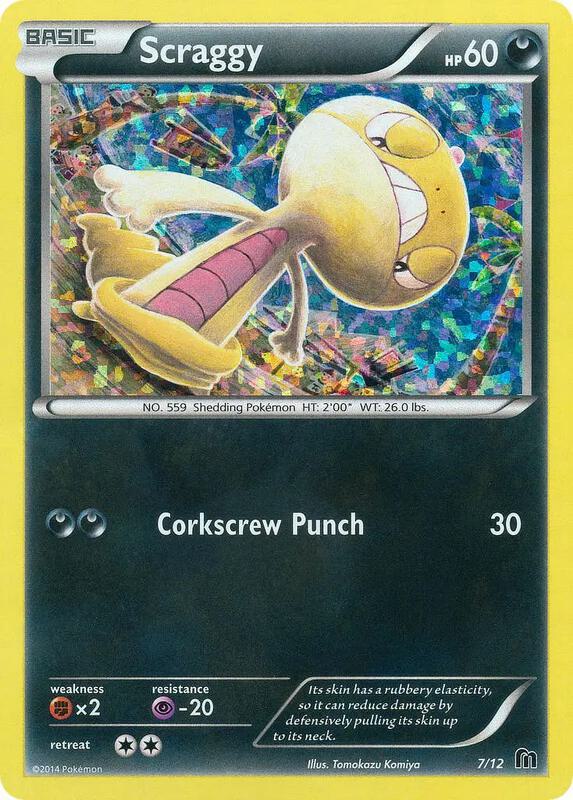
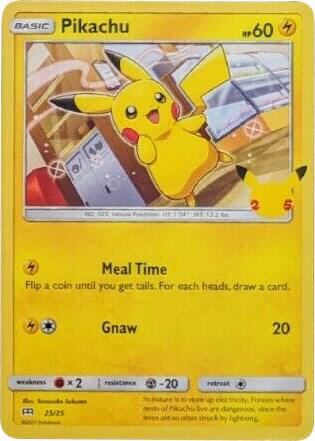
Almost nothing, with two exceptions that are not the ones people expect. We hold thirteen McDonald's sets, 190 cards, and 181 of them carry an ask on September 23, 2026 totalling $4,862.21. The median McDonald's card asks $7.98 and 28.7% of them ask under a dollar. Two sets hold 72.1% of the money: the Japanese Pokémon-e Minimum Pack at $2,166.42 on 24 cards, and McDonald's Collection 2016 at $1,339.44 on twelve. The 2021 set, which holds more PSA registry lines than any of the other twelve at 21,016 across 25 cards, is worth $40.34 in total.
A small population, said plainly
This is a 190-card study and the number it produces is small, in the way the other giveaway censuses in this batch are small: What Are POP Series Pokémon Cards Worth covers 153 league cards and Are Pokémon Black Star Promos Worth Anything covers 1,347 promos. What it is instead is complete: every McDonald's set in our catalog, every card in each, priced on one day with no floor and no top-N window. Nobody publishes that. The thirteen sets are the English McDonald's Collection for 2011, 2012, 2014 through 2019, and 2021 through 2024, plus the Japanese McDonald's Pokémon-e Minimum Pack. We hold no 2013 and no 2020 set in the catalog, which is a statement about our catalog and not about what McDonald's printed; both spellings return nothing on our set pages and nothing in our card table.
Every McDonald's set we hold, by summed ask on September 23, 2026. Registry lines are labelled lines held, not a slab count
| Set | Cards | Priced | Summed ask | Median card | Dearest card | Its share of the set | Registry lines held |
|---|---|---|---|---|---|---|---|
| McDonald's Pokémon-e Minimum Pack (Japanese) | 24 | 21 | $2,166.42 | $51.00 | Pikachu 010/018 $399.99 | 18.5% | 11,609 on 7 cards |
| [2016](/research/set-screen/mcdonald%27s%20collection%202016) | 12 | 12 | $1,339.44 | $130.00 | Scraggy $199.99 | 14.9% | 77 on 12 cards |
| [2018](/research/set-screen/mcdonald%27s%20collection%202018) | 12 | 12 | $327.45 | $22.58 | Psyduck $88.76 | 27.1% | 555 on 12 cards |
| [2015](/research/set-screen/mcdonald%27s%20collection%202015) | 12 | 12 | $238.16 | $13.60 | Torchic $53.34 | 22.4% | 221 on 12 cards |
| [2014](/research/set-screen/mcdonald%27s%20collection%202014) | 12 | 12 | $200.52 | $15.67 | Pikachu $42.26 | 21.1% | 220 on 12 cards |
| [2019](/research/set-screen/mcdonald%27s%20collection%202019) | 12 | 12 | $185.63 | $14.96 | Pikachu $36.82 | 19.8% | 573 on 12 cards |
| [2012](/research/set-screen/mcdonald%27s%20collection%202012) | 12 | 12 | $134.62 | $12.99 | Scraggy $20.41 | 15.2% | 170 on 12 cards |
| [2017](/research/set-screen/mcdonald%27s%20collection%202017) | 12 | 12 | $99.34 | $5.69 | Pikachu $29.79 | 30.0% | 262 on 12 cards |
| [2011](/research/set-screen/mcdonald%27s%20collection%202011) | 12 | 12 | $98.43 | $7.23 | Oshawott $17.86 | 18.1% | 251 on 12 cards |
| [2021](/research/set-screen/mcdonald%27s%20collection%202021) | 25 | 25 | $40.34 | $0.50 | Pikachu $25.27 | 62.6% | 21,016 on 25 cards |
| [2024](/research/set-screen/mcdonald%27s%20collection%202024) | 15 | 14 | $19.97 | $0.60 | Dragonite $6.15 | 30.8% | 8,781 on 14 cards |
| [2022](/research/set-screen/mcdonald%27s%20collection%202022) | 15 | 14 | $7.82 | $0.38 | Growlithe $1.55 | 19.8% | 580 on 14 cards |
| [2023](/research/set-screen/mcdonald%27s%20collection%202023) | 15 | 11 | $4.07 | $0.29 | Kirlia $0.67 | 16.5% | 196 on 11 cards |
| All thirteen | 190 | 181 | $4,862.21 | $7.98 | Pikachu 010/018 $399.99 | 8.2% of all thirteen | not summable, lines are shared |
The Japanese set is the outlier and it is worth being specific about why. Twenty-four cards, 21 of them priced, a median of $51.00 against $7.98 for the population, and its dearest card asks $399.99. We hold a recorded release date for the twelve English sets and none for this one, and in any case our daily tape is 25 days long, so this study makes no claim about when any of them was handed out or what it cost at the time. It is also unlinkable: Japanese sets have no page on this site, so the set name is plain text here while its cards link normally. The Japanese catalog at large is measured in Vintage Japanese Pokémon Card Prices and Japanese Promo Card Prices.
Grading depth and price run opposite ways
Line up the sets by how much PSA has graded and the value ordering runs the other way at both ends. The 2021 set holds 21,016 registry lines across its 25 cards and is worth $40.34 in total, $1.61 a card. The 2016 set holds 77 lines across its twelve cards and is worth $1,339.44, $111.62 a card. That is 273 times the grading depth for 1.4% of the value per card. The 2024 set is the same story at 8,781 lines and $19.97. The ordering does not invert cleanly across all thirteen, but both ends do: the two deepest English registries, 2021 at 21,016 lines and 2024 at 8,781, are the fourth and third cheapest English sets, and the shallowest, 2016 at 77 lines, is the dearest English set by a distance. The Japanese Pokémon-e set is what stops this being a rule. It holds the second deepest registry at 11,609 lines and it is the dearest set in the study.
The consequence for a buyer is that a McDonald's card's price and its evidence sit in different sets. Ten of the 190 cards carry a PSA 10 sold median at all, and they come from three sets: seven from the Japanese Pokémon-e set, two from 2024 and one from 2021. Six of those ten clear ten recorded sales. The other ten sets, including the $1,339.44 2016 set and the $327.45 2018 set, carry no PSA 10 sold median on any card. Absent is not zero: those cards have not sold for nothing, there is no recorded sale to quote. This is the same problem measured across the English catalog in Cards With a Price and No Sale, where 14,466 of 21,416 priced cards have no graded sale behind them.
Grading by set. Gem rates are medians over the cards whose registry row passes the trustworthiness check
| Set | Cards with a trustworthy gem rate | Median gem rate | Cards with a PSA 10 sold median | On ten or more sales |
|---|---|---|---|---|
| McDonald's Pokémon-e Minimum Pack (Japanese) | 7 | 57.1% | 7 | 3 |
| [2021](/research/set-screen/mcdonald%27s%20collection%202021) | 25 | 37.3% | 1 | 1 |
| [2024](/research/set-screen/mcdonald%27s%20collection%202024) | 9 | 16.7% | 2 | 2 |
| [2023](/research/set-screen/mcdonald%27s%20collection%202023) | 10 | 15.4% | 0 | 0 |
| [2011](/research/set-screen/mcdonald%27s%20collection%202011) | 10 | 11.4% | 0 | 0 |
| [2019](/research/set-screen/mcdonald%27s%20collection%202019) | 10 | 10.0% | 0 | 0 |
| [2012](/research/set-screen/mcdonald%27s%20collection%202012) | 7 | 9.1% | 0 | 0 |
| [2022](/research/set-screen/mcdonald%27s%20collection%202022) | 14 | 8.7% | 0 | 0 |
| [2017](/research/set-screen/mcdonald%27s%20collection%202017) | 6 | 8.3% | 0 | 0 |
| [2018](/research/set-screen/mcdonald%27s%20collection%202018) | 6 | 3.4% | 0 | 0 |
| [2014](/research/set-screen/mcdonald%27s%20collection%202014) | 6 | 0.0% | 0 | 0 |
| [2015](/research/set-screen/mcdonald%27s%20collection%202015) | 5 | 0.0% | 0 | 0 |
| [2016](/research/set-screen/mcdonald%27s%20collection%202016) | 7 | 0.0% | 0 | 0 |
The three 0.0% rows are real recorded zeros that pass our trustworthiness check, which is a different thing from a missing row. They pass because the lines behind them are small: the 2016 set's twelve cards hold 77 registry lines between them, so a line with no tens on it is a line with almost nothing on it. A 0.0% median on five to seven thin lines is not evidence that the cards are hard to gem. It is evidence that almost nobody has sent one. For a real gem-rate reading with weight behind it, Hard to Gem pools 17,730 cards.
The distribution
All 181 priced McDonald's cards by ask band. The bands are exhaustive and sum to $4,862.21
| Ask band | Cards | Share of cards | Summed ask | Share of value |
|---|---|---|---|---|
| Under $1 | 52 | 28.7% | $22.63 | 0.5% |
| $1 to $4.99 | 18 | 9.9% | $52.46 | 1.1% |
| $5 to $19.99 | 64 | 35.4% | $703.27 | 14.5% |
| $20 to $99.99 | 32 | 17.7% | $1,313.43 | 27.0% |
| $100 or more | 15 | 8.3% | $2,770.42 | 57.0% |
Fifteen cards hold 57.0% of the value and all fifteen come from the two sets named at the top: nine from the 2016 set and six from the Japanese one. The typical McDonald's card sits in the $5 to $19.99 band, which holds 64 of the 181 and 14.5% of the money. Nothing in this population trades like a chase card, and only the Japanese Pokémon-e set and the 2016 English set trade above the cost of a sleeve and a top loader.
What this cannot show
Five limits. First, this is 190 cards, which is small enough that a single relisting moves a set-level figure; the 2023 set's whole value is $4.07. Second, every price is an ask on one day, and nine of the 190 carry no ask at all and sit outside every sum. Third, our release dates are recorded under the provider's set names rather than ours, and they cover twelve of the thirteen; the Japanese Pokémon-e set has none. No launch, first-year or since-release figure appears here anyway, because the daily tape is 25 days long and cannot reach a release date from 2011 or 2016. Fourth, a PSA registry line can be shared by several products, so the registry column is labelled lines held and is never summed across the population or read as a slab count. Fifth, our daily tape is 25 days long, so no trend or peak figure exists for any of these cards.
What would overturn this
The 72.1% concentration rests on 36 cards in two sets, and the 2016 set's $1,339.44 rests on twelve asks with no recorded sale behind any of them. A single sold comp on any 2016 card at a fraction of its ask would move that set's contribution and the concentration figure with it. A 2013 or 2020 McDonald's set entering our catalog would change the population from thirteen and the count from 190. And the contrast between the deeply graded modern sets and the shallow 2016 one would break if either the 2021 or the 2024 set acquired a card worth more than the 2016 median of $130.00.
Population. Every catalog row whose folded set name contains `mcdonald`, over the 62,343-product catalog after deduplicating on `tcg_id`. Folding normalises to NFKD, strips combining marks and maps curly apostrophes to straight, which matters here because the set names carry a typographic apostrophe. That returns thirteen sets and 190 rows: twelve English McDonald's Collection sets and the Japanese McDonald's Pokémon-e Minimum Pack. The residual check, every catalog row whose CARD name mentions McDonald's, returns nothing, so no card sits outside a McDonald's set. No 2013 or 2020 set exists in the catalog and neither spelling resolves on our set pages; that is recorded as absent from our catalog and no claim is made about what was printed. Prices. `price_history` on day 20719, 2026-09-23; these are ASKS, the daily dump's market figure for the canonical printing rather than the dearest one, not sales. 181 of the 190 carry one and the nine without are excluded from every sum, median and share rather than counted as zero. The band table is exhaustive over the 181 and sums to $4,862.21. Graded. `graded_snapshots`, latest day per card key and grade, across the catalog-id and TCGplayer-id keyspaces, fresher row wins. These are SOLD medians. Stale-row rule, applied across this whole batch: after the fresher-keyspace read, any median dated before day 20695 (2026-08-30, the start of the current daily tape) is dropped, because the graded feed rotates roughly a seventh of the catalog a day and an older row is a reading from a different week. It removed zero rows across all 190 McDonald's cards. Collision test, run on every graded row used in this study: several products can share one PSA registry line, so a sold count at a grade is compared against the registry count at that grade whenever the registry row passes the trustworthiness check, and a row recording more than two sales per graded copy is withheld. One sale per copy is not a ceiling, because a slab can be sold more than once, so this is a declared threshold and not an impossibility; the stricter one-sale-per-copy bar is counted beside it below. No McDonald's row is withheld by it; four of the six gated PSA 10 rows sit on registry rows the trustworthiness check rejects and cannot be tested at all, which is stated rather than silently treated as a pass. Sensitivity: the stricter one-sale-per-copy bar withholds nothing here either, so no figure in this study differs between the two thresholds. The `on ten or more sales` column applies a minimum sample of ten; the column beside it is ungated so the reader can see the difference. Registry. `population_snapshots`, latest day per key. Reported as `registry lines held` with the card count beside it and never summed across the population, because several products can share one PSA line and a pooled total would double count. Gem rates pass `gemRateIsTrustworthy()`, which rejects a recorded zero tens on a line of 100 or more or on a line that also records nines or PSA 10 sales; the number of cards that passed is printed in the table rather than implied. Release dates. `report:spread:setsmeta` records them under the PROVIDER's set names, not ours: McDonald's Promos 2011, 2012, 2014 through 2019 and 2022 through 2024, plus McDonald's 25th Anniversary Promos, which is the 2021 set. Twelve of the thirteen carry a date, from 2011-06-17 to 2025-01-21, and the Japanese Pokémon-e set does not. A lookup on our own catalog spelling returns nothing and must not be read as an absent date. No dated, launch or since-release claim appears in this study regardless, because the daily tape is 25 days long. Links. Every McDonald's set screen linked here was fetched on 2026-09-23 and its title read back. Twelve of the thirteen also have a `/set/` page, at the provider's spelling rather than ours: `/set/mcdonald's promos 2016` renders the 2016 set and `/set/mcdonald's 25th anniversary promos` renders the 2021 one. Those pages quote a `sethist2` total on a different date from this study's tape (the 2016 page reads $1,208 against our $1,339.44), which is why the set screens are linked here instead. Every catalog spelling, `/set/mcdonald's collection 2016` included, returns a 404, and so does every spelling of a 2013 or 2020 set. Median convention: upper-middle on even samples.