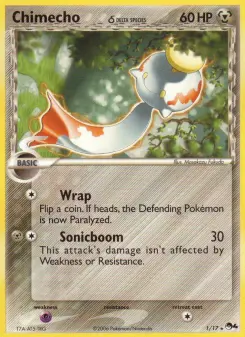
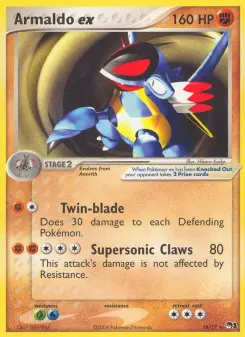
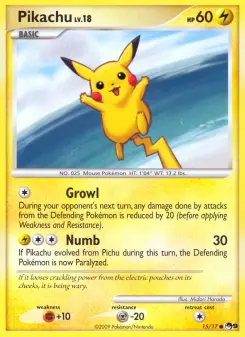
The nine POP Series sets hold 153 cards and $5,337.93 of ask on September 23, 2026, a median of $15.40 a card. That is a small number and the point of this study is not its size, it is that nobody else publishes the whole census. The finding sits in the comparison: 148 of the 153 POP cards share a name with a card that also came out of a booster pack in the same era, and matched against those twins the league handout is the dearer of the two 104 times, at a median of 2.08 times the pack card. But that average hides a clean reversal. Where the pack card asks under a dollar the POP copy runs 11.89 times it. Where the pack card asks $100 or more, the POP copy runs 0.23 times it. The handout is a premium on a common and a discount on a chase card, and the crossover sits around twenty dollars.
Nine sets, seventeen cards each
POP stands for Pokémon Organized Play, the league programme the cards were handed out through. We hold no recorded release date for any of the nine sets, so nothing in this study is dated except the day it was measured. Every POP set is exactly seventeen cards, and almost every card in them is a reprint of something that also appeared in a booster pack, with a POP logo where the set symbol goes. Six of the nine, Series 1, 2, 6, 7, 8 and 9, carry no set link and no card link from the 187 articles we had published before this one; the other three carry five set links and eight card links between them. All nine have a working set page, and the per-set totals below come from the daily card tape rather than from those pages, which quote a different instrument and a different date.
The nine POP Series sets, asks on September 23, 2026
| Set | Cards | Priced | Summed ask | Median card | Dearest card | Its share of the set |
|---|---|---|---|---|---|---|
| POP Series 4 | 17 | 17 | $1,748.00 | $37.20 | Chimecho δ $750.00 | 42.9% |
| POP Series 3 | 17 | 17 | $707.73 | $29.10 | Ho-Oh ex $125.00 | 17.7% |
| POP Series 5 | 17 | 15 | $653.77 | $25.66 | Mew δ $149.59 | 22.9% |
| POP Series 2 | 17 | 17 | $565.04 | $22.55 | Celebi ex $166.74 | 29.5% |
| POP Series 1 | 17 | 17 | $468.35 | $13.98 | Rayquaza $165.14 | 35.3% |
| POP Series 6 | 17 | 17 | $444.16 | $16.74 | Pikachu $95.12 | 21.4% |
| POP Series 9 | 17 | 17 | $353.99 | $4.74 | Pikachu $199.99 | 56.5% |
| POP Series 7 | 17 | 17 | $219.70 | $8.26 | Flaaffy $34.00 | 15.5% |
| POP Series 8 | 17 | 17 | $177.19 | $7.90 | Croagunk $30.65 | 17.3% |
| All nine | 153 | 151 | $5,337.93 | $15.40 | Chimecho δ $750.00 | 14.1% |
Two cards are missing from those totals and the exclusion changes a denominator, so it is stated here rather than buried. POP Series 5 contains Espeon ★ and Umbreon ★, two of the 27 English Gold Stars, and both are excluded from every figure in this study. Espeon ★ has no reading on our ask tape on any of its 25 days and no graded sold median at any grade, which is absent rather than zero. Umbreon ★'s rows fail a provider-collision check: a PSA 10 sold median of $363.00 on 121 sales against a registry line holding 53 tens, 2.28 sales per graded copy, and an ask tape reading $71.35 for twelve straight days. The ratio alone is borderline and a bar set at 2.5 per copy would have kept it; what settles it is the ask tape and the two 2021 Umbreon Star reprints, whose PSA 10 medians read $373.09 and $384.50 against its $363.00. So POP Series 5 is counted as 15 priced cards of 17 everywhere above, and both cards belong to Cheapest Way to Own a Gold Star Pokémon Card, which does the analysis properly.
The handout against its pack twin
A POP card and the pack card it reprints are the same picture with a different symbol, which makes them a natural pair: same Pokémon, same art, same era, one given out at a league night and one pulled from a booster. The match here is mechanical. For each POP card we take every English card with the same folded name printed in the same era, EX era and e-Card sets for POP Series 1 through 5 and Diamond and Pearl era sets for POP Series 6 through 9, take the median of their asks, and divide. 148 of the 153 match. The five that do not are Pichu Bros., Mew δ, Zangoose δ and the two Gold Stars, and they are named here rather than dropped quietly.
The POP premium by what the pack twin is worth. All 148 matched pairs, no band empty
| Pack twin's median ask | Pairs | Median POP over twin | POP dearer | Lowest | Highest |
|---|---|---|---|---|---|
| Under $1 | 32 | 11.89x | 32 of 32 | 1.08x | 120.8x |
| $1 to $4.99 | 36 | 4.56x | 36 of 36 | 1.12x | 438.6x |
| $5 to $19.99 | 37 | 1.93x | 28 of 37 | 0.24x | 17.5x |
| $20 to $99.99 | 29 | 0.51x | 7 of 29 | 0.14x | 5.2x |
| $100 or more | 14 | 0.23x | 1 of 14 | 0.02x | 1.1x |
Five bands, monotone, no exceptions, and the two ends are unanimous: every one of the 32 pairs whose pack twin asks under a dollar has the POP copy dearer, and thirteen of the fourteen pairs whose pack twin asks $100 or more have it cheaper. The reason is not mysterious. A POP set is seventeen cards handed out in small numbers, so the POP printing of a bulk common is genuinely scarcer than the bulk common. But the pack printing of a chase card carries the thing collectors actually want, which is the card as it was released, and the league reprint is the substitute. The same asymmetry between a stamped or handed-out printing and the ordinary one is measured on modern cards in The Pokémon Center Stamp Premium and on the Wizards-era giveaways in The Handout Grails.
Read by set the premium is not flat either, and the low end is where the ex reprints are. Five POP cards reprint an ex card, all of them in POP Series 1 through 4, and the POP copy is the dearer of the two on just one of the five, at a median of 0.37 times the pack card. POP Series 1 holds two of those five and runs 0.61x; POP Series 6 holds none and runs 8.86x.
Median POP premium by set, over the era-matched pairs in each
| Set | Matched pairs | Median POP over twin | POP dearer |
|---|---|---|---|
| POP Series 1 | 17 | 0.61x | 8 of 17 |
| POP Series 2 | 17 | 1.66x | 10 of 17 |
| POP Series 3 | 16 | 1.38x | 9 of 16 |
| POP Series 4 | 17 | 2.25x | 14 of 17 |
| POP Series 5 | 13 | 5.19x | 10 of 13 |
| POP Series 6 | 17 | 8.86x | 14 of 17 |
| POP Series 7 | 17 | 4.56x | 15 of 17 |
| POP Series 8 | 17 | 3.65x | 13 of 17 |
| POP Series 9 | 17 | 1.25x | 11 of 17 |
The twenty-six clean pairs, printed in full
A name match can pull in several printings of the same Pokémon, and the median of a handful of asks is a softer comparison than a single card against a single card. So here is the tightest version: every POP card that has exactly one same-era English twin, both of them priced, all 26 of them, ordered by the ratio. A reader who distrusts the matching rule can check this table card by card. Its median is 5.00x and the POP copy is dearer in 22 of the 26.
Every POP card with exactly one era-matched English twin, both priced. 26 pairs, complete and contiguous
| POP card | Set | POP ask | Pack twin | Twin's set | Twin ask | Ratio |
|---|---|---|---|---|---|---|
| Chimecho δ | POP Series 4 | $750.00 | Chimecho δ | Holon Phantoms | $1.71 | 438.60x |
| Stantler | POP Series 7 | $14.65 | Stantler | Secret Wonders | $0.27 | 54.26x |
| Delibird | POP Series 7 | $26.02 | Delibird | Great Encounters | $0.85 | 30.61x |
| Low Pressure System | POP Series 3 | $7.80 | Low Pressure System | Dragon | $0.42 | 18.57x |
| Pokémon Fan Club | POP Series 4 | $111.00 | Pokémon Fan Club | Aquapolis | $7.39 | 15.02x |
| Sentret | POP Series 7 | $4.76 | Sentret | Secret Wonders | $0.32 | 14.87x |
| Charmeleon δ | POP Series 5 | $89.99 | Charmeleon δ | Crystal Guardians | $6.97 | 12.91x |
| Treecko δ | POP Series 4 | $25.68 | Treecko δ | Crystal Guardians | $2.52 | 10.19x |
| High Pressure System | POP Series 3 | $4.98 | High Pressure System | Dragon | $0.60 | 8.30x |
| Meowth δ | POP Series 5 | $21.80 | Meowth δ | Holon Phantoms | $3.12 | 6.99x |
| Charmander δ | POP Series 5 | $41.50 | Charmander δ | Crystal Guardians | $6.75 | 6.15x |
| Latios | POP Series 7 | $30.45 | Latios | Great Encounters | $5.12 | 5.95x |
| Corsola | POP Series 7 | $2.15 | Corsola | Secret Wonders | $0.43 | 5.00x |
| Roseanne’s Research | POP Series 8 | $10.77 | Roseanne's Research | Secret Wonders | $2.95 | 3.65x |
| Pokémon Park | POP Series 2 | $47.74 | Pokémon Park | Aquapolis | $23.65 | 2.02x |
| Latias | POP Series 7 | $33.30 | Latias | Great Encounters | $18.17 | 1.83x |
| Mr. Briney's Compassion | POP Series 2 | $14.77 | Mr. Briney's Compassion | Dragon | $8.19 | 1.80x |
| Pelipper δ | POP Series 5 | $4.70 | Pelipper δ | Crystal Guardians | $2.68 | 1.75x |
| Multi Technical Machine 01 | POP Series 2 | $3.61 | Multi Technical Machine 01 | Expedition Base Set | $2.06 | 1.75x |
| Heal Energy | POP Series 4 | $10.23 | Heal Energy | Deoxys | $6.64 | 1.54x |
| Gallade | POP Series 7 | $20.37 | Gallade | Secret Wonders | $14.84 | 1.37x |
| Rare Candy | POP Series 8 | $7.90 | Rare Candy | Great Encounters | $6.76 | 1.17x |
| Celebi ex | POP Series 2 | $166.74 | Celebi ex | Unseen Forces | $370.00 | 0.45x |
| Ho-Oh ex | POP Series 3 | $125.00 | Ho-Oh ex | Unseen Forces | $338.08 | 0.37x |
| Tyranitar ex | POP Series 1 | $113.82 | Tyranitar ex | Unseen Forces | $499.99 | 0.23x |
| Armaldo ex | POP Series 1 | $23.94 | Armaldo ex | Legend Maker | $137.98 | 0.17x |
The top row is the outlier of the study and deserves a caveat rather than a headline. Chimecho δ asks $750.00 while the [Holon Phantoms](/research/set-screen/holon%20phantoms) printing of the same card asks $1.71. That is one listing on each side and no recorded sale on either, so it belongs in the table and not in the conclusion. The four rows at the bottom are the more useful end, because all four are ex cards and all four run the same way: the league reprint of an ex card is worth between a sixth and a half of the pack copy. Three of those four pack twins sit in Unseen Forces, which is measured in Unseen Forces Card Prices, and the EX-era sets that supply most of the twin side of this study are measured in EX Era Pokémon Cards Value and Expedition Base Set Card Prices. The Diamond and Pearl twins behind POP Series 6 through 9 are in Diamond and Pearl Era Card Prices. The δ mechanic that shows up six times in this table has its own study in A 191-Card Set Nobody Printed.
Almost nothing here has ever been graded
Five of the 151 POP cards carry a PSA 10 row in the graded feed. We then asked the whole run of 153 a single question, which card carries a PSA 10 sold median on ten or more recorded sales whose row survives the collision test, and it returns exactly one card under either threshold: Charmander δ at $729.50 on sixteen sales against a $41.50 ask. The other gated row is Turtwig, whose provider tape records 32 PSA 10 sales against a registry line holding three PSA 10s, 10.67 sales per graded copy, which is not resale. Fifteen POP cards carry a PSA 9 and eighteen carry a row at one PSA grade or the other, which leaves 133 of 151 with an ask and no recorded PSA sale behind it. Fifteen more carry a CGC row and nothing from PSA, so counting every grading company 33 of the 151 have some recorded sale and 118 have none. Any POP price you read, here or anywhere, is a listing.
Graded and registry coverage by set. A quotable PSA 10 sale means ten or more recorded sales and a registry line that survives the collision test. The two POP Series 5 Gold Stars are excluded from every column
| Set | Cards | With a trustworthy gem rate | Median gem rate | With a PSA 10 row in the feed | Quotable PSA 10 sale |
|---|---|---|---|---|---|
| POP Series 1 | 17 | 16 | 13.6% | 1 | 0 |
| POP Series 2 | 17 | 17 | 23.2% | 0 | 0 |
| POP Series 3 | 17 | 16 | 16.2% | 0 | 0 |
| POP Series 4 | 17 | 16 | 12.3% | 0 | 0 |
| POP Series 5 | 15 | 13 | 8.6% | 1 | 1 |
| POP Series 6 | 17 | 9 | 2.7% | 2 | 0 |
| POP Series 7 | 17 | 6 | 9.1% | 0 | 0 |
| POP Series 8 | 17 | 10 | 5.4% | 1 | 0 |
| POP Series 9 | 17 | 14 | 8.3% | 0 | 0 |
The gem-rate column is thin in places: only six of POP Series 7's seventeen cards and nine of POP Series 6's have a registry row we trust at all, against seventeen of seventeen in POP Series 2. A sparse column like that is a coverage statement, not a difficulty statement, and the difference matters. For a gem-rate reading with real weight behind it, Hard to Gem pools 17,730 cards and The Least Graded Cards in Pokemon is about exactly this end of the registry.
What this cannot show
Five limits. First, 153 cards is a small population and 151 asks is a small sample; one relisting moves a set total, and POP Series 8's whole value is $177.19. Second, both sides of every pair are asks on one day, so the premium is a premium between two listings and not between two sales, and Pokémon Card Ask vs Sold Price is about how far apart those can sit. Third, the pairing is a name and era match, not a picture match, so a POP card whose twin is a different artwork of the same Pokémon is paired anyway; the 26-row table is the subset where that risk is smallest and its list is printed in full so it can be disputed. Fourth, the era rule is ours: POP Series 1 through 5 match against EX-era and e-Card sets and 6 through 9 against Diamond and Pearl era sets, a mechanical rule that will misplace any POP card whose original printing sits outside its own era window. Fifth, our daily tape is 25 days long, so no POP trend, peak or return figure exists. Set completion cost is deliberately not computed here; that ground belongs to What Completing a Set Actually Costs.
What would overturn this
The band result is the claim, and one band moving off its rung would break it. The $5 to $19.99 band is the weakest, at 1.93x, with the POP card dearer on only 28 of its 37 pairs; if a re-pricing pushed that band below 1.00x the crossover would move down a rung and the story would change from a premium on commons to a premium only on bulk. The 148-pair total is also disputable: a different era rule, or a picture-level match instead of a name match, would produce a different population, and anyone who builds one can compare it against the 26-pair table printed above, which does not depend on the era rule at all.
Population. Every catalog row whose `set_name` is one of POP Series 1 through 9: 153 distinct products after deduplicating the catalog on `tcg_id`. Exactly seventeen rows in each of the nine sets. Two rows, `pop5-16` Espeon ★ and `pop5-17` Umbreon ★, are excluded from every figure: the first has no ask reading and no graded row, and the second fails a provider-collision check (a PSA 10 sold median of $363.00 on 121 recorded sales against a registry line holding 53 tens, 2.28 sales per graded copy, with its own ask tape sitting at $71.35 for twelve days and its two 2021 reprints reading $373.09 and $384.50). Where a POP Series 5 total appears it is over 15 cards, not 17, and the table says so. Prices. `price_history` on day 20719, 2026-09-23; ASKS, the daily dump's market figure for the canonical printing rather than the dearest one, never sales. All 151 non-excluded POP cards carry one. Pairing. For each POP card, every English catalog row with the same folded name, carrying a day-20719 ask, whose card id matches `ex<n>-` or `ecard<n>-` for POP Series 1 to 5 and `dp<n>-` or `pl<n>-` for POP Series 6 to 9. Folding normalises to NFKD, strips combining marks, maps curly apostrophes to straight and drops the gender signs, which is what pairs POP Series 8's Roseanne’s Research with Secret Wonders' Roseanne's Research. The ratio is the POP ask divided by the MEDIAN of the twins' asks, computed per card; band and set figures are medians of those per-card ratios, never ratios of sums. 148 of 153 match and the five that do not are named in the text. Twins per matched card: median 3, maximum 12, exactly one twin on 26 of them, and that 26-pair subset is printed in full. Graded. `graded_snapshots`, latest day per card key and grade, across both keyspaces, fresher row wins; SOLD medians, each with its sample. Stale-row rule, applied across this whole batch: after the fresher-keyspace read, any median dated before day 20695 (2026-08-30, the start of the current daily tape) is dropped, because the graded feed rotates roughly a seventh of the catalog a day and an older row is a reading from a different week. It removed zero rows across all 153 POP cards; every graded median used here is dated day 20719. Collision test, run on every graded row used in this study: several products can share one PSA registry line, so a sold count at a grade is compared against the registry count at that grade whenever the registry row passes the trustworthiness check, and a row recording more than two sales per graded copy is withheld. One sale per copy is not a ceiling, because a slab can be sold more than once, so this is a declared threshold and not an impossibility; the stricter one-sale-per-copy bar is counted beside it below. It withholds one of the two gated POP PSA 10 rows, pop6-17 Turtwig at $84.00 on 32 recorded sales against a registry line holding three PSA 10s, which is why POP Series 6 reads zero in the last column of the grading table while reading two in the column before it. Sensitivity: the stricter one-sale-per-copy bar withholds two further rows, pop6-15 Piplup at three sales and pop8-10 Rare Candy at six, both under the ten-sale gate, so every figure in this study is the same under either threshold. The quotable count was taken as its own query over all 153 rows rather than inferred from the withholding, and it returns one card under both. The `on ten or more sales` column applies a minimum sample of ten. Registry. `population_snapshots`, latest day per key; gem rates pass `gemRateIsTrustworthy()` and the count of cards that passed is printed beside each median rather than implied. No registry absolute is printed as a slab count. Instruments. The `/set/pop series N` pages quote `sethist2` totals, which are a different instrument on a different date from the day-20719 card tape used here: the POP Series 5 page reads $2,677 against this study's $653.77 over 15 priced cards, and POP Series 1 reads $824 against $468.35. Every figure in this study comes from the card tape and every one of the nine set pages was fetched on 2026-09-23 and its title read back. Median convention: upper-middle on even samples.