
The starter you picked as a child is the most personal question in Pokemon, and it turns out to be a priced one. We took all 27 starter Pokemon and their 27 final evolutions, 1,153 priced English printings, and measured each against the cards printed beside it in the same set at the same rarity. The generational answer is brutally simple and it is not nostalgia in general: it is Kanto. Generation 1 starters and their finals ask 5.14x their cohorts. Every other generation sits between 0.93x and 1.91x, and two of them sit below parity, meaning the starter asks LESS than the average card printed next to it. Pool those eight generations and they sit at 1.24x on 782 measured printings, a real premium but an ordinary one. The starter premium people argue about is almost all Kanto.
The generational ladder
Each generation pools its three starters and their three final evolutions, so every row covers six species. The premium is the median across that generation's printings of the card's ask divided by the median ask of every other English card in its set at its printed rarity. Rows are contiguous, all nine generations appear, and the printing counts sum to the stated total.
Starter line cohort premium by generation
Starter lines by generation, in generation order, rows sum to 1,046 measured printings
| Generation | Priced printings | Measured | Sets | Premium | Above cohort | Median ask |
|---|---|---|---|---|---|---|
| Generation 1, Kanto | 301 | 264 | 67 | 5.14x | 240 of 264 | $20.48 |
| Generation 2, Johto | 137 | 133 | 35 | 1.91x | 114 of 133 | $5.34 |
| Generation 3, Hoenn | 153 | 143 | 37 | 1.71x | 106 of 143 | $6.00 |
| Generation 4, Sinnoh | 116 | 98 | 32 | 1.34x | 66 of 98 | $2.11 |
| Generation 5, Unova | 98 | 89 | 24 | 1.06x | 50 of 89 | $1.85 |
| Generation 6, Kalos | 107 | 99 | 27 | 1.31x | 63 of 99 | $2.55 |
| Generation 7, Alola | 88 | 85 | 27 | 0.93x | 36 of 85 | $0.98 |
| Generation 8, Galar | 93 | 80 | 17 | 0.94x | 34 of 80 | $0.97 |
| Generation 9, Paldea | 60 | 55 | 9 | 1.19x | 33 of 55 | $1.11 |
Squirtle beats Charmander
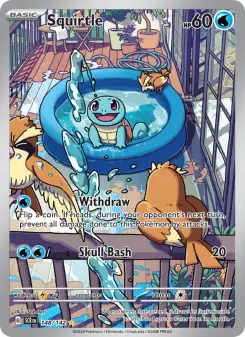
Charizard has the highest median ask of the 27 final evolutions in this study, $68.57, and it makes the Kanto row look like a Charmander story. It is not. Split the Kanto three at the base form and the order inverts: Squirtle asks 6.66x its cohort across 30 measured printings, Bulbasaur 5.51x across 28, and Charmander 2.78x across 47. Charmander is the most printed of the three and the one that ranks lowest against its own neighbours, while Charizard itself sits at 8.96x. A species inherits nothing from its evolution.
The Kanto six, base forms and finals
| Species | Priced printings | Measured | Premium | Median ask |
|---|---|---|---|---|
| Squirtle | 31 | 30 | 6.66x | $4.86 |
| Bulbasaur | 30 | 28 | 5.51x | $8.42 |
| Charmander | 49 | 47 | 2.78x | $3.21 |
| Charizard | 105 | 83 | 8.96x | $68.57 |
| Blastoise | 43 | 39 | 2.69x | $32.58 |
| Venusaur | 43 | 37 | 1.75x | $22.42 |
The dearest starter card is not a Charizard
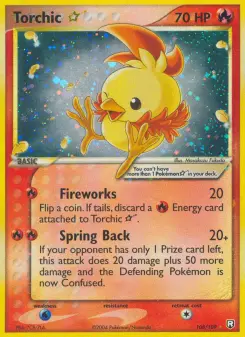
Sorted by raw ask, the top of the starter list is led by a Gold Star Torchic at $4,500.00 and a Gold Star Treecko at $2,400.00, both from EX Team Rocket Returns. Neither carries a recorded PSA 10 sale on our tape, so both figures are ASKS with nothing behind them, and they are printed here with that stated rather than left to imply a market. The Charizards below them are asks too, and three of the five have no recorded PSA 10 sale either: the Plasma Storm, Dragon Frontiers and Base Set cards, all of them named again in every Charizard's PSA 10 premium ranked. The other two rest on five and eleven verified sales. Nothing at the top of this table is a thick market.
Dearest starter-line printings by raw ask, ranks 1 to 8 of 1,153
| Rank | Card | Set | Raw ask | Cohort premium |
|---|---|---|---|---|
| 1 | Torchic | EX Team Rocket Returns | $4,500.00 | 49.18x |
| 2 | Treecko | EX Team Rocket Returns | $2,400.00 | 26.23x |
| 3 | M Charizard EX | XY Flashfire | $1,501.23 | not in a cohort |
| 4 | Mudkip | Nintendo Black Star Promos | $1,500.00 | 20.82x |
| 5 | Shining Charizard | Neo Destiny | $1,495.00 | 27.16x |
| 6 | Charizard | Plasma Storm | $1,150.00 | not in a cohort |
| 7 | Charizard | EX Dragon Frontiers | $1,000.00 | 23.53x |
| 8 | Charizard | Base Set | $919.98 | 48.24x |
Two ways this could be wrong
The first objection is age, and it is the serious one. A Kanto starter has had twenty-seven years of printings and a Paldea starter has had three, so the Kanto row contains vintage scarcity that no modern generation can have. The test is to measure every generation in the same window. Restricted to the Scarlet & Violet and Mega Evolution eras, where all nine generations carry printings, Kanto still leads at 2.62x, Kalos follows at 1.71x, Hoenn at 1.40x and Johto at 1.38x, with the rest between 1.03x and 1.19x. The Kanto premium halves and survives.
The same nine generations restricted to Scarlet & Violet and Mega Evolution printings
| Generation | Printings | Measured | Premium | Median ask |
|---|---|---|---|---|
| Generation 1, Kanto | 56 | 43 | 2.62x | $15.81 |
| Generation 2, Johto | 22 | 22 | 1.38x | $0.96 |
| Generation 3, Hoenn | 5 | 5 | 1.40x | $0.22 |
| Generation 4, Sinnoh | 14 | 13 | 1.09x | $4.67 |
| Generation 5, Unova | 23 | 18 | 1.08x | $1.36 |
| Generation 6, Kalos | 24 | 21 | 1.71x | $2.37 |
| Generation 7, Alola | 18 | 17 | 1.03x | $0.86 |
| Generation 8, Galar | 18 | 18 | 1.07x | $0.80 |
| Generation 9, Paldea | 52 | 49 | 1.19x | $1.11 |
One row there is too thin to lean on and is flagged rather than dropped: Hoenn contributes five measured printings to the modern window, so its 1.40x rests on five cards and should be read as no information rather than as a level. Kanto's 43 and Paldea's 49 carry their rows properly.
The second objection is that one species carries each generation. Kalos is the case to check, because it sits third in the modern window, and it is Greninja: 29 measured printings at 3.56x against Chesnaught's 0.82x and Delphox's 1.66x. The generational figure is a median across all six species' printings, so a single popular member lifts it without owning it. The Kanto table above shows the same weighting inside the generation where it matters most, and the three Kalos figures here show it in the generation where the objection bites hardest.
What this study cannot show
The 54 species are the base starters and their final evolutions only. Middle evolutions are excluded, which removes Charmeleon, Wartortle, Ivysaur and their 24 counterparts, and that choice is arbitrary rather than principled: it keeps the comparison to the two forms every player has an opinion about. Regional variants that share a name are folded in, because the matcher works on the card name.
107 of the 1,153 priced printings sit in a cohort of ten or fewer other cards and are dropped, and they are not evenly spread: Kanto loses 37 of 301 while Johto loses 4 of 137. Trainer kits are not the reason, because they lose none of them. The 37 are spread over 21 sets: three apiece from Detective Pikachu, Pokemon GO, 151 and Phantasmal Flames, five from the POP Series runs and the rest one or two to a set. Nine of the 37 come from sets that really are tiny: three from Detective Pikachu, which holds 18 priced products, five from the POP Series, which hold 16 or 17 each, and one from Best of game, which holds 9. The other 28 come from bigger sets where a thin rarity tier holds fewer than eleven cards. Prices are ASKS from the daily tape, and the two figures at the top of the dearest table have no sale behind them at all.
Generation membership is assigned by species, not by set, so a Kanto starter printed in 2026 counts as Kanto. That is the point of the modern-window rebuild, and without it the headline ladder is partly a statement about when each generation's cards were printed rather than about the creatures.
What would overturn this
The claim is that the starter premium is concentrated in one generation and that two generations sit below parity. A recompute on the same day's tape placing any generation other than Kanto first, or returning every generation above 1.00x, would overturn it. The age objection is the live one: a recompute of the Scarlet & Violet and Mega Evolution window that removed Kanto's lead would reduce the finding to an age effect, which is why that table is printed. Related work: the species premium for the full 302-name ranking, does reprinting a Pokemon cost it anything for the printing-count side, and how much is a Charizard card worth for the species that dominates the Kanto row.
Sources: the `cards` catalog and the daily `price_history` tape, read on day 20718, September 22 2026. Population, cohort and species attribution are identical to the species premium: products deduplicated on the TCGplayer product id, asks from the most recent daily market figure, cohorts of every other English product in the same set at the same printed rarity with a ten-other-member floor, species from the 1,025-name `pokemon_indices` table with both sides folded to one canonical key, cards naming two or more species excluded. The 54 species are the three starter base forms and their three final evolutions for each of the nine generations: Bulbasaur, Charmander, Squirtle, Venusaur, Charizard, Blastoise; Chikorita, Cyndaquil, Totodile, Meganium, Typhlosion, Feraligatr; Treecko, Torchic, Mudkip, Sceptile, Blaziken, Swampert; Turtwig, Chimchar, Piplup, Torterra, Infernape, Empoleon; Snivy, Tepig, Oshawott, Serperior, Emboar, Samurott; Chespin, Fennekin, Froakie, Chesnaught, Delphox, Greninja; Rowlet, Litten, Popplio, Decidueye, Incineroar, Primarina; Grookey, Scorbunny, Sobble, Rillaboom, Cinderace, Inteleon; Sprigatito, Fuecoco, Quaxly, Meowscarada, Skeledirge, Quaquaval. Middle evolutions are not included, and regional forms fold into their species because the matcher works on the card name. 1,153 priced English printings carry those names and 1,046 sit in a measurable cohort. A generation's premium is the median across all its measured printings of the card's ask over its cohort's leave-one-out median, upper-middle on even samples; it is not an average of the six species' medians, so a species with more printings carries more weight inside its generation, and the per-species figures are printed so that weighting is visible. Median ask is taken over every priced printing of the generation, a wider population than the measured one, and both counts are in the table. The modern-window rebuild keeps only printings whose card id places them in the Scarlet & Violet or Mega Evolution eras by the house era map and rebuilds nothing else, so cohorts are the full-population cohorts; its Hoenn row holds five printings and is flagged in the text. The dearest-printing table sorts on the raw ask across all 1,153 priced printings, ties broken on the card id ascending, and marks the two printings that sit outside a measurable cohort rather than omitting them. Not financial advice.