
Grading arithmetic gets done in multiples, and multiples lie to you about small cards. The claim sounds fine: a PSA 9 on this card sells for twice the raw copy, so even a miss pays. Then the invoice arrives and it is denominated in dollars. We joined every English card on our book that carries both a live raw price and a PSA 9 sold median built on at least eight verified sales, 192 of them, and asked one narrow question with a checkable answer. If your submission comes back a 9, does the 9 by itself return the raw card's value plus the fee you paid? Across the board it does so on 64 cards out of 192.
The fee is the variable, not the card
Before any property of any card, here is the sensitivity of the whole result to the one number every grading discussion treats as background noise. At $15 all in, 49.5% of the 192 clear. At $20, 39.6%. At $25, 33.3%. At $30, 28.6%. Halve the fee and you nearly double the population of cards where a 9 is self-financing. Nothing else in this study moves as many cards as that, and nothing else in this study is as easy for a submitter to change: bulk tiers, group submissions and shipping consolidation are all levers on the same variable, and the era, the set and the character are not.
PSA 9 economics by raw price band (moonstone graded tape, September 2, 2026)
| Raw band | Cards | Median raw | Median PSA 9 | Median multiple | Median dollar gap | Share clearing raw + $25 |
|---|---|---|---|---|---|---|
| Under $2 | 16 | $1.12 | $18.57 | 22.96x | $17.96 | 31.3% |
| $2 to $4 | 15 | $2.76 | $19.00 | 7.54x | $16.60 | 26.7% |
| $4 to $8 | 17 | $6.38 | $20.00 | 3.38x | $13.62 | 0.0% |
| $8 to $16 | 26 | $10.68 | $24.04 | 2.12x | $12.25 | 15.4% |
| $16 to $32 | 24 | $21.48 | $27.24 | 1.31x | $6.52 | 8.3% |
| $32 to $64 | 30 | $43.84 | $68.81 | 1.76x | $32.09 | 50.0% |
| $64 to $128 | 27 | $86.93 | $121.50 | 1.26x | $23.54 | 48.1% |
| $128 to $256 | 15 | $202.61 | $310.00 | 2.10x | $162.70 | 66.7% |
| $256 to $512 | 11 | $418.85 | $455.14 | 1.06x | $26.15 | 54.5% |
| Over $512 | 11 | $679.51 | $999.99 | 1.03x | $20.49 | 45.5% |
Read that table as two regimes rather than two trends. Below $32 raw the multiple is spectacular and the refund rate is dismal: bands from under $2 up to $32 print multiples of 23x, 7.5x, 3.4x, 2.1x and 1.3x while clearing the fee on 31%, 27%, 0%, 15% and 8% of their cards. Above $32 the multiple collapses to somewhere between 1.0x and 2.1x with no trend left in it, and the refund rate jumps to between 45% and 67%. The multiple column, which is what listings quote, and the refund column, which is what your wallet experiences, are telling you the same thing from two directions: the fee is a fixed number of dollars, and fixed costs are murder on small numbers. An earlier version of this table read raw prices from the flagship printing rather than the canonical one and reported a clean monotone collapse from 7.74x to 1.05x; on the prices the card pages actually show, the collapse is real below $32 and there is no ladder above it.
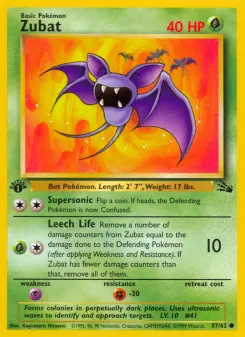
Zubat from Fossil is the whole article in one row. Its PSA 9 median is $23.00 on 14 verified sales against a raw price of $0.50, a multiple of 46x, the kind of number that gets screenshotted. The gap is $22.50. At a $25 fee the submission loses money even in the good outcome of a 9. The same shape repeats down the cheap end: Spearow from Jungle prints 43.58x on 8 comps and an $18.31 gap; Ekans prints 30.10x on 8 comps and a $13.97 gap. Three cards with spectacular multiples and not one of them refunds the invoice.
What the refunding cards have in common, and what confounds it
Split the 192 by whether the 9 clears raw plus $25 and look at the registries behind them. Of the 188 cards that also carry a PSA population reading, the ones whose 9 refunds gem at a median lifetime rate of 4.6%. The ones whose 9 does not gem at 34.9%. That is a very large split, and it has a very large confound sitting on top of it: the refunding cards are also the expensive ones, at a median raw price of $69.48 against $17.72, and gem rate falls with price for reasons that have nothing to do with grading economics. The split survives inside price bands, but not evenly. Above $64 raw it is emphatic, 2.7% against 51.5% on 61 cards. In the $8 to $16 band it is 12.8% against 33.0% on 26. Below $4 it is 13-15% against 42-50% on small cells. We would state the finding only for the top of the board: above $64 raw, a low gem rate is the single best marker of a card whose 9 will pay for itself, and below that the population reading is confounded enough with price that we would not act on it.
The mechanism, where it holds, is not subtle. When almost nothing gems, the raw pool is full of played and damaged copies and a certified 9 is buying you authentication and condition assurance that the raw market cannot supply. When two cards in three gem, a 9 is the label the market gives to the copies that failed, and it prices accordingly. That is the same variable our rating engine turned out to be quietly running on, as The Gate Is the Market documents.
The top of the market, where the 9 is a liability
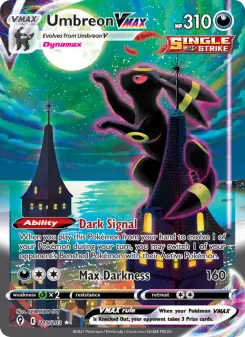
On 31 of the 192 cards the PSA 9 sells for less than the raw copy, and the list is a roll call of the modern chase tier. Umbreon VMAX from Evolving Skies prints a $2,000.50 PSA 9 median on 156 verified sales against a $2,378.74 raw price, a $378.24 hole before the fee. Rayquaza VMAX from the same set prints $999.99 on 157 comps against $1,250.43. Victini from White Flare prints $428.31 on 190 comps against $567.98. Mew ex from Paldean Fates prints $830 on 864 comps against $929.82. These are the deepest tapes in the study, not thin ones, and the message is consistent: on a card the market expects to gem, the 9 is the certified announcement that yours did not.
That Umbreon VMAX row needs reconciling with our own multiple ladder, which calls the same card 2.51x richer than its raw-price rung. Both are true and they are about different grades. The 10 is a large multiple of raw because the market pays enormously for the gem outcome on that card; the 9 is below raw because the same market treats a 9 as proof the copy missed. A card can be the best gem trade on the board and the worst 9 on the board at once, and the wider the gap between those two facts, the more of your submission's expected value is riding on a single grader's opinion.
The opposite tail is where the dollars live. Charizard Star from Dragon Frontiers carries a $15,125 PSA 9 median on 30 verified sales against a $4,000 raw price, a gap of $11,125. Rayquaza from Dragons Exalted prints $3,839.04 on 22 comps against $659.95. Mew from Southern Islands prints $3,450 on 31 comps against $578.20. Charizard from Base Set prints $2,599 on 13 comps against $868.56. Every one of them is a card where a clean copy is genuinely rare and the raw pool cannot prove itself.
Cohort: English cards in the moonstone catalog holding both a canonical printing price read September 2, 2026 and a PSA 9 sold median from our graded ladder cache built on at least 8 verified sold comps, giving 192 cards; 188 of those also carry a PSA population reading and form the gem-rate comparison. Raw price is the CANONICAL printing price, the same figure the card pages show. That is a correction from an earlier version of this study, which read the flagship-printing field and therefore quoted, for example, Dragons Exalted Rayquaza at $1,049 against the $659.95 its own card page shows. Restating the study on canonical prices raises the median multiple from 1.78x to 2.03x and the $25 clear rate from 26.0% to 33.3%, and it is the reason this piece's title says one card in three rather than one in four. It is still a quoted price rather than a sold median, so the multiples and dollar gaps remain biased in favour of the graded side. Graded ladders were written between August 19 and September 2, 2026, with 88% of them stamped on August 20 and 21, so the sold tape ages by up to two weeks across cards and every quoted comp count is the count behind that specific median. Fee is stated at $25 all in, covering a value-tier submission plus one-way shipping, with a full sensitivity band of $15 to $30 given in the text; it excludes insurance, return postage, your time, and the sale-side fees on either leg. Bands are powers of two on raw price; on canonical prices every band from under $2 to over $512 holds at least 11 cards, so unlike the earlier version no cell is suppressed. An era cut was computed and is not published: three of the 192 cards fall in no era bucket at all, several era cells hold fewer than a dozen cards, and the eras track raw price so closely that the cut adds nothing the price bands do not already say. Gem rate is the lifetime ratio of PSA 10 population to total PSA population at the latest registry snapshot we hold. Selection bias worth naming: a card only enters this study if enough people already submitted it to build a PSA 9 tape, which tilts the sample toward cards the hobby has already decided are worth grading. Not financial advice.