
A ten is a ten, the saying goes, and the label on the holder is marketing. Our tape prices 4,792 products in both a PSA 10 and a CGC 10 sold median on September 22, 2026, and the median one puts the CGC 10 at 42.50% of the PSA 10. That is not a rounding difference between two graders. It is more than half the value of the card, and it grows with the price: 71.27% of the PSA 10 on cards under $25, 21.04% on cards above $1,000. The slab is not a certificate. It is a brand, and the market prices it like one.
The whole ladder, one grader against another
Six pairs are printable from our tape, each requiring both grades on the same product. Read them as a single sentence: a CGC 10 is worth about two fifths of a PSA 10 and about one and a half PSA 9s, a BGS 9.5 is worth about half a PSA 10, and a BGS 9 is worth about five sixths of a PSA 9. The products column is the honest caveat, because a pair holding 624 products is not a pair holding 4,792.
Every grader pair our tape prices, latest sold medians on September 22, 2026
| Pair | Products | Median ratio | Quarter cut | Three-quarter cut | Left side dearer on |
|---|---|---|---|---|---|
| CGC 10 over PSA 10 | 4,792 | 42.50% | 26.13% | 63.83% | 371 cards |
| BGS 9.5 over PSA 10 | 624 | 49.01% | 31.42% | 63.56% | 15 cards |
| CGC 9.5 over PSA 10 | 980 | 20.52% | 12.04% | 31.47% | 2 cards |
| CGC 9 over PSA 9 | 2,925 | 53.01% | 36.47% | 75.38% | 282 cards |
| BGS 9 over PSA 9 | 547 | 83.38% | 58.68% | 108.94% | 183 cards |
| CGC 10 over PSA 9 | 4,278 | 147.12% | 100.97% | 216.24% | 3,228 cards |
The last row is the one that reframes the decision. A CGC 10 beats a PSA 9 on 3,228 of 4,278 cards, and on the 1,522 pairs carrying 10 or more verified comps on both the CGC 10 and the PSA 9 it wins 1,248 times, 82.00%. That gate is on those two grades only; it does not also require the card to carry a PSA 10 median. So the CGC slab is not worthless. It sits between the two PSA grades everyone actually argues about, closer to the nine than to the ten.
The discount grows with the card
Median CGC 10 as a share of the PSA 10, by PSA 10 sold median
Six tiers, 4,792 cards, none left over, and the ratio falls at every step. On a $30 card the holder costs you 48% of the value; on a four-figure card it costs you 79%. The practical reading is that CGC is at its least punitive exactly where grading is least worth doing, and at its most punitive where the whole point of the slab is the buyer's confidence in a five-figure purchase.
Three ways this could be wrong
First objection: our own earlier study said 51.1%, not 42.50%. It did, on 90 cards, in the half point. Both numbers are right, and the difference is comp depth rather than an error in either. The ratio rises monotonically as the comp gate rises, because thin CGC pools sit on the cheap tail of each card's sale distribution, and the earlier study's 90 cards were the deepest tape we then held.
The same ratio at five comp gates, applied to BOTH grades
| Minimum verified comps on each grade | CGC 10 over PSA 10 | Products | BGS 9.5 over PSA 10 | Products |
|---|---|---|---|---|
| None (the tape's own floor is 3) | 42.50% | 4,792 | 49.01% | 624 |
| 5 or more | 44.57% | 3,455 | 52.68% | 310 |
| 10 or more | 47.87% | 2,067 | 55.17% | 127 |
| 20 or more | 50.62% | 1,068 | 56.75% | 37 |
| 30 or more | 51.76% | 675 | 61.68% | 16 |
So the citable figure depends on which question is being asked. Across every card we can price, the CGC 10 is worth 42.50% of the PSA 10. Across cards with a genuinely liquid market on both sides, it is worth 50.62%. Both are printed here; neither is hidden behind the other.
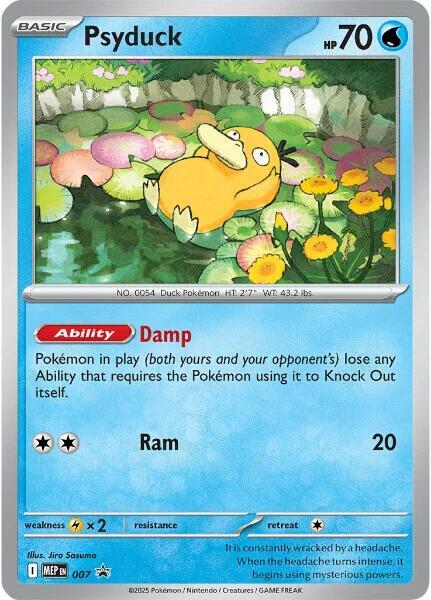
Second objection: the CGC medians are stale, so this is a timing artifact. The 1,068 cards at the 20-comp gate carry 20 or more verified CGC 10 sales each, and the table below prints the comp count for every named row. The deepest CGC pool among the ten named below, Psyduck, has 86 CGC 10 comps against 103 PSA 10 comps. That is not a thin series against a deep one.
Third objection: it is a Japanese-card effect, because CGC is less established in that market. The ten widest gaps at the 20-comp gate are all English cards, and the ten cards where CGC wins by the most are six Japanese and four English. If anything the Japanese rows are the ones where CGC holds up.
Where the gap is widest, and where it inverts
Both tables below are the head and the tail of a single ranking of the 1,068 products carrying 20 or more verified comps in both grades, ordered by the CGC 10 over PSA 10 ratio, printed with no rank skipped in either direction.
Widest gaps: ranks 1 to 10 of 1,068, ordered by CGC 10 over PSA 10 ascending
| Rank | Card | Set | CGC 10 over PSA 10 | CGC 10 (comps) | PSA 10 (comps) |
|---|---|---|---|---|---|
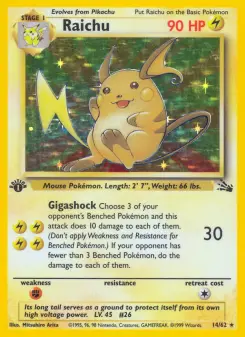
| 1 | Raichu | Fossil | 5.69% | $315.50 (21) | $5,549.50 (29) |
| 2 | Psyduck | MEP Black Star Promos | 6.14% | $23.50 (86) | $382.86 (103) |
| 3 | Noctowl | SVP Black Star Promos | 6.22% | $11.00 (27) | $176.72 (156) |
| 4 | Flareon | Brilliant Stars Trainer Gallery | 8.20% | $37.00 (31) | $451.38 (95) |
| 5 | Braixen | Silver Tempest Trainer Gallery | 9.42% | $17.50 (20) | $185.72 (31) |
| 6 | Squirtle | SVP Black Star Promos | 9.45% | $15.00 (25) | $158.75 (26) |
| 7 | Computer Error | Wizards Black Star Promos | 9.79% | $23.25 (34) | $237.50 (21) |
| 8 | Galarian Zapdos | SWSH Black Star Promos | 9.92% | $12.50 (23) | $126.00 (43) |
| 9 | Poochyena | Crown Zenith Galarian Gallery | 10.02% | $24.25 (22) | $242.00 (23) |
| 10 | Mew V | Crown Zenith | 10.16% | $20.82 (22) | $205.00 (91) |
Where CGC wins: ranks 1 to 10 of 1,068, ordered by CGC 10 over PSA 10 descending
| Rank | Card | Set | CGC 10 over PSA 10 | CGC 10 (comps) | PSA 10 (comps) |
|---|---|---|---|---|---|
| 1 | Here Comes Team Rocket! | Team Rocket | 253.32% | $189.99 (33) | $75.00 (230) |
| 2 | Espeon - 066/SV-P | SV-P Promotional Cards (Japanese) | 183.94% | $315.00 (23) | $171.25 (61) |
| 3 | ゼクロムex | ブラックボルト (Japanese) | 172.22% | $23.25 (56) | $13.50 (48) |
| 4 | Articuno | Pokemon TCG Classic: Blastoise (Japanese) | 165.85% | $68.00 (27) | $41.00 (24) |
| 5 | Dawn | Phantasmal Flames | 162.68% | $117.75 (43) | $72.38 (493) |
| 6 | ミュウex | ポケモンカード151 (Japanese) | 148.36% | $564.50 (24) | $380.50 (263) |
| 7 | ゼクロムex | ブラックボルト (Japanese) | 143.81% | $229.49 (28) | $159.58 (296) |
| 8 | Milotic ex | Surging Sparks | 140.46% | $334.99 (41) | $238.50 (359) |
| 9 | Banette | Ascended Heroes | 139.34% | $85.00 (22) | $61.00 (228) |
| 10 | オリジンディアルガVSTAR | VSTARユニバース (Japanese) | 135.84% | $244.50 (25) | $179.99 (67) |
Sixty-eight of the 1,068 deep-tape cards have a CGC 10 worth more than their PSA 10, 6.37%. Look at the comp counts in that second table and a pattern appears: the PSA side is usually the deeper pool, so these are cards where the PSA 10 has been driven down by volume rather than cards where CGC commands a premium. Dawn from Phantasmal Flames carries 493 PSA 10 sales against 43 CGC 10 sales. A thin market on a scarce holder is not the same thing as a strong market.
What would overturn this
The central claim is the level and the slope together. A recompute on `graded_snapshots` for the same evaluation day that put the median CGC 10 above 60% of the PSA 10 across the whole 4,792, or that found the six price tiers flat rather than falling, would overturn it. The secondary claim is the comp-gate direction: if the ratio FELL as the gate rose, our reconciliation with the half point would be wrong and so would the explanation. Related: is a PSA 9 half a PSA 10, the basement of the registry, how much a PSA 10 adds.
Source: `graded_snapshots` (product key, grade, UTC day, median, sample_size), latest row per product and grade with a median above zero on or before day 20718 (September 22, 2026 UTC). Day 20719 is excluded because it was the UTC day still being written while this study ran, 7,207 rows against 29,676 at the time of the query and still filling afterwards. Seven grade labels sit on the tape and this study uses six of them in pairs; coverage on that day is PSA 10 on 8,677 products, PSA 9 on 8,293, CGC 10 on 5,975, CGC 9 on 3,302, CGC 9.5 on 1,122, BGS 9.5 on 667 and BGS 9 on 560, and each pair's population is the intersection, printed in its own row. All figures are SOLD medians from individually verified comps; no ask appears anywhere in this study. `sample_size` is the provider's count of kept verified comps behind that median, and the tape does not publish a median below three. The graded tape is keyed on either the product id or the catalog id, so both are asked; 1,443 graded rows carry a key we cannot map to a product and are excluded, which cannot bias a pair because an unmappable row has no partner. EVERY COUNT IS DEDUPED ON THE TCGPLAYER PRODUCT ID: 1,212 ids are claimed by two catalog rows each, and where two rows reach one product the deeper comp pool is kept. Medians and percentiles use the upper-middle nearest-rank convention, the value at index floor(p x n) of the ascending sample. Price tiers are cut on the PSA 10 sold median and partition the 4,792 exactly once. The headline ladder applies NO comp gate; the full gate ladder is printed so the cap can be judged, and the two named tables use a 20-comp gate on both sides, stated in their titles, which is a selection on comp depth and describes well-evidenced cards rather than cards in general. Two rows in the named tables carry a catalog name in Japanese because that is the name our catalog holds for the linked card, and the link goes to that card. An absent grade is NOT RECORDED, never zero: a product with a PSA 10 and no CGC 10 is excluded from that pair rather than scored as a CGC 10 of zero. Ranking ties break on the product id ascending. Not financial advice.