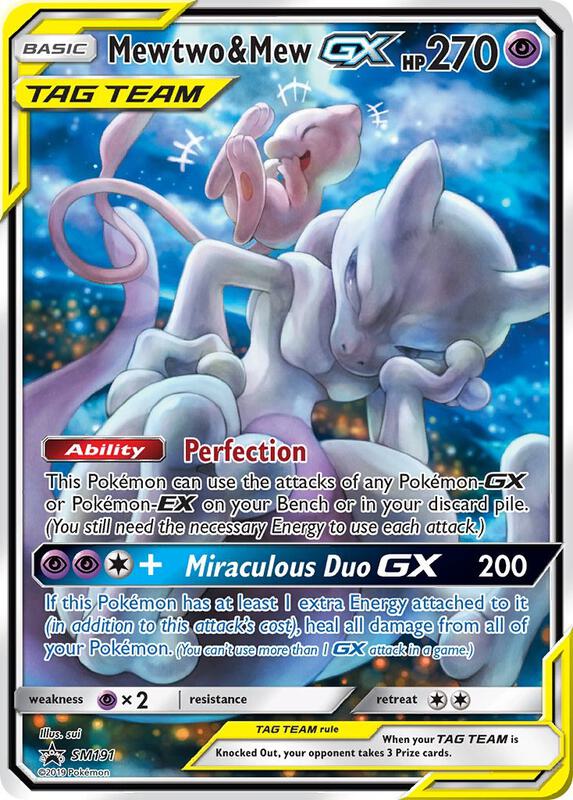
Mewtwo & Mew GX SM191/248 from the SM Black Star Promos asks $387.37 on our daily tape and its PSA 10 sells for a median $2,125.00 across 638 verified completed sales, recorded on September 23 2026. That comp count is the 49th deepest of the 5,879 products we price with an ask, a PSA 10 sold median and a PSA registry line we can prove belongs to one card. The premium those 638 sales support is 5.49x, which sits at the 25th percentile of the same cohort, below a median of 12.35x. This is the pattern the whole study is about: the card is in the top one percent of the catalog for how much slab evidence exists about it, and at the 25th percentile for what a slab adds.
The full ladder
This card is one of 143 products in the 5,879-card cohort that carry a sold median at every one of the seven grades we record. Every figure below is a median over verified completed sales, with the number of sales behind it. The raw line is an ASK from the daily tape and is included only so the multiple has a denominator.
Mewtwo & Mew GX SM191 graded ladder, all rows read September 23 2026
| Grade | Sold median | Verified sales | Multiple of the raw ask |
|---|---|---|---|
| PSA 10 | $2,125.00 | 638 | 5.49x |
| BGS 9.5 | $1,453.34 | 9 | 3.75x |
| CGC 10 | $1,095.00 | 37 | 2.83x |
| CGC 9.5 | $755.00 | 8 | 1.95x |
| BGS 9 | $579.50 | 8 | 1.50x |
| PSA 9 | $517.50 | 315 | 1.34x |
| CGC 9 | $463.75 | 25 | 1.20x |
| Raw (ask, not a sale) | $387.37 | n/a | 1.00x |
Two things in that table are worth reading twice. The PSA 10 fetches 1.94 times the CGC 10, close to the 2.50x median across the 143 full-ladder products and well inside the range measured in the same card, two slabs. And the BGS 9.5 outsells the CGC 10 by 1.33x, which is the half-point result from the half point reproducing on a single card: across our 143 full-ladder products the BGS 9.5 beats the CGC 10 on 77 of them, a shade over half, and this is one.
Where it sits in the catalog
The cohort is every product carrying all four of a day-20719 ask, a PSA 10 sold median on two or more verified sales, a trustworthy gem rate and a registry line that no other product claims. There are 5,879 of them. A percentile here is the share of that cohort strictly below this card's value, and the rank counts from the top.
Mewtwo & Mew GX SM191 against the 5,879-product graded-ladder cohort
| Measure | This card | Cohort median | Percentile | Rank |
|---|---|---|---|---|
| Verified PSA 10 sales | 638 | 14 | 99.1 | 49 of 5,879 |
| Raw ask | $387.37 | $18.93 | 97.4 | 151 of 5,879 |
| PSA registry line | 19,995 | 822 | 96.7 | 194 of 5,879 |
| Gem rate | 49.7% | 44.4% | 58.4 | 2,448 of 5,879 |
| PSA 10 premium | 5.49x | 12.35x | 25.1 | 4,406 of 5,879 |
Against the wider catalog rather than the cohort, the registry is the 206th deepest of the 20,805 products carrying an unshared registry reading, and the comp count is the 60th deepest of the 8,693 products with a PSA 10 sold median on two or more sales. The card is not obscure by any measure we hold. What it is not is cheap to buy and expensive to slab, and the cohort table says why: the premium falls as the evidence deepens. Our catalog-wide version of that result is in easy grades are cheap grades and the multiple ladder, and it holds on this card to the decimal.
A tag team with a promo's supply
The closest population to this card is not its set, which is a promo family rather than a product, but the tag-team cards themselves. 106 English cards naming two or more species and ending GX, ex or EX clear the cohort's four gates. Mewtwo & Mew GX SM191 is ninth of those by raw ask, third by verified PSA 10 sales, and fiftieth by premium. Only two cards in the group have deeper sold tape, and both are the same card in different printings.
The five deepest sold tapes among 106 English tag-team cards, September 23 2026
| Card | Set | Raw ask | PSA 10 sold | Verified sales | Premium | Registry |
|---|---|---|---|---|---|---|
| Moltres & Zapdos & Articuno GX | SM Black Star Promos | $153.72 | $435.00 | 917 | 2.83x | 77,360 |
| Moltres & Zapdos & Articuno GX | Hidden Fates | $49.33 | $155.21 | 647 | 3.15x | 21,050 |
| Mewtwo & Mew GX | SM Black Star Promos | $387.37 | $2,125.00 | 638 | 5.49x | 19,995 |
| Moltres & Zapdos & Articuno GX | Hidden Fates | $47.02 | $134.70 | 446 | 2.86x | 27,007 |
| Pikachu & Zekrom GX | SM Black Star Promos | $216.07 | $1,965.00 | 438 | 9.09x | 14,595 |
Three of those five are SM Black Star Promos, which is the shape of that family: handed out in tins and collection boxes, printed in quantity, and graded in quantity afterwards. The family has no set page on this site and its set screen resolves to a different promo family, so it is named here rather than linked. What promo cards are worth as a class is are Black Star Promos worth anything, and the Sun & Moon era they sit in is Sun & Moon era card prices.
The cards people buy by mistake
Folding accents, apostrophes and the provider's number suffix, ten products in our catalog are named Mewtwo & Mew GX. Four are English, the promo above plus three cards in Unified Minds, and six are Japanese. The number is the only thing that separates them, they all carry a price on the day, and they trade between $35.28 and $450.00 raw. The Unified Minds secret rare asks MORE than the promo and has one fifteenth of its sold tape.
Every product named Mewtwo & Mew GX, by raw ask, September 23 2026, rows sum to 10
| Card | Set | Number | Raw ask | PSA 10 sold | Sales | Registry |
|---|---|---|---|---|---|---|
| Mewtwo & Mew GX | SM11: Miracle Twin (Japanese) | 098/094 | $450.00 | $3,200.00 | 26 | 5,994 |
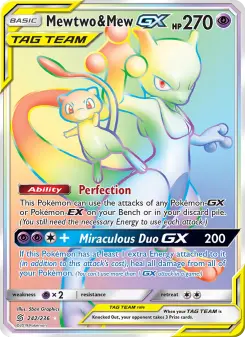
| Mewtwo & Mew GX | Unified Minds | 242/236 | $420.76 | $2,070.00 | 43 | 2,910 |
| Mewtwo & Mew GX | SM Black Star Promos | SM191/248 | $387.37 | $2,125.00 | 638 | 19,995 |
| Mewtwo & Mew GX | Unified Minds | 222/236 | $189.39 | $689.99 | 12 | 2,157 |
| Mewtwo & Mew GX | SM11: Miracle Twin (Japanese) | 108/094 | $169.99 | $700.00 | 14 | 1,211 |
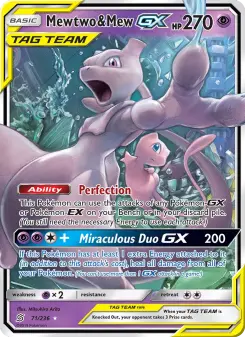
| Mewtwo & Mew GX | Unified Minds | 71/236 | $142.98 | $893.19 | 133 | 6,872 |
| Mewtwo & Mew GX | SM12a: Tag All Stars (Japanese) | 222/173 | $109.99 | $1,075.00 | 14 | 2,575 |
| Mewtwo & Mew GX | SM11: Miracle Twin (Japanese) | 097/094 | $76.75 | $537.50 | 24 | 1,922 |
| Mewtwo & Mew GX | SM12a: Tag All Stars (Japanese) | 052/173 | $39.21 | $132.25 | 46 | 11,514 |
| Mewtwo & Mew GX | SM11: Miracle Twin (Japanese) | 029/094 | $35.28 | $150.75 | 136 | 5,565 |
The two Tag All Stars rows nearly went missing from that table, and how is worth saying. Each of them is claimed by two catalog rows sharing one TCGplayer product id, and the row that survives our deduplication carries the Japanese-script name, so a sweep that folds the surviving name alone finds eight products rather than ten. This sweep folds EVERY catalog row claiming each product, which is the only version that returns the full ten. Japanese sets have no page of any kind on this site, so those set names are unlinked prose while their cards link normally. The same-name problem measured across the whole catalog is the 10,872 cards that look like other cards.
What the registry did, and what the tape did
We hold four registry readings for this card, from September 7 to September 23 2026, a span of 16 recorded days. Over them the line went from 19,599 submissions to 19,995, a gain of 396 slabs, about 24.75 a day and 2.02% of the standing population. 151 of those 396 came back as tens, a marginal rate of 38.1% against a lifetime rate of 49.7%. New submissions gemming below the historical rate is the general pattern, not a quirk of this card: across the 1,330 cohort members with two or more readings and at least 40 slabs added, the marginal rate came in below the lifetime rate 70% of the time, and the same drift is measured card by card in the gem rate drift and where the new slabs go.
The two price series disagreed over the same fortnight. Our recorded PSA 10 median never rose across the eleven readings between September 8 and September 23, going from $3,050.00 on 567 verified sales to $2,125.00 on 638, while the raw ask rose 1.17% from $382.90 to $387.37. Seven of its ten steps fell, three were flat and none went up, which is not the shape of noise, but it is also not seven price cuts: the median is recomputed each reading over the comps our provider surfaces that day, so it moves both because new sales land and because the pool underneath it changes. The weekly per-card series, which runs 129 readings from January 27 2025 to September 22 2026, has the card at $100.05 then and $389.65 now, a rise of 289.5%, with its highest reading of $390.05 on September 18 2026.
Proving the registry line belongs to this card
A PSA population absolute is worth nothing if the registry line is shared, and many are: our shared-line detector flagged 883 of 24,385 population keys, affecting 788 products. This card's key is not among them. The second test is the one a shared line fails loudest: recorded sales per graded copy at a grade. A slab can change hands more than once, so this is a ratio rather than a physical ceiling, and the bar we declare is 1.0, above which a graded key is almost certainly pooling more than one product. Here it is 638 PSA 10 sales against 9,935 recorded tens, a ratio of 0.06, and 315 PSA 9 sales against 7,061 recorded nines, 0.04. Both pass with room, so 19,995 is printed as an absolute. Two assertions run over the graded figures in this series, and they reach different rows. The staleness assertion, that no printed median predates the daily tape, runs on all 258 graded rows the 66 products this series links carry, across PSA, BGS and CGC alike, and removes one. The pooling ratio can only be computed where the registry records a count at that grade, which is PSA 10 and PSA 9 and nothing else: 114 of the 257 rows that survive, and the highest of those 114 is 0.94, on a Wizards-era Eevee whose line holds 31 tens against 29 recorded PSA 10 sales.
What this study cannot show
The raw price is an ASK and every graded price is a SOLD median, so 5.49x divides a listing by a transaction. No grading fee, postage, wait or failure rate appears in it, and at a 49.7% gem rate about half of what you send comes back below a 10, where the 9 is worth $517.50; the arithmetic that turns a multiple into a return is is grading Pokemon cards worth it. The graded tape is short. We hold eleven readings for this card, the first on September 8 2026, so nothing here describes a year. And the graded tape is volatile in a way the ask is not: across 67,275 adjacent-day pairs on 9,048 keys the PSA 10 median is unchanged 90.6% of the time, but when it moves the median move is 8.14% in a day against 2.08% for the ask.
What would overturn this
The claim is that this card sits in the top one percent of the catalog for slab evidence and at the 25th percentile of it for slab premium. A recompute of the 5,879-product cohort on any day returning a premium percentile above 50 for this card, or a comp-depth percentile below 90, would overturn it. A finding that the 638 sales pool more than one printing would overturn the comp half of it outright. Related card studies published the same day: Special Delivery Charizard, M Charizard EX from Evolutions, Magikarp & Wailord GX and Alakazam ex from 151.
Sources: the `cards` catalog, `price_history`, `graded_snapshots` and `population_snapshots` in production, read on day 20719, September 23 2026. The card is resolved by NAME AND NUMBER against the catalog: Mewtwo & Mew GX, number SM191, set SM Black Star Promos, catalog id smp-SM191, TCGplayer product id 197856. A folded same-name sweep returns ten products: three other English rows (Unified Minds 71, 222 and 242) and six Japanese rows, all ten priced on the day and all ten printed above. The sweep folds EVERY catalog row claiming each product id, not the row that survives deduplication: both Tag All Stars printings are claimed by a jat- row carrying the romanised name and a ja- row carrying the Japanese-script name, the script row wins the dedupe, and a sweep over surviving names alone returns eight. RAW is an ASK, the day-20719 `price_history` reading. GRADED figures are SOLD medians over verified completed sales with the sale count beside them, taken from the latest `graded_snapshots` row per grade across BOTH keyspaces, catalog id and product id, with the fresher row winning; for this card the product-id keyspace is fresher at every grade. REGISTRY is `population_snapshots`, latest reading per key, September 23 2026 for this card; the latest day differs per card across this series and is stated individually. Gem rates pass `gemRateIsTrustworthy()`, which rejects the rows written before 2026-09-09 that recorded an absent PSA 10 breakdown as zero: the September 14 reading on this card is one of those and is excluded, so the growth window runs September 7 to September 23 on readings that both carry a gem count. Registry lines are tested for sharing by `sharedRegistryKeys()` over all 24,385 population keys (883 flagged, 788 products affected, this card not among them) and by the grade-by-grade pooling ratio described below. Two assertions run over the graded rows this series prints, and they do not cover the same rows. STALENESS: on every product this module prints a graded figure for, and after the fresher-keyspace rule, any median dated before day 20695, the first day of the current daily tape, is dropped, because the never-refreshed catalog-id keyspace holds rows old enough to invert against their own neighbouring grade. That assertion runs on all 258 graded rows the 66 products this module links carry, at every grade and every grader, and removes exactly one, a CGC 10 dated day 20694 on a card whose graded figures are not printed here, leaving 257. The cohort below is built WITHOUT that gate: applied across the whole catalog it drops nine PSA 10 medians, leaving 8,684 products with a PSA 10 median on two or more sales and a cohort of 5,871, 4,183 English and 1,688 Japanese, and no rank printed in this series moves by more than seven places. POOLING RATIO: recorded sales at a grade divided by the registry count at that grade. This is NOT an impossibility test, and calling it one would be wrong: `graded_snapshots` counts SALES and one slab can sell more than once, so a ratio above 1 is evidence that a graded key is pooling another product, not a physical contradiction. The declared bar is 1.0. `population_snapshots` records a per-grade count at PSA 10 and PSA 9 only, so the ratio is computable on 114 of those 257 rows and on no BGS or CGC row at all; the highest of the 114 is 0.94, 29 PSA 10 sales against the 31 tens on the Wizards-era Eevee's line, and only three exceed 0.5. THE COHORT: 63,600 catalog rows deduplicate to 62,388 products on the TCGplayer product id, 1,212 rows collapsing; 44,400 carry a day-20719 ask; 20,805 carry an unshared registry reading; 18,239 of those support a trustworthy gem rate; 8,693 carry a PSA 10 sold median on two or more verified sales; 5,879 carry all four and are the cohort, 4,191 English and 1,688 Japanese. Percentile is the share of the cohort strictly below this card's value; rank counts from the top with ties counted; medians are upper-middle on even samples. The tag-team population is the 106 cohort members whose English name contains an ampersand and ends GX, ex or EX. The volatility figures use every adjacent-day pair in the PSA 10 graded tape (67,275 pairs on 9,048 keys) and every adjacent-day pair in `price_history` days 20714 to 20719 (261,184 pairs on 52,474 products), the later window chosen because days 20704 to 20713 are partial. The weekly per-card series is `ppthist:197856`, whose first reading is January 27 2025 and last September 22 2026; series that lost their 2025 start to a refresh bug are excluded from any 2025 claim and this one did not. Not financial advice.